YouTube Video Ideas for India in 2026: 9 Frameworks That Beat the Same 10 Niches
How to find YouTube video ideas in India in 2026 — 9 frameworks for finding angles your audience searches for but no one is making, plus the validation checklist.
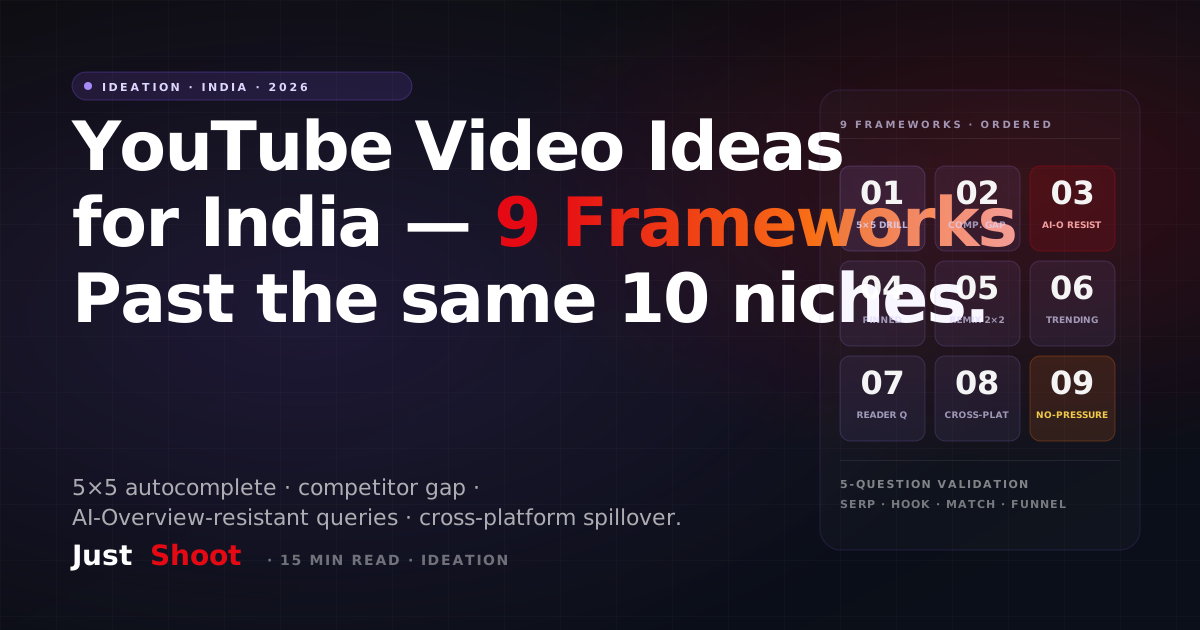
YouTube Video Ideas for India in 2026: 9 Frameworks That Beat the Same 10 Niches
By Ashok Sachdev, Founder of JustShoot · Published 2026-05-25
Every Indian creator who has run a channel for more than 6 months runs into the same wall: ideas dry up, the obvious topics get repetitive, and the topics that are not obvious feel risky to bet a full production cycle on. Every Twitter thread tells you to "niche down" or "study your analytics," which is true but useless when you are staring at a blank Notion page on Tuesday morning trying to lock the topic for Friday's upload.
This post is the working ideation framework we use inside JustShoot's Topic Research agent and that we recommend Indian creators run through manually on slow weeks. Nine frameworks, ordered from highest-yield to most-specialised, each one a repeatable procedure that surfaces 3–10 video ideas in roughly 15 minutes. None of them require a paid keyword tool. All of them assume you already know your niche and your audience; they are about finding angles, not picking niches.
Why Indian creator ideation is structurally different
Three things about the Indian creator market in 2026 make the ideation problem harder than it looks in US/global growth advice.
First, the obvious topics in any niche are crowded fast. India ships 250–400 thousand new YouTube videos per day across all languages combined — the obvious framings on any topic ("what is SIP", "how to start a YouTube channel", "best phone under 30K") have been covered by hundreds of channels, and the SERP is owned by 4–6 incumbents who got there first.
Second, the long tail in Hindi and Hinglish is undersaturated. The same topic in English will return 500+ competing videos; the romanized Hinglish version will return 20–50; the Devanagari Hindi version often returns under 20. The opportunity is structural — the same audience, less competition — but it requires the creator to spec the angle in the right script.
Third, AI search surfaces (Google's AI Overviews, ChatGPT web search, Perplexity, Gemini) are now actively rewriting which queries land on YouTube and which land on text answers. A "what is" query in 2026 increasingly returns an AI Overview at the top, which means video ideas that target "what is X" queries earn less traffic than they would have in 2023. The ideation framework has to shift toward queries the AI Overview cannot answer cleanly — comparison, experience, demonstration, opinion, and time-bound numeric updates.
The nine frameworks below are calibrated to these three realities.
Framework 1 — The 5×5 search bar drill
The fastest ideation method. Open YouTube in an incognito Indian session. Type the first word of your niche (e.g., "SIP", "phone", "biryani"). Note the 5 autocomplete suggestions. Pick one. Type the suggestion + a space. Note the next 5 autocomplete suggestions. Pick one. Repeat 3 more times.
Each branch through the tree is a video idea — the autocomplete is the real-time search demand surface, deeper than any keyword tool. Indian creators specifically should do this drill in three sessions: once in English, once in romanized Hinglish, once with the Hindi-Devanagari first word. The three trees overlap by maybe 30 %, which means 70 % of the ideas you surface are distinct.
A 15-minute 5×5 drill across three languages produces 60–90 raw idea candidates. The yield rate after filtering for "actually winnable" is roughly 8–12 video ideas.
Framework 2 — The competitor-gap teardown
Pick the three highest-performing channels in your niche that are within 5× your current sub count. Open their videos page. Sort by most popular. For each of their top 10 videos, write down two things: what the title promises, and what the comments say the video was missing.
The comments are the gold. Indian YouTube comments are unusually descriptive — viewers say what they wanted that did not get covered, what they expected and did not get, what they would have made the video about. Each repeated "missing" complaint is a video idea. If 12 comments on a competitor's top video say "yaar aapne X bata diya lekin Y nahi cover kiya", Y is your next video — and you can title it as the missing piece ("Y — jo [creator name]'s video mein nahi tha").
This framework also surfaces what we call "fork videos" — videos that take a popular framing and apply it to a more specific audience your competitor did not target. "Best mutual funds for SIP" → "Best mutual funds for SIP for under-25 first earners". Same topic, narrower audience, less competition.
Framework 3 — The AI-Overview-resistant query
Open Google in an Indian session. Type queries your niche cares about. For each query, look at the top of the SERP. If there is an AI Overview answering the query directly, that query is partially cooked — the search no longer lands as cleanly on a video. If there is no AI Overview but the SERP is video-heavy, that query is the play.
The queries that systematically lack AI Overviews are the ones where the answer requires:
- A current price, rate, or number (these change too fast for AI Overviews to maintain confidently — "current EV charging cost per km India 2026", "current home loan rate SBI 2026")
- An opinion or recommendation in a contested space (where AI Overviews hedge because there is no consensus — "should I invest in NPS or PPF 2026", "is Bangalore better than Pune to settle")
- A personal demonstration (where the value is in seeing or hearing it done — "how to do a south Indian thali at home", "how to set up OBS for streaming")
- A time-bound update on a fast-moving topic (regulations, policies, releases — "what changed in F&O rules 2026")
These four categories of queries are the most defensible video ideas in 2026. They survive the AI Overview compression because the answer is genuinely better delivered as a video. The full mechanic for getting cited in AI Overviews when they do appear is in our YouTube SEO checklist for 2026 — step 6 covers the sourced-200-word answer pattern.
Framework 4 — The pinned-comment mining
Open three channels in your niche that publish weekly or more. Look at the pinned comment on their last 10 videos. The pinned comments fall into 3 categories: the creator answering a frequent question, the creator linking to a referenced video, or the creator teasing the next video.
Each frequent-question pinned comment is a standalone video idea waiting to be made. If [a finance creator]'s pinned comment on a SIP video says "Loads of you asking about ELSS vs PPF for tax saving — making a full video next week," you can make that video first if you ship faster, or you can wait to see what they cover and then make the variant they did not (ELSS for the under-25, ELSS for the salaried 30-something with EMI, etc.).
This framework works best on commentary, finance, education, and tech-review channels — niches where audience questions are surfaced explicitly. Lifestyle and vlog channels rarely use pinned comments this way; the framework is weak there.
Framework 5 — The "remix" matrix
Take any video idea from frameworks 1–4. Run it through a 4-cell matrix:
| New audience | Existing audience | |
|---|---|---|
| New angle | A: The breakthrough video | B: The deep-dive |
| Same angle | C: The translation play | D: The repeat (skip) |
Cell A — new angle for a new audience — is the highest-yield, highest-risk video. The angle is novel, the audience does not know you, the upside is biggest if it works. Cell B — new angle, existing audience — is the workhorse: your subscribers want a deeper version of what they already engage with. Cell C — same angle, new audience — is the translation play: take a video that worked and remake it in a different language (English to Hinglish, Hinglish to Tamil, Hindi to Bengali) for a new audience that has not seen it. Cell D — same angle, same audience — is the repeat trap; do not make this video.
Most Indian creators over-index on cell B (deep-dives) and under-index on cell C (translations). The translation play is the highest-yield single tactic on Indian YouTube in 2026, because the language pick decides which SERP you compete in and the cross-language SERPs are far less saturated than any single-language one.
Framework 6 — The reverse-engineered trending angle
Open YouTube Trending in India. Look at the top 30 videos. Note which are music (skip), which are scripted creator content (study), which are news clips (skip), which are short-form reels-style (skip if you are long-form). For each scripted creator video that is genuinely trending, identify three things: the format (explainer, vlog, commentary, reaction, tutorial), the language, and the hook style.
The trending list does not give you topics — topics that are trending today are stale tomorrow. What it gives you is the format-and-hook-style currently winning attention. Take that format and hook style and apply it to your own evergreen topic. If a 14-minute Hinglish explainer with a "frame-the-stakes" hook is in the top 30, your next video on your evergreen topic should be a 14-minute Hinglish explainer with a frame-the-stakes hook — the format is what is rewarded by the algorithm in this 2-week window, regardless of the topic.
Re-run this framework every 2 weeks. The format-of-the-month shifts that often on Indian YouTube.
Framework 7 — The reader-question newsletter feedback loop
This framework requires you to have a newsletter, a Telegram group, an Instagram broadcast channel, or a Discord — any direct-to-audience channel where viewers can reply. The mechanic: at the end of every weekly issue, ask one question ("What do you want me to cover next?"). Read the replies. Cluster them. The top 3 clusters are your next 3 videos.
The signal here is high-quality because the people replying are already your audience, and the questions they ask are the questions your wider audience also has but does not articulate. Indian creators chronically under-invest in this loop because newsletters feel like a separate workflow — but the ideation yield is so high that it is worth setting up even if the newsletter has only 200 subscribers. (We are running the same pattern at JustShoot itself; the Indian Creator Weekly newsletter feeds questions back into our blog calendar.)
Framework 8 — The cross-platform spillover
What topics are getting traction on Indian Twitter, Indian Reddit (r/IndianYouTubers, r/india, r/indianstreetbets, niche subreddits), Instagram Reels, and ShareChat right now? Spend 20 minutes scrolling each. The topics blowing up on these platforms are the topics your audience will be searching for on YouTube in the next 7–14 days.
The lag is meaningful: a topic that trends on Indian Twitter today peaks on YouTube search in roughly 5–10 days. Creators who ship within that window catch the front of the search wave; creators who ship in week 3 hit the back. The framework is highest-yield for news-adjacent niches (current affairs, finance commentary, tech news) and lower-yield for evergreen niches (tutorials, lifestyle), where the timing edge matters less.
Framework 9 — The "what would I want to make if I had no audience pressure" exercise
The least systematic framework, but the most important on a long enough timeline. Spend 30 minutes writing a list of the videos you would make if you had no subscribers, no algorithm pressure, no monetisation target, no thumbnail anxiety. The list will surface 5–15 ideas you have been suppressing because they feel "off-brand" or "too narrow" or "too personal."
A meaningful percentage of these ideas will turn out to be the best videos on the channel. The reason is that audience pressure produces optimised-but-derivative ideas, and the best Indian creators we have worked with periodically run a video that came from this framework — usually once every 8–12 uploads — and it routinely becomes a top-10-views video on the channel. The framework is the antidote to ideation drift toward the safe-and-already-covered.
The validation checklist — pick which idea to actually ship
Nine frameworks generate 50–100 raw idea candidates over a month. The bottleneck is picking which 4–6 to actually ship. Run each candidate through this 5-question check:
- Is the query searchable? Type the planned title into YouTube search in an Indian session. If autocomplete suggests it, demand is verified. If autocomplete does not suggest it but Google search does, the YouTube-search audience is small but the discovery may come from external SERP.
- Is the SERP winnable? Look at the top 5 results for the planned title. If they are all from 1M+ sub channels with videos under 90 days old, the SERP is locked. If at least one slot is from a sub-100K channel or a video over 12 months old, you have a winnable opening.
- Is there a clear opening 100 words? Can you write the first 100 words of the script — the hook plus the direct answer — in 5 minutes? If yes, the topic is concrete enough to shoot. If you spend 15 minutes and the hook still feels generic, the topic is too vague.
- Does it earn at least one of the magnets / next-video pulls? Does the topic naturally set up a follow-up video, a comment prompt, or a CTA that feeds your funnel? Standalone videos are fine occasionally; chained videos compound channel growth.
- Does it match your channel's voice? Read the planned hook in your head — does it sound like you would actually say it? If it sounds like a generic AI-written line, rework it until it carries your channel's signature transitions and identity markers. The Tone Fingerprint framework covers what to look for.
Ideas that pass 4 of 5 questions are ship candidates. Ideas that pass 3 or fewer go back into the pool for refinement.
How JustShoot's Topic Research agent collapses this into one run
The frameworks above are the procedures the Topic Research agent inside JustShoot's pipeline runs automatically when a creator hits "Suggest topics" on a new project. The agent takes the channel's niche, sub-niche, target audience, and language as inputs, runs the equivalent of frameworks 1, 3, 5, and 6 against current search data, and returns 8–12 ranked video ideas with the angle, the target query, the suggested format, and a brief on why this idea is winnable. The output feeds directly into the Script Research agent (which builds the brief) and then the Script Writer (which writes the draft in the channel's Tone Fingerprint).
The full 9-agent pipeline runs at 100 credits per video. Tiered pricing: Starter ₹499/month (500 credits, ~5 videos), Pro ₹699/month (1000 credits, ~10 videos), Studio ₹899/month (2000 credits, ~20 videos with up to 3 channels). Annual −20 %. 7-day free trial, no card required.
For the SEO half of the pre-production loop — once you have the idea, how to make sure it ships in a metadata pack that ranks — the working version is in the YouTube SEO checklist for 2026. For the language pick that decides which SERP your idea competes in, see Hinglish vs Hindi vs English. For the script structure that turns the idea into a publish-ready 7-block draft, see the script template.
If you want the weekly trending-angle feed delivered to your inbox (frameworks 6 and 8, automated), the Indian Creator Weekly newsletter ships every Friday with three trending angles, one channel teardown, and three Hinglish hook templates.
FAQ
Q: How do I find YouTube video ideas for an Indian channel in 2026? The fastest method is the 5×5 autocomplete drill — type the first word of your niche into YouTube search in an Indian session, note the 5 autocomplete suggestions, pick one, type it + a space, repeat 3 more times. Run the drill in three languages (English, romanized Hinglish, Devanagari Hindi) for full coverage. A 15-minute drill produces 60–90 raw idea candidates; the yield after the 5-question validation checklist is 8–12 ship candidates. Eight other frameworks (competitor gap, AI-Overview-resistant query, pinned comment mining, remix matrix, trending-angle reverse-engineering, newsletter loop, cross-platform spillover, no-audience-pressure exercise) compound on this.
Q: What video ideas work best on Indian YouTube right now? The AI-Overview-resistant categories are the most defensible in 2026 — current prices and rates, opinion in contested spaces, personal demonstrations, and time-bound updates on fast-moving topics. These four query types systematically lack AI Overviews and route searchers to videos. Niche-specific examples: "current EV cost per km India 2026", "should I invest in NPS or PPF 2026", "how to set up OBS for streaming on a low-end PC", "what changed in F&O rules 2026". Topics that are pure "what is X" are increasingly intercepted by AI Overviews and earn less video traffic than they did in 2023.
Q: How many YouTube video ideas should I have in my backlog? The working ratio is 4–6 ship-ready ideas per month of upload cadence. A weekly-upload channel needs 16–24 ship-ready ideas in backlog; a daily channel needs 120–180. The backlog should be running 2–3 months ahead so the script-writing workflow is not starting from "what should I make" every week. The validation checklist filters raw candidates to ship-ready at roughly a 1-in-7 ratio, so a 30-minute weekly ideation session generates ~5 raw candidates of which ~1 is ship-ready — which scales to weekly cadence over a year.
Q: How do I know if a YouTube topic is too saturated to make? Type the planned title into YouTube search in an Indian session. Look at the top 5 results. If all 5 are from channels with 1M+ subs and the videos are under 90 days old, the SERP is locked — pick a different angle. If at least one slot is from a sub-100K channel or a video over 12 months old, the SERP is winnable. The same check on Google search (look for AI Overviews) tells you whether the query will route to a video at all in 2026. A query with no AI Overview and a fragmented SERP is the most winnable topic shape.
Q: Should I copy ideas from US/global creators in my niche? The format and hook style transfer; the topic specifics rarely do. A US-finance video on "401k vs Roth" does not translate to India; the format (explainer, 12-min, frame-the-stakes hook, 5-beat structure) does — apply that format to "NPS vs PPF" and you have the working Indian variant. Transfer the structure, replace the topic with the India-specific equivalent. Direct topic-translation is one of the most common ideation mistakes; the audience can tell when the original was not made for them.
Ashok Sachdev is the founder of JustShoot, an AI Content OS for Indian YouTube creators. The Topic Research agent inside the 9-agent pipeline runs the ideation frameworks above against the channel's niche, audience, and Tone Fingerprint. Pricing: Starter ₹499/month, Pro ₹699/month, Studio ₹899/month. Annual −20%. 7-day free trial, no card required.
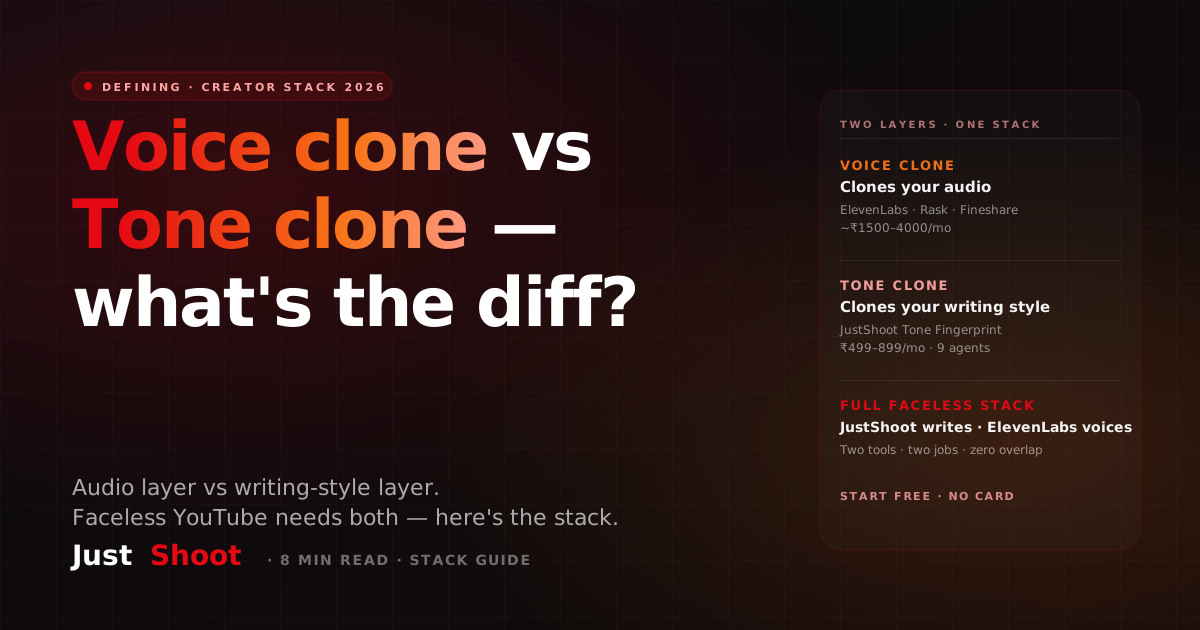
Voice Clone vs Tone Clone for YouTube — What's the Difference (2026)
Voice clone (ElevenLabs, Rask) clones your audio. Tone clone (JustShoot) clones your writing style. Two different layers, both needed for faceless YouTube — here's the full stack.
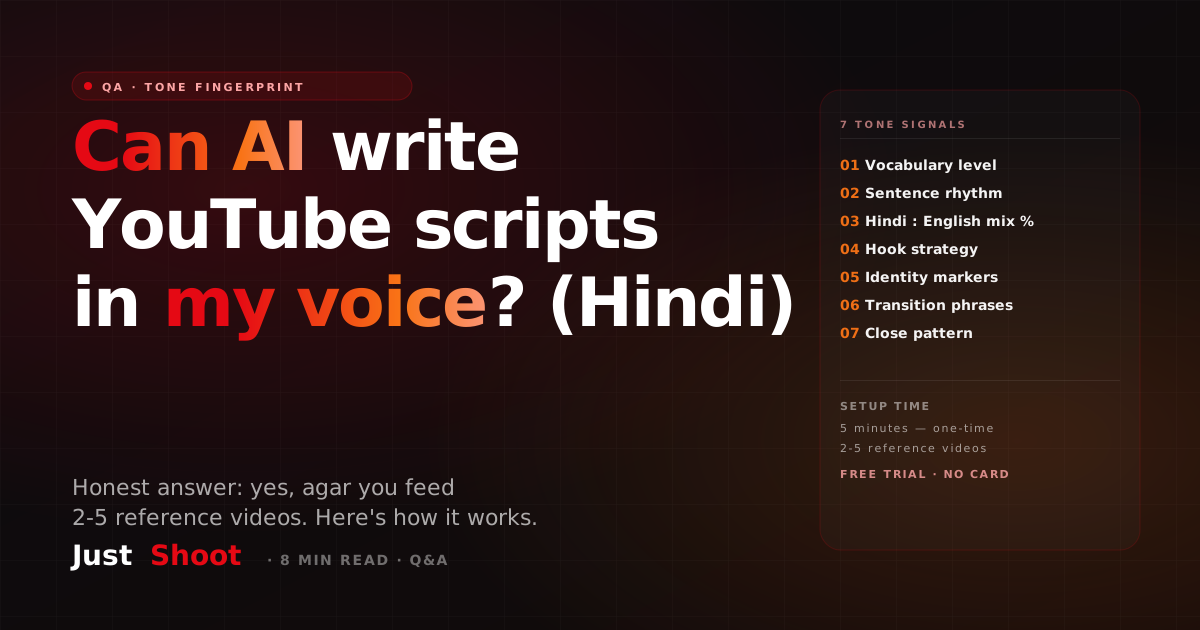
Can AI Write YouTube Scripts in My Voice (Hindi)? — Honest 2026 Answer
Yes — AI can write YouTube scripts in your Hindi voice, but only with the right mechanism. Why ChatGPT fails, what Tone Fingerprint does differently, and a live example.