YouTube Script Template (Hindi & Hinglish): Copy-Paste Structure for Hook, Body, CTA
A working YouTube script template for Hindi and Hinglish creators in 2026 — the 7-block structure, fill-in slots for hook, body, CTA, and per-niche variations.
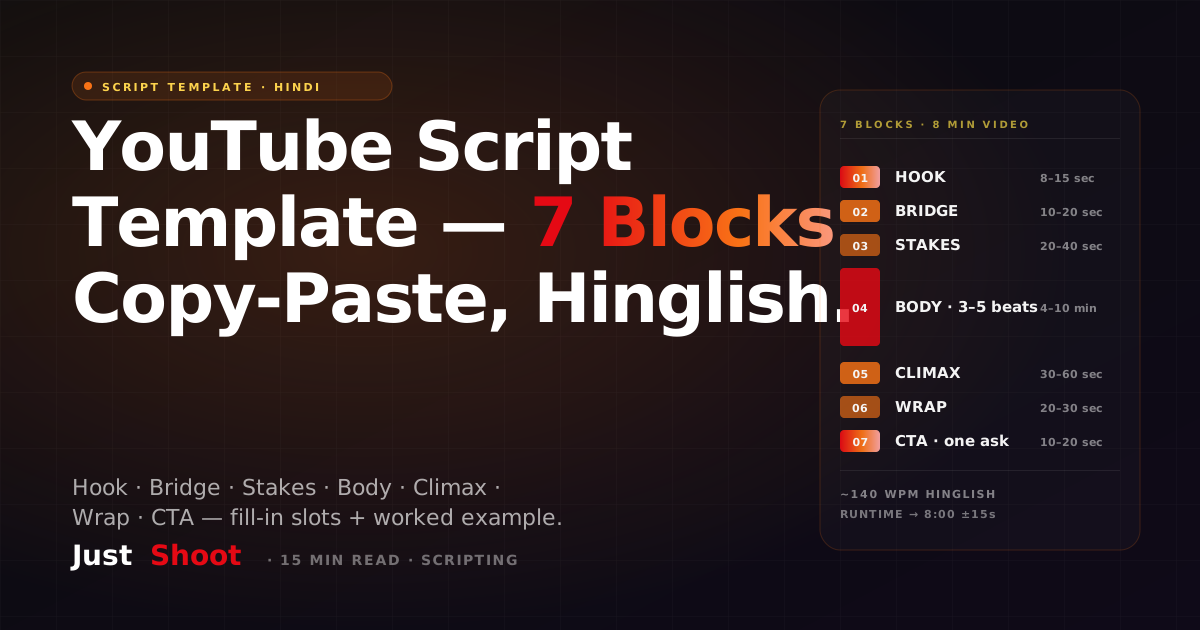
YouTube Script Template (Hindi & Hinglish): Copy-Paste Structure for Hook, Body, CTA
By Ashok Sachdev, Founder of JustShoot · Published 2026-05-25
Most Hindi and Hinglish YouTube scripts fail at the same place — somewhere between the hook and the first content beat — and the reason is structural, not stylistic. The creator opens with a strong line, then has to figure out how to land the actual point of the video, and the middle 3–4 minutes turn into a wandering middle that loses retention. The fix is a fixed, repeatable script structure that the creator fills in for each video, instead of starting from a blank page every time.
This post is the 7-block template we use inside JustShoot's Script Writer agent and that we recommend Indian creators copy onto a Notion page or a Google Doc and reuse. It is built for 6–14 minute long-form videos in Hindi or Hinglish (the structure is identical; the language inside the blocks shifts). Per-niche variations — finance, commentary, tech-review, education, gaming, lifestyle — are in the second half of the post.
If you only want the skeleton and the worked example, scroll to the section titled "The full template" — everything before it is the reasoning behind why each block exists in this order.
Why a fixed template beats a blank page
The blank-page problem is universal — every creator who writes from scratch each video loses 30–90 minutes per video to structural decisions ("kya pehle bolun, kya baad mein, CTA kahan rakhun") that should have been settled once at the channel level and reused. The fixed-template approach inverts the workflow: structure is decided once, content is what changes per video. The reason it works on Indian YouTube specifically is that audience expectation in Hindi/Hinglish content is heavier than in English content — viewers build a stronger anchor on what comes when, and meeting that anchor consistently is what drives retention.
The 7-block template below is the structure that consistently performs across the channels we have audited. It is not the only structure that works, but it is the simplest one that gets a creator above the 50–55 % average view duration mark for a 10-minute video, which is the threshold above which YouTube's algorithm starts compounding promotion. If you want the deeper read on why retention compounds at this threshold and what the metric looks like in YouTube Studio, see our 18-step YouTube SEO checklist — step 18 covers the day-7 retention audit in detail.
The 7 blocks — what each one does
| Block | Length | Purpose | Failure mode if skipped |
|---|---|---|---|
| 1. Hook | 8–15 seconds | Stop the scroll, promise the value | Audience scrolls in 3 sec |
| 2. Bridge | 10–20 seconds | Transition from hook to body without losing attention | Bumpy retention drop at 0:20 |
| 3. Stakes | 20–40 seconds | Why this matters to the viewer specifically | Audience tunes out by 1:00 |
| 4. Body | 4–10 min | The actual content, structured as 3–5 beats | Loose middle, drops at 3:00 |
| 5. Climax | 30–60 seconds | The one insight the video pays off | No memorable moment to share |
| 6. Wrap | 20–30 seconds | Recap of what was delivered | Viewer forgets the value |
| 7. CTA | 10–20 seconds | One ask: subscribe, watch next, comment | Wasted close, no compounding |
The blocks are not equal in importance. The hook (block 1), the body's first beat (start of block 4), and the climax (block 5) are the three highest-leverage parts of the script — they together carry roughly 60 % of the impact on retention and watch time. The other four blocks exist to transport the audience from one of these three to the next without losing them.
The full template — fill-in slots, ready to copy
The version below is the bare structural template. Below it is a worked example for a Hinglish finance video on SIP returns. Below that are the per-niche variations.
[BLOCK 1 — HOOK | 8–15 sec | language: hinglish/hindi]
[Open with one of: question / stat / frame-the-stakes / story]
[The promise must contain: (a) the topic, (b) a specific outcome, (c) a time-bound claim]
[Example slot: "Yaar, scroll mat karo abhi. Agle ___ minute mein ___ ho jaayega."]

[BLOCK 2 — BRIDGE | 10–20 sec]
[One sentence that signals "I am about to explain", not "Hi, welcome"]
[Example slot: "Iska answer 3 layers mein hai, aur main aapko teeno bataunga."]

[BLOCK 3 — STAKES | 20–40 sec]
[Why this viewer specifically should care]
[Include: a number, a date, a name (verifiable)]
[Example slot: "Sirf ___ percent log ___ jaante hain, jiski wajah se ___ hota hai."]

[BLOCK 4 — BODY | 4–10 min, structured as 3–5 beats]
  [BEAT 1 — the most counter-intuitive point]
    [Setup: 2–3 sentences]
    [Insight: 1 sentence]
    [Proof: stat / source / example]
    [Transition: signature phrase]
  [BEAT 2 — the supporting context]
    [Same structure]
  [BEAT 3 — the application]
    [Same structure]
  [BEAT 4 (optional) — the objection handle]
  [BEAT 5 (optional) — the meta-insight]

[BLOCK 5 — CLIMAX | 30–60 sec]
[The one line you want quoted in the comments]
[Build to it with a pause cue: "Lekin asli baat yeh hai…"]

[BLOCK 6 — WRAP | 20–30 sec]
[Recap: 3 sentence summary of the three biggest takeaways]
[Frame: "Toh agar aap yaad rakhte hain teen cheezein…"]

[BLOCK 7 — CTA | 10–20 sec]
[ONE ask, not three. Pick one of:]
  [(a) Subscribe + reason]
  [(b) Next video link + reason]
  [(c) Comment prompt + question]
The worked example — Hinglish finance video on SIP returns
To make the template concrete, here is a full script for a hypothetical 8-minute video titled "SIP mein 1 lakh invest karke 10 saal mein kitna milega? Sach yeh hai."
HOOK (12 sec) — "Yaar ek second ruko. Agar tumne soch rakha hai ki SIP mein har mahine 8 hazaar daloge aur 10 saal mein crorepati ban jaaoge — toh aaj ka video tumhare liye hai. Main aapko exact math dikhane wala hoon, and spoiler — number woh nahi hai jo tumhe Instagram pe dikhaya gaya."
BRIDGE (15 sec) — "Yeh poori cheez 3 parts mein samjhayenge: pehla — actual returns ka formula, doosra — kahan log misled hote hain, teesra — kya real expectation set karni chahiye. Three minutes mein full clarity."
STAKES (30 sec) — "Dekho data clear hai — SEBI ke 2024 ke disclosure ke according, India mein equity mutual fund ka 10-year average return roughly 12–14 percent rahta hai. Lekin har Instagram reel jo aapne dekhi hogi, woh 18 percent ya 22 percent claim karti hai. Aur is gap mein, lakhs of retail investors apna real planning kharab kar lete hain — kyunki number unrealistic hai, aur jab actual return aata hai, woh nirash ho jaate hain aur SIP rok dete hain."
BODY — BEAT 1 (90 sec, counter-intuitive) — "Pehla point sabse important hai. SIP returns 'compound' hote hain, lekin 'compound' ka matlab woh nahi hai jo aapko Instagram pe bataya gaya. Yeh hai actual formula — Maturity = P × ((1+r)^n − 1) / r × (1+r), jahan P monthly investment hai, r monthly return rate hai, aur n total months. Ek 8000 rupees per month SIP, 12 percent annual return par, 10 saal mein lagbhag 18 lakh ke aaspas pahunchti hai. Ek crore nahi. Misled hone ki wajah yeh hai ki Instagram ki examples 20–25 saal ka horizon dikhati hain, jisme number actually impressive ho jaata hai — lekin 10 saal mein nahi."
BODY — BEAT 2 (90 sec, context) — "Doosra point — 12 percent expected return bhi guarantee nahi hai. Last 10 saal mein Nifty 50 ka actual CAGR roughly 13.5 percent raha hai, lekin yeh average hai. Beech mein 2018–19 mein ek saal aisa bhi tha jab return 2 percent tha. SIP ka real value hi yeh hai ki market down ke time aapko sasta NAV mil jata hai, aur long-term average bhar deta hai. Iska matlab — agar aap ek single year ke return pe panic kar ke SIP roke, aapne real compounding miss kar diya."
BODY — BEAT 3 (90 sec, application) — "Teesra — toh planning kaise karein? Real number yaad rakho: 8000 monthly × 10 saal × 12 percent = roughly 18.5 lakh. 12000 monthly × 15 saal × 12 percent = roughly 60 lakh. Crorepati banne ka realistic plan — 15000 monthly × 20 saal × 12 percent = roughly 1.5 crore. Yeh actual math hai. Ab agar aapne expectations is range mein set kiye, toh aapka SIP discipline strong rahega, kyunki number believable hai."
CLIMAX (40 sec) — "Lekin asli baat yeh hai — SIP failure kabhi 'low return' ki wajah se nahi hota. SIP failure 99 percent unrealistic expectations ki wajah se hota hai. Real number jaante ho, toh tum continue karoge. Fake number believe karte ho, toh 3 saal mein chhod doge. Yahi pure mutual fund industry ka secret hai — discipline, not magic."
WRAP (25 sec) — "Toh teen takeaways — pehla, 10 saal mein 8 hazaar ki SIP roughly 18 lakh banegi, na ki ek crore. Doosra, 12 percent average return hai, single year nahi. Teesra, crorepati banne ke liye 15+ saal lagega minimum, aur woh bilkul achievable hai agar expectation realistic ho."
CTA (15 sec) — "Agar yeh helpful laga toh next video dekho — main wahan exact dikhauunga ki kaise apna SIP amount tax-efficient banaye. Link description mein hai. Agar koi specific scheme analyse karwani ho, comment mein likh do — main next month roundup mein cover karunga."
The whole script runs roughly 1,150 words. Spoken at a natural Hinglish pace of roughly 140 words per minute, that lands at the 8:00–8:15 mark. The template's predictability — block 1 always 8–15 sec, body always 3–5 beats — makes the timing math straightforward.
Per-niche variations
The 7-block skeleton is the same across niches. What changes is the hook style, the body beat structure, and the CTA framing. Here is how the template adapts.
Commentary / current affairs (Dhruv Rathee–style)
The biggest change is in block 4. Commentary videos usually run 5 beats, not 3, because the structure is closer to argument-building than tutorial-delivery. Beat 1 is the claim. Beat 2 is the evidence. Beat 3 is the counter-claim from the opposing side. Beat 4 is why the counter-claim does not hold up. Beat 5 is the synthesis. The climax is the "lekin asli baat" moment that reframes the entire video.
Length is also longer — commentary videos typically run 12–18 minutes, so each beat is 2–3 minutes instead of 90 seconds. The CTA is almost always a comment prompt ("Aapka kya opinion hai?") because comment volume is the engagement signal commentary channels live on.
Tech review
Body runs 5 beats, but each beat is short (60–90 sec). Beat 1 is "what is it." Beat 2 is "what works." Beat 3 is "what does not work." Beat 4 is "who should buy it." Beat 5 is "the verdict + the alternative." The climax in tech-review is the verdict line; the CTA is almost always a watch-next link to a comparison video on the same channel.
Education (JEE/NEET/school)
Body runs 4 beats: concept, example, mistake to avoid, practice problem. The CTA in education videos is the highest-converting of any niche when it asks the viewer to "try this problem in the comments — I will reply by name" — the social proof of seeing the teacher reply to other students drives the next subscribe.
Gaming (BGMI/Free Fire)
The skeleton compresses. Hook is 5–8 sec (gaming audiences scroll faster), bridge is 5–10 sec, stakes is 10–15 sec, body runs as 3 quick beats with clip cuts between them, climax is the highlight moment, wrap is 10 sec, CTA is the next-stream announcement. Total runtime 4–7 min, not 8–14.
Lifestyle / vlog
The script is looser — vlogs work on emotional arc more than informational structure. The 7 blocks compress to 4: open (sets the day/event), middle (the lived experience), turn (the unexpected moment), close (the takeaway + soft CTA). The CTA is usually "tag a friend who needs to see this" — community-share is the engagement signal vlog channels are scored on.
For the niche-specific deeper read on script structure, the How to write a YouTube script in your own voice (Hinglish included) guide covers how the template combines with the channel's Tone Fingerprint to produce scripts that sound like the creator rather than a generic AI rendering of the structure. The language pick — Hinglish vs Hindi vs English — also affects how the template runs; the language decision framework walks through it.
How to use the template if you write your own scripts
Three workflow recommendations.
First, paste the template into a Notion page or Google Doc and duplicate it for each new video. Do not start a blank document. The 5 minutes saved on structure decisions compound into 30–60 minutes saved per script over the course of a year.
Second, fill in blocks 1, 5, and 7 first — hook, climax, CTA. These are the three highest-leverage parts and they constrain everything else. Once you know the hook line and the climax line, the body beats almost write themselves because they only need to bridge the two.
Third, time the script on a stopwatch as you write. Read aloud at your natural pace. If the script reads in 6 minutes when you wanted 9, either the beats are thin or you cut too many examples — add a beat. If the script reads in 12 minutes when you wanted 9, the beats are bloated — cut one. Word-count targets are unreliable across Hindi and English because the words-per-minute is different (Hindi/Hinglish averages ~140 wpm vs English ~150 wpm), so the stopwatch is the source of truth.
How JustShoot's Script Writer collapses this into one agent run
The template above is the structure JustShoot's Script Writer agent uses internally. The agent reads three inputs — the channel's Tone Fingerprint (which encodes language ratio, vocabulary level, sentence rhythm, hook style, identity markers, signature transitions, and close pattern), the video's research brief from the upstream Script Research agent, and the target runtime — and produces a publish-ready draft in roughly 90 seconds. The draft follows the 7-block structure but the language, the rhythm, the slang, and the close all match the creator's existing videos, not a generic AI register.
The credit math for the full pipeline: 100 credits per 9-agent run. Starter ₹499/month covers ~5 videos; Pro ₹699/month covers ~10; Studio ₹899/month covers ~20 with up to 3 channels (separate Tone Fingerprint each). Annual −20 %. 7-day free trial, no card required.
If you want to compare what a tone-locked script writer outputs against a generic ChatGPT prompt for the same brief, the side-by-side is in ChatGPT for YouTubers India: Honest Comparison With JustShoot — the structural difference is most visible in block 1 (the hook) and block 5 (the climax).
FAQ
Q: What is the best YouTube script template for Hindi and Hinglish creators in 2026? The 7-block template — hook, bridge, stakes, body (3–5 beats), climax, wrap, CTA — is the structure that consistently performs across Hindi and Hinglish channels at the 50–55 % average view duration threshold above which YouTube's algorithm compounds promotion. The template is identical across Hindi and Hinglish; only the language inside the blocks shifts. The full fill-in-the-slot version is above; the per-niche variations (finance, commentary, tech-review, education, gaming, lifestyle) adjust the body's beat count and the CTA framing.
Q: How long should a Hindi YouTube script be? For an 8–10 minute long-form video, the script runs roughly 1,100–1,500 words spoken at a natural Hindi/Hinglish pace of ~140 words per minute. Hindi spoken faster than 160 wpm is hard to follow; slower than 120 wpm reads as plodding. The reliable way to length-check is to read the script aloud on a stopwatch; word-count targets are unreliable because Hindi and English have different words-per-minute.
Q: Where should the CTA go in a YouTube script — start, middle, or end? End. One CTA. The single biggest CTA mistake is asking for 3 things in 30 seconds (subscribe + comment + share + watch next) — viewers comply with zero. Pick one ask: subscribe with a reason, or watch the next video with a reason, or comment on a specific prompt. Education and commentary channels convert best on the comment prompt; tech-review and tutorial channels convert best on the watch-next; lifestyle channels convert best on the share-with-a-friend.
Q: Do I need a different script template for Hindi shorts? Yes. The 7-block long-form template compresses to 3 blocks for shorts: hook (3–5 sec, must contain the payoff promise), insight (15–25 sec, single beat), payoff + CTA (3–7 sec, one ask, usually "watch full video"). Shorts that try to run the full 7-block structure feel slow and drop in the first 5 seconds. The structural shift is meaningful — short scripts are not "shorter long scripts," they are a different structure.
Q: Can I use the same script template across all my YouTube videos? Yes, intentionally. The benefit of the template is repeatability — your audience builds an anchor on what comes when, the algorithm rewards consistent retention patterns, and you cut 30–90 minutes of structural decisions per script. The content inside the blocks changes per video, the structure does not. The only times to deviate are special-format videos (anniversary specials, Q&A episodes, live recaps), which deserve their own one-off structure.
Ashok Sachdev is the founder of JustShoot, an AI Content OS for Indian YouTube creators. The Script Writer agent inside the 9-agent pipeline uses the 7-block template above, prefilled with the channel's Tone Fingerprint. Pricing: Starter ₹499/month, Pro ₹699/month, Studio ₹899/month. Annual −20%. 7-day free trial, no card required.
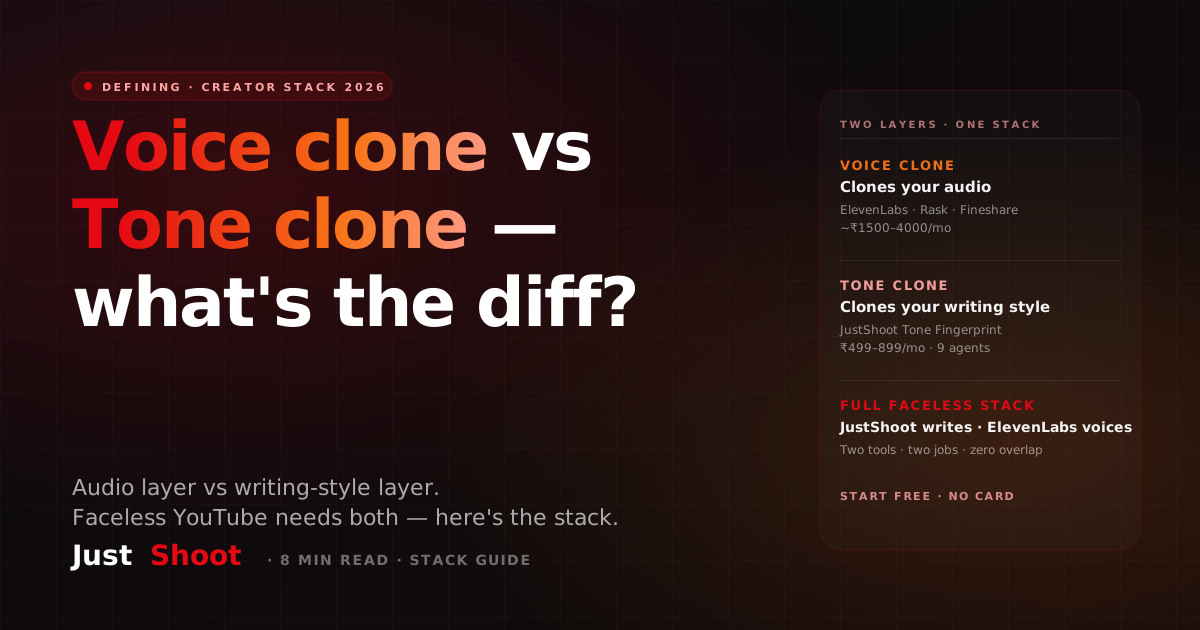
Voice Clone vs Tone Clone for YouTube — What's the Difference (2026)
Voice clone (ElevenLabs, Rask) clones your audio. Tone clone (JustShoot) clones your writing style. Two different layers, both needed for faceless YouTube — here's the full stack.
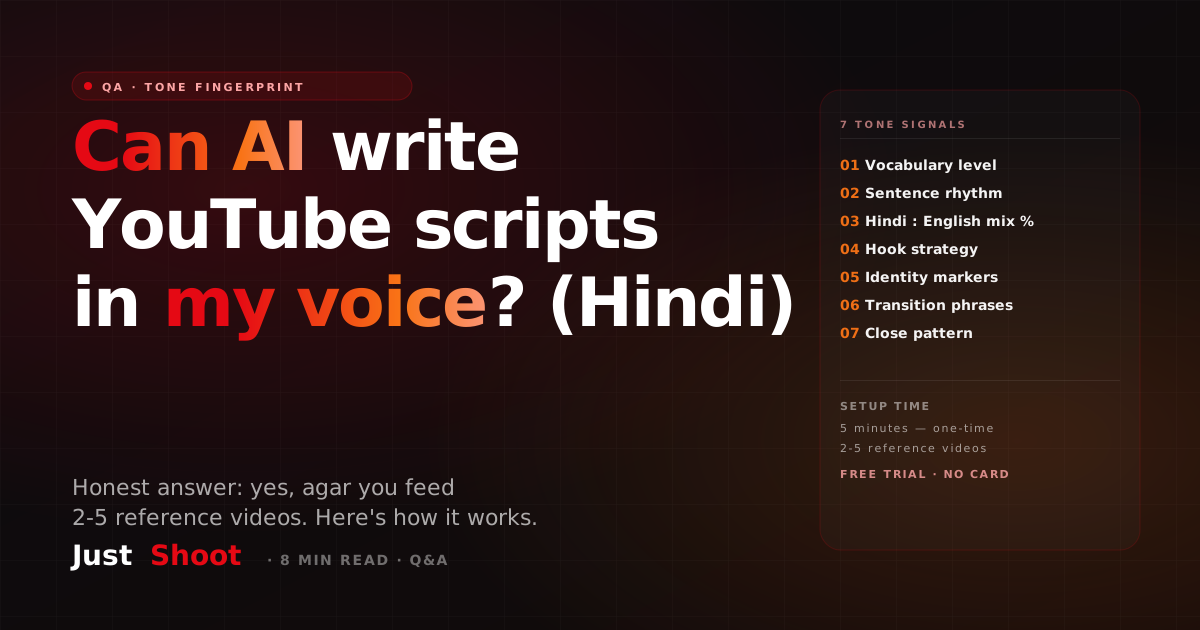
Can AI Write YouTube Scripts in My Voice (Hindi)? — Honest 2026 Answer
Yes — AI can write YouTube scripts in your Hindi voice, but only with the right mechanism. Why ChatGPT fails, what Tone Fingerprint does differently, and a live example.