Voice Clone vs Tone Clone for YouTube — What's the Difference (2026)
Voice clone (ElevenLabs, Rask) clones your audio. Tone clone (JustShoot) clones your writing style. Two different layers, both needed for faceless YouTube — here's the full stack.
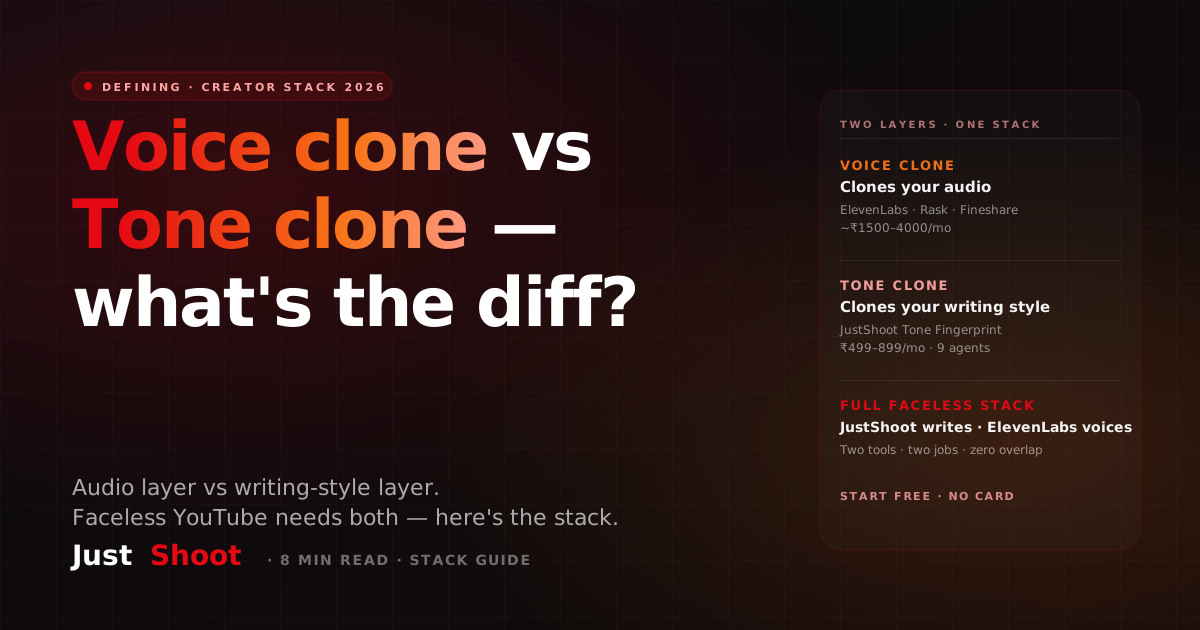
Voice Clone vs Tone Clone for YouTube — What's the Difference (2026 Definitive Guide)
By Ashok Sachdev, Founder of JustShoot · Published 2026-05-27
Half of every "AI YouTube workflow" tutorial in 2026 conflates two completely different things — voice clone and tone clone. They sit at different layers of the stack, they solve different problems, and choosing the wrong one (or assuming one tool does both) is the most common reason creators ship faceless videos that technically work but feel hollow. This post is the clean disambiguation — what each is, what it does, what it does not do, and how they stack together in a real production workflow.
Short answer (40 words)
Voice clone = audio layer. Tools like ElevenLabs and Rask synthesize your spoken voice from a sample. Tone clone = writing layer. Tools like JustShoot's Tone Fingerprint reproduce your script style — vocabulary, rhythm, hooks, blend ratio. Faceless creators need both; they sit at different layers.
The two layers — defined precisely
Voice clone (audio synthesis)
A voice clone is an AI-generated audio reproduction of a specific human voice. You feed the system 1-5 minutes of clean voice recording, and it produces a synthetic voice model that can read any text in approximately your voice — same pitch, timbre, accent, breathing pattern.
The dominant tools in 2026 — ElevenLabs (best-in-class Hindi/Hinglish since Q1 2026 update), Rask AI (multilingual focus, cheaper Indian-language tier), Fineshare (free tier for hobbyists), PlayHT (good for English, weaker Hindi). All of them operate at the audio layer — text in, audio out.
What voice clone does:
- Reads any script in your voice
- Maintains pitch and accent
- Handles multiple languages with one voice model (ElevenLabs and Rask are best at this for Indian languages)
- Outputs broadcast-quality audio in <2 minutes per 10-minute video
What voice clone does not do:
- Write the script
- Choose the words
- Decide on the hook style or blend ratio
- Maintain your channel's identity markers
- Fix bad script structure
Tone clone (writing style reproduction)
A tone clone is a structured profile of how you write — not how you sound. You feed the system 2-5 reference videos, and it extracts a measurable pattern across 7 signals (vocabulary, language balance, rhythm, hooks, identity markers, transitions, close). Every new script generation uses that pattern as system context, so the output is in your writing style.
The dominant tool for tone clone — JustShoot's Tone Fingerprint. Most generic LLMs (ChatGPT, Claude, Gemini) can be coached toward a style in a single session, but they do not persist the fingerprint across sessions — the writing drifts back to the model's default register within 2-3 prompts. Full breakdown of how the 7 signals work in our tone-of-voice framework post.
What tone clone does:
- Generates scripts in your channel's writing style
- Maintains blend ratio across videos (e.g., 65/35 Hindi-English per sentence)
- Carries identity markers across sessions ("bhai ek second," "asal mein")
- Locks hook strategy and close pattern per channel
- Produces tone-matched output that lands at 90+ percent self-rated similarity
What tone clone does not do:
- Generate audio
- Read the script in your voice
- Synthesize a voiceover
- Replace ElevenLabs or Rask
Why people conflate them (and why it matters)
The conflation happens because both tools are described as "clone your voice for YouTube." The word "voice" carries two meanings in English — the sound (audio) and the style of expression (writing). Marketing copy across the AI YouTube space uses "voice" interchangeably, which leads to creators buying one tool expecting both capabilities and being confused when their script still sounds generic or their narration still sounds robotic.
The cost of conflation is real. We see two common failure modes:
Failure mode 1 — Voice clone + generic script. Creator subscribes to ElevenLabs Hindi, clones their voice perfectly, then runs a generic ChatGPT script through it. The narration sounds like them, but the script is generic AI-flavored — wrong blend ratio, wrong hooks, no identity markers. The audience detects the voice as theirs but the writing as not theirs. Retention drops 15-20 percent in the first minute (source: JustShoot, 2026 A/B data).
Failure mode 2 — Tone clone + flat TTS. Creator uses JustShoot to generate a tone-matched script, then runs it through a basic free TTS (Google Text-to-Speech, Microsoft Edge Read Aloud). Script is great, but the audio reads as monotone robot. Audience hears "robot voice" before they hear "great script" and bounces.
Both failure modes are fixable — by understanding the two layers are independent and both required.
The full faceless YouTube stack (where each tool slots in)
This is the actual 2026 production stack for an Indian faceless YouTube channel. Five layers, each with a specific tool category. Voice clone and tone clone sit at different layers — neither can be skipped.
Layer 5 — Distribution            (YouTube upload + shorts + cross-post)
                                   ↑
Layer 4 — Visual layer            (Pexels stock B-roll / Runway AI clips / Kling)
                                   ↑
Layer 3 — Audio layer             (ElevenLabs / Rask — VOICE CLONE)
                                   ↑
Layer 2 — Writing layer           (JustShoot Tone Fingerprint — TONE CLONE)
                                   ↑
Layer 1 — Idea + research         (Topic agent + research brief)
The pipeline is sequential — script must exist before voice can read it, voice must exist before B-roll can be timed against it, B-roll must exist before edit can begin.
JustShoot covers Layer 1 + Layer 2 + parts of Layer 4 and 5 (storyboard search queries, thumbnail prompts, SEO metadata, shorts scripts). JustShoot does not cover Layer 3. ElevenLabs/Rask cover Layer 3 only.
Most creators ship faceless videos with the stack:
- Script: JustShoot Starter ₹499/mo
- Voice: ElevenLabs Starter ₹500/mo (Hindi/Hinglish)
- B-roll: Pexels free + Pixabay free
- Edit: CapCut free
- Total stack cost: ~₹1,000/month
Full breakdown of this stack with niche-by-niche economics is in our faceless channels use case page and the 7 faceless niche ideas post.
Stack diagram — JustShoot + ElevenLabs in practice
Here is what a real script-to-voice handoff looks like in a working faceless workflow:
Step 1 (Layer 2): JustShoot Script Writer agent generates 1,500-word
        tone-locked Hinglish script with [HOOK], [B-ROLL] markers,
        identity markers locked from your channel's fingerprint.

Step 2 (Layer 2 → 3): Creator copies the script text (~3 seconds).
        [B-ROLL] and [HOOK] cues are stripped before paste — those
        go to the editor, not the voice tool.

Step 3 (Layer 3): Script text pasted into ElevenLabs project.
        Voice model (your clone, or a stock Hindi voice like Aditi/
        Raju/Devyani) generates voiceover in ~90 seconds.

Step 4 (Layer 4): JustShoot Storyboard agent's B-roll search queries
        pasted into Pexels/Pixabay. Footage downloaded.

Step 5 (Layer 5): CapCut edit — voiceover on timeline, B-roll cuts
        synced to [B-ROLL] markers from original JustShoot script.
        Captions auto-generated.
End-to-end time for a 10-minute faceless video — 30-45 minutes per video once stack is configured. First-time setup ~2 hours (voice clone training + JustShoot fingerprint build + B-roll bookmark library).
Where JustShoot fits in this stack
JustShoot owns the writing layer — script in your channel's exact tone, plus the storyboard/thumbnail/SEO/shorts package around it. JustShoot does not own the audio layer and never will — voice synthesis is a different technical problem (real-time audio generation, multi-language phoneme modelling, breath control) handled best by dedicated tools like ElevenLabs and Rask.
Starter ₹499/month — 500 credits, ~5 full 9-agent pipelines, perfect for a weekly-upload faceless channel. Pro ₹699 (10 videos), Studio ₹899 (20 videos, 3 channels with separate Tone Fingerprints). Annual −20%. Credits roll over. 7-day free trial, no credit card. Tone Fingerprint tool is free standalone — paste your video URL, get 7-signal breakdown, no signup.
The combination — JustShoot for Layer 2 + ElevenLabs (or your preferred voice tool) for Layer 3 — is the 2026-dominant faceless stack in India for ₹1,000-2,000 total monthly cost.
FAQ
Q: Does JustShoot make audio voice clones? No. JustShoot is a tone clone — writing style reproduction. Voice cloning (audio synthesis) is a different technical problem handled by ElevenLabs, Rask, Fineshare, or PlayHT. We deliberately stay in the writing layer because that's where the per-channel differentiation lives.
Q: Does ElevenLabs write the script? No. ElevenLabs reads text in your voice. The script has to exist first — written by you, by ChatGPT, by Claude, or by JustShoot. ElevenLabs and JustShoot are complementary tools at different layers, not competitors.
Q: Can one tool eventually do both layers? Technically possible, practically unlikely in 2026. The two layers require different model architectures (LLM for tone, audio diffusion for voice), different training data, different infrastructure cost profiles. Tools that try to bundle both typically do one well and the other poorly. The dominant 2026 stack is purpose-built tools at each layer.
Q: For a face-on-camera creator, do I even need voice clone? No — you have your real voice. You still benefit from tone clone (the writing layer) for script consistency, but the audio layer is your own recording. Voice clone is specifically a faceless-channel tool.
Q: If I'm using JustShoot for the script and ElevenLabs for the voice, what's the audience's quality cliff? The cliff is usually at the script layer, not the voice layer. ElevenLabs Hindi in 2026 is broadcast-quality — most listeners cannot distinguish it from a real human voice in blind tests. Where audiences detect "AI video" is the script — wrong hook style, wrong blend ratio, no identity markers. Fix the script and the cliff disappears. Full breakdown on why scripts matter more than voice quality for faceless channels.
Try the tone-locked workflow free for 7 days
No card. Sign in, paste your channel URL, pick 2-5 reference videos for the Tone Fingerprint, ship your first tone-matched script in 30 minutes. Pair the output with your existing ElevenLabs/Rask voice clone for the full faceless stack. Unlimited generations during the trial. Start free.
If you want to test the tone-clone layer without signing up, the free Tone Preview takes 60 seconds and gives you the full 7-signal breakdown. No signup, no credit card.
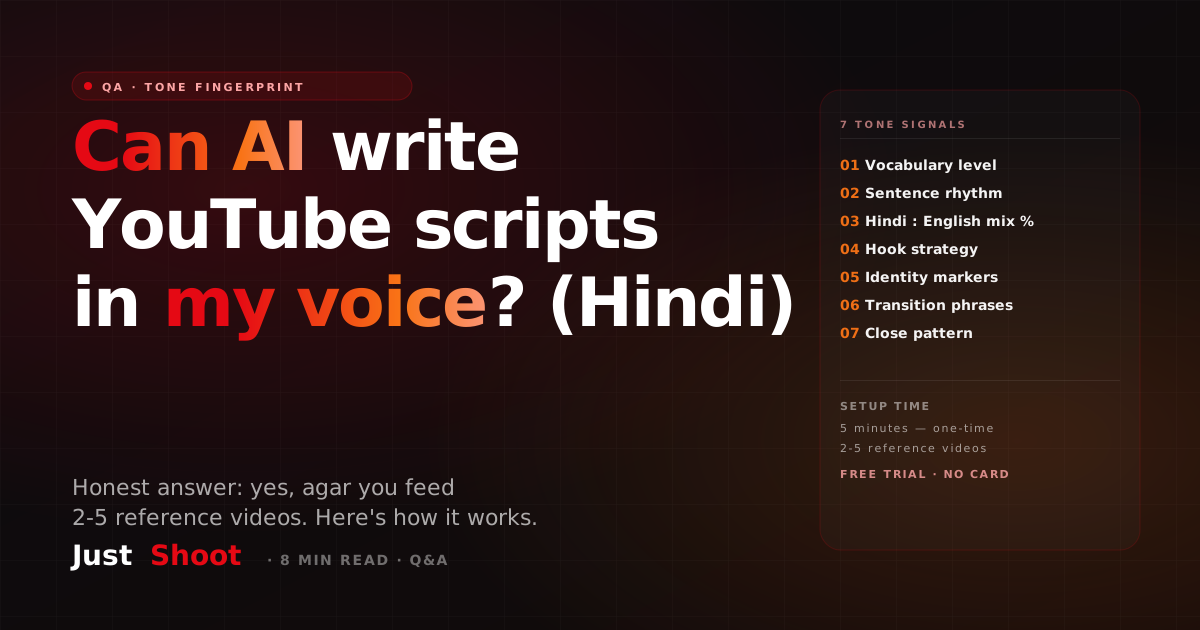
Can AI Write YouTube Scripts in My Voice (Hindi)? — Honest 2026 Answer
Yes — AI can write YouTube scripts in your Hindi voice, but only with the right mechanism. Why ChatGPT fails, what Tone Fingerprint does differently, and a live example.
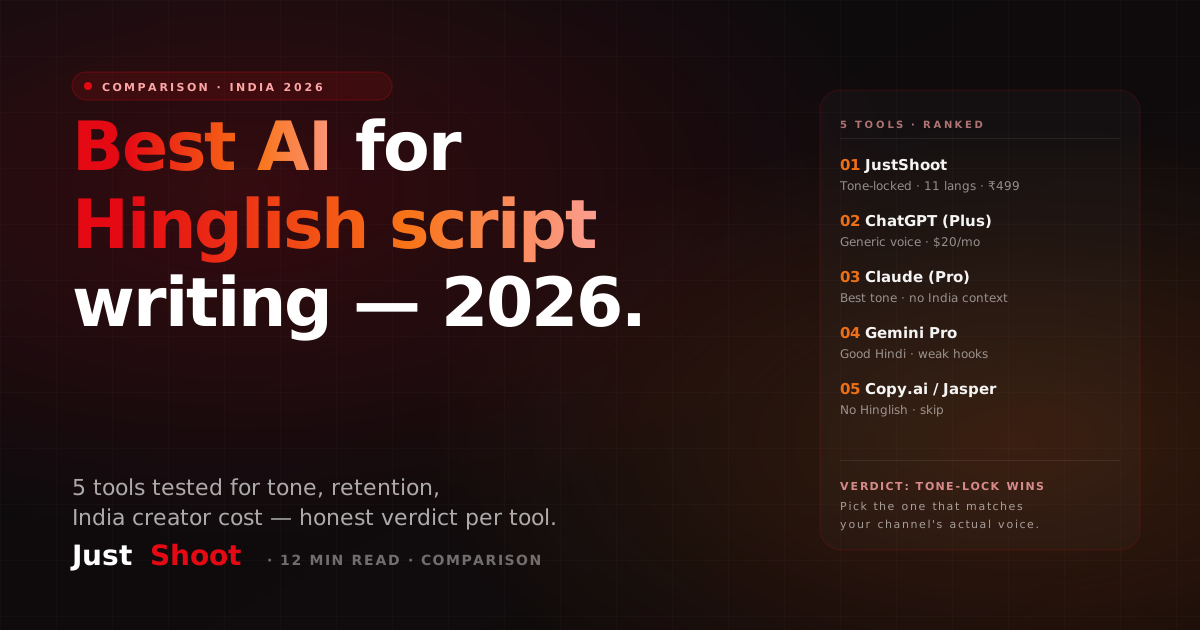
Best AI for Hinglish Script Writing 2026 — Honest Comparison (5 Tools)
Which AI writes the best Hinglish YouTube scripts in 2026 — JustShoot vs ChatGPT vs Claude vs NotebookLM vs Gemini. Per-tool blend ratio, hook quality, identity-marker scores.