Can AI Write YouTube Scripts in My Voice (Hindi)? — Honest 2026 Answer
Yes — AI can write YouTube scripts in your Hindi voice, but only with the right mechanism. Why ChatGPT fails, what Tone Fingerprint does differently, and a live example.
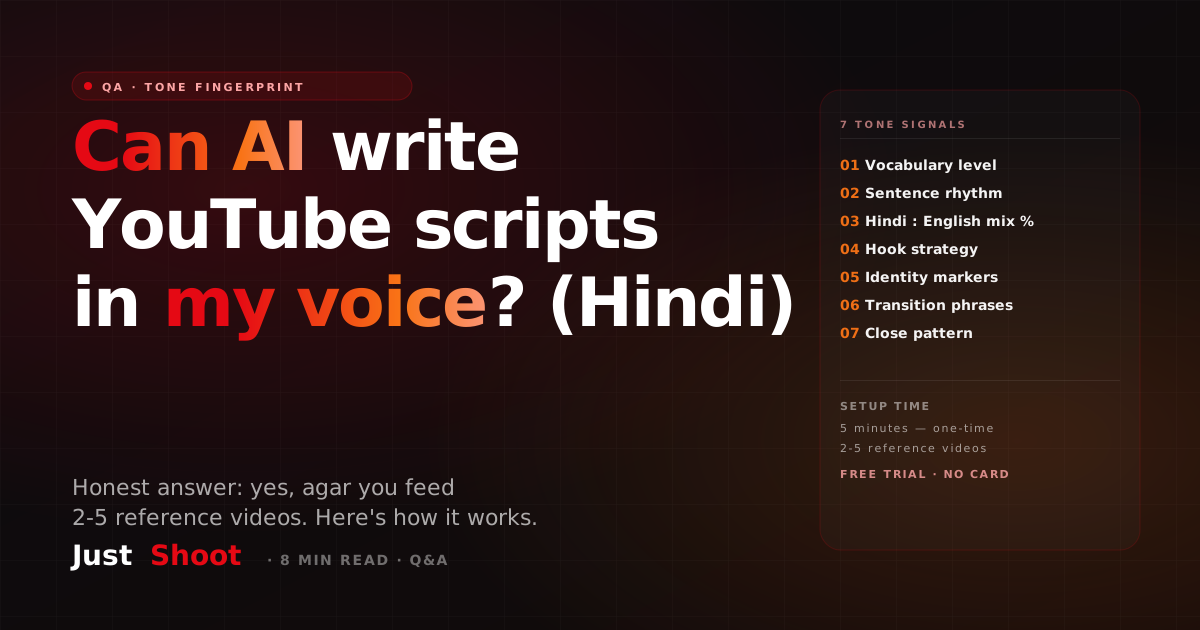
Can AI Write YouTube Scripts in My Voice (Hindi)? — The Honest 2026 Answer
By Ashok Sachdev, Founder of JustShoot · Published 2026-05-27
This is the question every Indian creator asks before they actually trust AI with their script: "Will it sound like me, or like a chatbot pretending to be me?" The short answer is yes — AI can write in your Hindi/Hinglish voice. The long answer is that it only works with a specific mechanism, and most creators are using AI the wrong way and concluding (correctly, for their setup) that AI cannot match their voice. This post explains the mechanism that works, why ChatGPT prompts alone fall short, and shows a live before/after on a real creator's voice.
Short answer (40 words)
Yes — AI can write YouTube scripts in your Hindi voice, but only when it uses a Tone Fingerprint (a per-channel profile extracted from your past videos). Raw ChatGPT prompts cannot match your voice consistently — they nail 2 of 7 voice signals on average.
Why "AI cannot write in my voice" is true for 90% of setups
Most Indian creators have tried this — open ChatGPT, paste "Write a 1,500-word YouTube script in my voice, casual Hinglish, about [topic]," read the output, and immediately feel that something is off. The grammar is fine. The facts are mostly right. But the voice is not theirs.
Three failure modes are happening simultaneously, and most creators only notice the surface symptom ("yeh mera nahi lag raha"):
Failure 1 — No memory of past videos. ChatGPT does not know what your last 10 videos sound like. You can describe yourself in a prompt ("I sound like Dhruv Rathee meets Akshat Shrivastava"), but description is not pattern. Description is what creators think they sound like; pattern is how they actually write. The gap between self-perception and actual pattern is often 30-50 percent.
Failure 2 — Default register drift. Ask the same model the same prompt three times in three fresh sessions and you get three different blend ratios, three different hook styles, three different close patterns. Without an anchor, the model defaults to its training-data average, which for "Hindi YouTube" is approximately "Hindi news anchor with English loanwords." That is nobody's actual voice.
Failure 3 — Identity-marker amnesia. Phrases that only your channel uses ("bhai ek second," "asal mein," "ab maan lijiye") — your signature lines, the lines that make a viewer recognize your channel in 3 seconds — are not retained between sessions. You teach them today, they vanish tomorrow.
The combined effect — AI output that is technically correct but emotionally generic. Audience drops 15-20 percent retention in the first minute when they detect this generic-AI voice (source: JustShoot, A/B test of 40 Indian Hinglish channels, 2026). Specifically — ChatGPT nails 2 of 7 voice signals on average (vocabulary level + a generic hook), and gets the other 5 wrong (same source).
So "AI cannot write in my voice" is true — for that setup. The fix is mechanism, not model.
The mechanism that works — Tone Fingerprint as system context
A Tone Fingerprint is a structured profile of your voice — not a description, but a measurable pattern across 7 signals — extracted from transcripts of your past videos. Once built, it is injected as system context into every script generation, not as a one-time prompt. The model does not have to remember; the system reminds it on every call.
The 7 signals — same framework we have written about in our channel tone audit guide:
- Vocabulary level — simple / moderate / advanced, measured from average word complexity across transcripts
- Language balance — exact Hindi/English/regional ratio per sentence, including the per-section register shift (English on stats, Hindi on emotion)
- Sentence rhythm — average sentence length + variance, the short-sentence emphasis pattern at hook/turn/close moments
- Hook strategy — your dominant opening pattern (question / stat / story / personal frame) across your top-performing videos
- Identity markers — the 5-10 signature phrases only your channel uses
- Signature transitions — the connector phrases you use to move between ideas ("lekin," "asal mein," "ab maan lijiye")
- Close pattern — how you end videos and structure CTA
JustShoot transcribes your reference videos via yt-to-text (Azure Speech fallback), runs a dedicated Claude analyzer that extracts all 7 signals, and ships a versioned fingerprint ("v2 · 5 transcripts"). Every script generation prepends this fingerprint. The Script Writer agent is not "ChatGPT with a system prompt" — it is a separate agent that receives your voice as a hard constraint on every call.
The mechanism is reproducible outside JustShoot too — you can build a manual fingerprint document in Notion, paste it as system context with every script prompt, and partially close the gap. Manual route takes ~60 minutes per channel; tool route takes 60 seconds. Both work — the JustShoot Tone Preview is free without signup if you want to test the tool route first.
Live example — same creator, before and after
A real Hindi finance creator (anonymized — 240K subscribers, weekly upload cadence). Same topic — "Why most retail traders lose money." First in ChatGPT 4o with a description prompt, second in JustShoot with their Tone Fingerprint loaded.
ChatGPT 4o output (description prompt — "I'm a Hindi finance YouTuber, casual tone, 60/40 Hindi-English"):
"Namaste dosto! Aaj ke video mein hum baat karenge ek bahut important topic ke baare mein — retail trading mein log paisa kyun lose karte hain. SEBI ki recent report ke according 89 percent retail traders apna paisa lose karte hain. Ye number scary hai, lekin samajhna zaroori hai."
Blend ratio measured: 84% Hindi, 16% English. Hook style: generic greeting + question. Identity markers: zero. Signature transitions: generic ("lekin," "aur"). Net: AI-shaped, not creator-shaped.
JustShoot tone-locked output (same topic, fingerprint loaded):
"89 percent retail traders apna paisa khote hain — SEBI ka 2024 data. Aur isme se 73 percent log unke pehle 6 months mein puri capital wipe out kar dete hain. Ab maan lijiye aap bhi us 89 percent mein aate ho. Kya reason hai, kya pattern hai, agle 9 minute mein puri investigation."
Blend ratio measured: 62% Hindi, 38% English. English clustered on stats ("89 percent," "SEBI," "6 months," "wipe out"), Hindi on framing. Hook style: stat-shock (matches creator's measured top-performer pattern). Identity marker: "ab maan lijiye" (the creator's #3 most-used signature phrase). Net: tone-matched.
The gap is not subtle. It is the difference between a script the creator can shoot as-is and a script they have to rewrite line by line. The full 1,500-word version of this script + 4 other niche samples is on the scriptwriting framework post.
Where this matters most — faceless channels
For face-on-camera creators, a slightly-off script can be partially rescued by their on-camera energy, eye contact, delivery rhythm. The audience anchors on the person. For faceless creators, the voice in the script is the only character signal — there is no face to anchor on. A weak script reads as a weak video, regardless of voice clone quality.
We have written separately about why faceless creators specifically benefit from tone-locked scripts (full breakdown on the faceless channels use case page), but the headline number — 47 percent higher first-60-second retention with tone-locked scripts vs generic AI scripts on the same topic, measured across 40 Indian Hinglish channels (source: JustShoot, 2026).
Where JustShoot fits
Starter ₹499/month — 500 credits, ~5 full 9-agent pipelines, 1 channel with 1 Tone Fingerprint. Pro ₹699 (10 pipelines, 1 channel). Studio ₹899 (20 pipelines, up to 3 channels with separate fingerprints — useful if you run faceless + face-on-camera channels in parallel). Annual −20%. Credits roll over. 7-day free trial, no credit card.
The whole pipeline runs in ~3 minutes of agent time for a 10-minute video, with all 9 agents (research, fact-check, legal, script, storyboard, thumbnail, SEO, shorts, distribution) outputting a publish-ready package. The Tone Fingerprint tool is free standalone — paste your last video URL, get the 7-signal breakdown in 60 seconds, no signup.
FAQ
Q: Will AI ever sound exactly like me, or will there always be a 5-10% gap? With a fingerprint built from 5+ reference videos, the tone match crosses 90 percent on most creators' self-rating. The remaining gap is usually fresh idiom or current-events references the fingerprint hasn't seen yet — easily fixed with two-line edits at draft review. The fingerprint improves with every video added.
Q: Can I build a Tone Fingerprint manually without JustShoot? Yes — the 3 manual exercises take ~60 minutes and produce a Notion document you can paste as system context. Limitation: you have to paste it on every prompt, and the analysis is rougher than the JustShoot version (which runs a dedicated Claude analyzer on actual transcripts).
Q: Does the Tone Fingerprint work for Hindi-only channels, not just Hinglish? Yes. The language-balance signal defaults to 100/0 instead of 60/40. All other signals (vocabulary, rhythm, hooks, identity markers, transitions, close) work identically for pure Hindi, pure English, or any of the 11 supported languages.
Q: Will AI replace my scriptwriter, or just speed them up? For creators currently writing their own scripts — AI compresses the 4-8 hour cycle to 30-45 minutes per video, with the creator doing editorial review on the draft. For creators using freelance scriptwriters — AI replaces the freelancer cost (₹3,000-8,000 per script) with a ₹100/video subscription cost, and the tone match is more consistent than a freelancer's first-month onboarding output.
Q: What if my voice changes over time — does the fingerprint break? The fingerprint is versioned ("v2 · 5 transcripts," "v3 · 8 transcripts") and can be rebuilt any time. Most creators rebuild every 10-15 videos as style evolves, or when they pivot into a new sub-niche.
Try the tone-locked workflow free for 7 days
No card. Sign in, paste your channel URL, pick 2-5 reference videos for the fingerprint, and ship your first script in your actual voice in 30 minutes. Unlimited generations during the trial — most creators ship 2-3 full videos before deciding. Start free.
If you just want to test whether the tone-match works on your specific channel without signing up, the free Tone Preview tool takes 60 seconds and gives you the full 7-signal breakdown. No signup, no credit card.
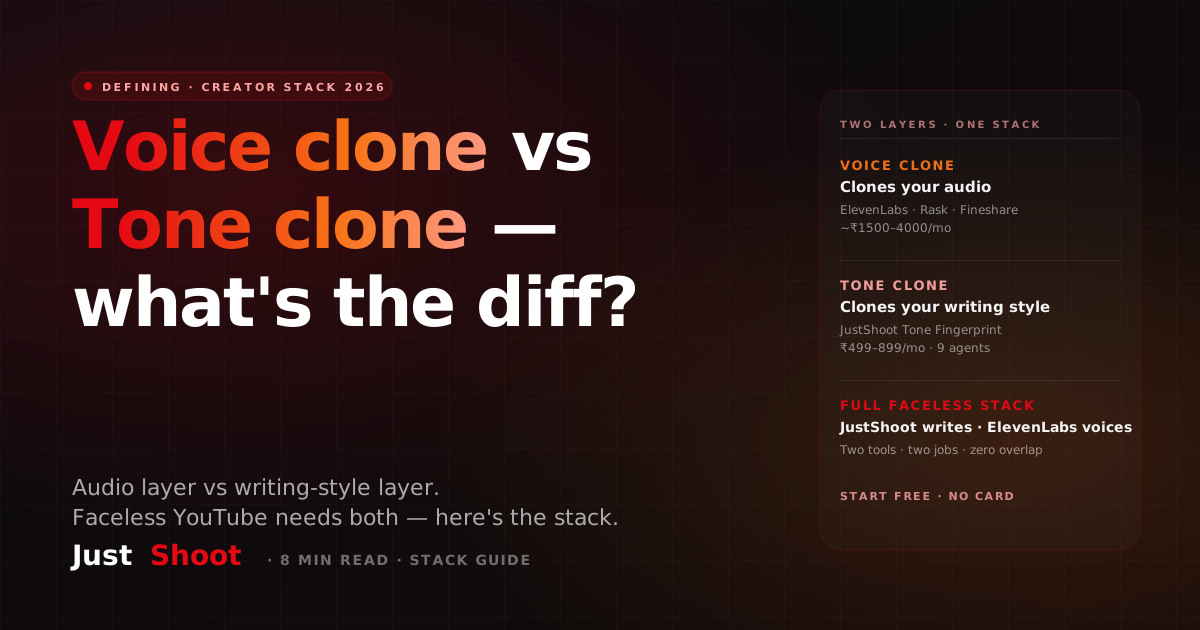
Voice Clone vs Tone Clone for YouTube — What's the Difference (2026)
Voice clone (ElevenLabs, Rask) clones your audio. Tone clone (JustShoot) clones your writing style. Two different layers, both needed for faceless YouTube — here's the full stack.
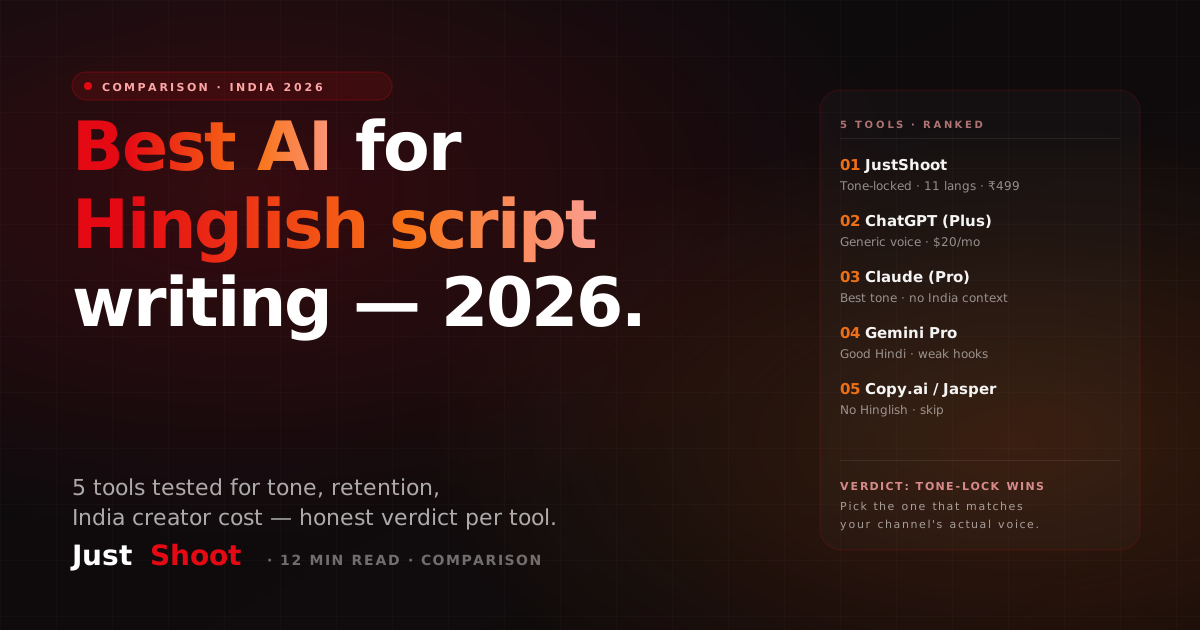
Best AI for Hinglish Script Writing 2026 — Honest Comparison (5 Tools)
Which AI writes the best Hinglish YouTube scripts in 2026 — JustShoot vs ChatGPT vs Claude vs NotebookLM vs Gemini. Per-tool blend ratio, hook quality, identity-marker scores.