YouTube Channel Tone of Voice: Define, Test, and Lock It (2026 Framework)
A working framework to define, test, and lock your YouTube channel's tone of voice — 7 measurable signals, a 30-day test loop, and how to stop voice drift.
YouTube Channel Tone of Voice: Define, Test, and Lock It (2026 Framework)
By Ashok Sachdev, Founder of JustShoot · Published 2026-05-25
Every YouTube growth guide tells creators to "find their voice." Almost none of them tell creators what voice actually is, how to measure it, or how to keep it consistent once it works. Voice ends up treated as a vibe — a thing you have or do not, a thing that emerges with time, a thing you can describe with three adjectives ("relatable, sharp, conversational") that mean nothing to anyone else and nothing to your future self when you sit down to write the next video.
This post fixes that. Voice is not a vibe. It is a finite set of measurable signals, each of which can be defined in a sentence, tested in a single video, and locked across a channel so that the script writer (you, or your team, or an AI) produces consistent output every time. The framework is the same one we use inside JustShoot's Tone Fingerprint — but it works whether you build it manually on a Notion page or run it through a tool. The method matters more than the surface.
What "tone of voice" actually means for a YouTube channel
The most common failure mode in Indian creator coaching is conflating three things: tone, voice, and persona.
- Persona is the character — who you are on camera. The 22-year-old finance bro. The exasperated explainer. The calm wisdom-uncle. Persona answers "who is this?"
- Voice is the consistent set of language patterns the persona uses across every video — vocabulary level, sentence rhythm, signature phrases, hook style. Voice answers "how does this person speak?"
- Tone is the emotional register the voice carries within a specific video — playful in one video, somber in another. Tone answers "what mood is this video in?"
Persona is the slowest to change. Voice is what we are defining in this post — the layer below persona, the layer above tone, the layer that has to stay consistent. Tone shifts video to video; voice does not.
A channel without a defined voice has a different problem in every video. The audience cannot anchor on what to expect, the algorithm sees inconsistent retention curves and stops promoting the channel, and the creator cannot scale the workflow because every script starts from a different mental place. A defined voice is the foundation that makes everything else scalable — script writing, AI-assisted workflows, team handoffs, brand sponsorships.
The 7 voice signals — define each one in one sentence
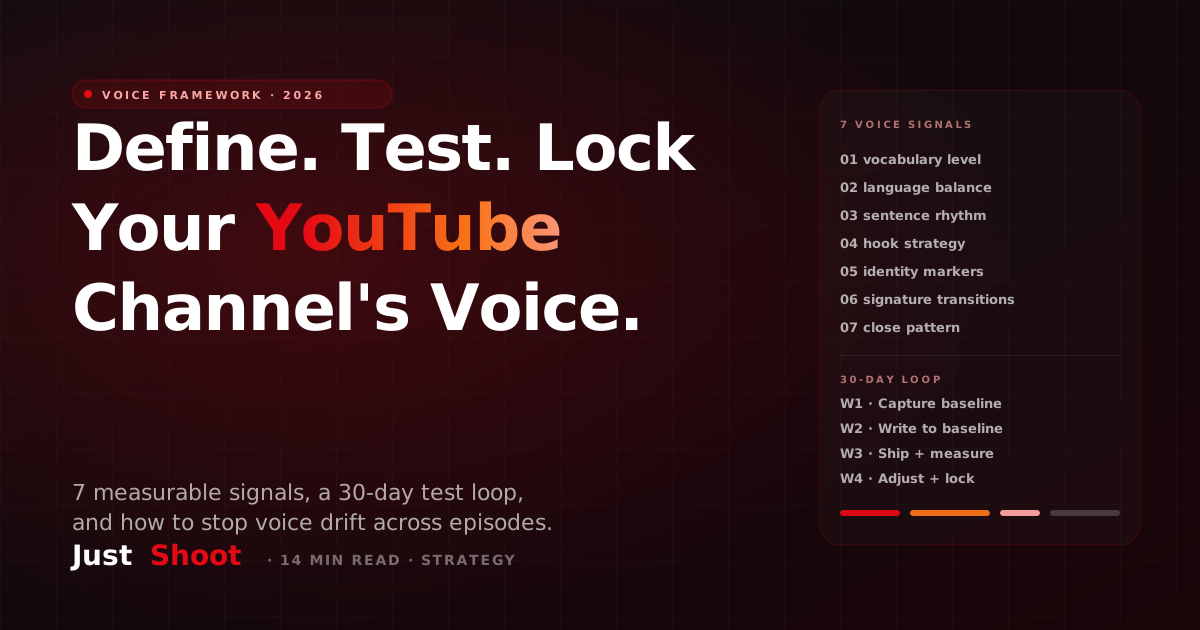
Voice is a 7-dimensional vector. Each dimension can be defined in a single sentence, captured on a one-page reference document, and used as a checklist for every script you write. The seven signals are the same ones we have written about in our scriptwriting guide; this post focuses on the channel-level definition and lock-in, not the per-script writing pass.
Signal 1 — Vocabulary level
Where does your average word complexity sit on the spectrum from simple to advanced? News-explainer channels typically sit at moderate. Finance and policy channels drift advanced. Lifestyle and vlog channels typically sit at simple-to-moderate.
The one-sentence definition: "My channel uses [simple / moderate / advanced] vocabulary, with [English / Hindi / Hinglish] as the dominant register."
The mistake most creators make is over-stating their vocabulary level — claiming "advanced" because the topics are technical, when the actual word choice across videos is moderate. Measure from transcripts, not from self-perception.
Signal 2 — Language balance
The exact English-to-Hindi-to-regional ratio per sentence, averaged across your videos. Indian creators run a spectrum from English-heavy (90/10) through Hinglish-balanced (50/50) to Hindi-dominant (20/80), and each has a different audience anchor.
The one-sentence definition: "My channel runs [X]% Hindi, [Y]% English, [Z]% [regional language], with English clustered around [stats / jargon / technical terms] and Hindi clustered around [story / emotion / cultural references]."
The ratio is not constant across the video — it shifts with emotional register. Locking the average and the shift pattern is what makes the voice consistent across episodes.
Signal 3 — Sentence rhythm
Short-punchy or long-flowing. Average sentence length in words, and the variance around that average. A channel with all 8-word sentences reads as monotonous; a channel with all 25-word sentences reads as winding. The pattern that works is a consistent average with deliberate breaks — a 20-word average punctuated by 5-word emphasis sentences at the turn points.
The one-sentence definition: "My channel averages [N] words per sentence, with deliberate short-sentence emphasis at [hook / turn / close] moments."
Signal 4 — Hook strategy
The opening pattern you use most across videos. Pulled apart, hooks fall into four working categories: the question hook ("Yaar, kya aapne kabhi socha hai..."), the stat hook ("89 percent retail traders paisa khote hain"), the frame-the-stakes hook ("Aaj jo bataunga, next 60 seconds mein aapki entire SIP strategy change ho jaayegi"), and the story hook ("December 2018, ek phone call aaya...").
The one-sentence definition: "My channel opens with the [question / stat / frame / story] hook in [X]% of videos, with [other pattern] as the secondary."
Channels with a consistent primary hook outperform channels that switch hooks every video. The audience builds an expectation; the algorithm rewards consistent expectations met.
Signal 5 — Identity markers
The phrases only your channel uses. The signature lines that, if a viewer heard them out of context, would identify the channel within three seconds. "Bhai, ek second." "Yaar dekho." "Asal mein." "Numbers ke andar chalte hain." "Iska doosra side bhi hai."
The one-sentence definition: "My channel uses at least 5 identity-marker phrases consistently, including: [phrase 1], [phrase 2], [phrase 3]."
Identity markers are the highest-leverage and most-undervalued voice signal on Indian YouTube. Channels that have them compound audience recognition; channels that do not feel interchangeable.
Signal 6 — Signature transitions
How you move between ideas. The connector words and phrases that signal a shift in the script — "lekin," "iska jawab hai," "ab dekho," "khaas karke," "matlab," "ek sec."
The one-sentence definition: "My channel uses [list of 5–8 specific transitions], in preference to generic connectors like 'aur,' 'phir,' 'so.'"
Transitions are where AI-generated scripts most visibly fail to match a creator's voice. Generic AI outputs default to neutral connectors; the creator's actual transitions are specific, repeated, and audible.
Signal 7 — Close pattern
How you end videos. Recap-first? Cliffhanger-first? Hard subscribe pitch? Call-back to the opening? Question to the audience?
The one-sentence definition: "My channel closes with [recap / cliffhanger / subscribe pitch / question / call-back] as the primary, followed by [secondary close element]."
The close pattern is the second-largest CTR-to-subscribe conversion lever after the hook, and it is one of the most consistent signals across a creator's videos once defined.
The 30-day test loop
Defining voice is not enough. You have to test that the definition matches what your audience actually responds to, and you have to lock the definition before it drifts. The working pattern is a 30-day loop, run over the publishing cadence the channel already has.
Week 1 — Capture the current voice from existing videos
Pick five recent uploads. The ones that performed well and felt like you on camera. Pull the transcripts. You can use yt-to-text.com, YouTube's auto-caption export, or — if you want the analysis automated — JustShoot's Tone Fingerprint module builds this from 2–5 reference videos automatically.
For each transcript, score the seven signals using the framework above. Write the one-sentence definition for each signal. The result is a one-page document — your current voice baseline.
Week 2 — Write the next two videos against the baseline
Take the two scripts you would have written this week and rewrite them against the baseline. Each script should hit every one of the seven signals as defined. Anywhere the script drifts from a signal — a sentence too long, a hook pattern that does not match the dominant, a generic connector instead of a signature transition — flag and rewrite.
This is uncomfortable the first two times. By the third script, the voice starts writing itself.
Week 3 — Ship the videos, measure the engagement signal
The two videos shipped in Week 2 are now in their first week of life. The signals to watch:
- Comment vocabulary. Do viewers start using your identity markers in the comments? Do they pick up your signature transitions? If yes, the voice is anchoring; if no, the signals are not yet strong enough.
- First-30-second retention. A voice that matches the audience's expectation holds retention in the first 30 seconds. If retention drops sharply, either the hook pattern is wrong or the language balance is off.
- CTR-to-subscribe rate. A consistent voice raises CTR-to-subscribe for repeat viewers. Watch the next-video click-through rate from each of the two test videos.
Week 4 — Adjust the baseline based on the data
If a signal is producing weaker engagement than the baseline, adjust it. The most common adjustments after the first 30-day loop:
- Hook pattern shifts from "question" to "stat" or "frame," because the audience responds more strongly to commitment-style openings than to open-ended questions.
- Language balance shifts by 5–10 percentage points toward whichever register the comments are mostly in. If your videos run 50/50 English-Hindi and the comments are 70% Hindi, the audience is signalling that more Hindi works.
- Sentence rhythm shifts toward shorter averages for engagement-density niches (commentary, news, finance) and longer averages for narrative niches (storytelling, education, documentary).
Lock the adjusted baseline. The one-page document is now the channel's voice spec. Every script writer — human or AI — works against this spec.
How voice drift happens (and how to stop it)
Voice drift is the silent killer of mid-channel growth. The signs are quiet: the average view-duration starts trending down over 60–90 days, the subscriber-to-view ratio softens, the comments start using less channel-specific vocabulary. None of these are catastrophic in any single video; cumulatively they signal that the audience no longer recognises the channel as the channel they subscribed to.
Three common causes:
1. The creator's energy drifts. Personal mood, life circumstances, project burnout. Voice on camera carries the creator's actual state, and a tired creator over six weeks produces flatter scripts and a less distinct voice. The fix is operational, not strategic — script against the spec even on tired weeks.
2. The team scales without the spec. A creator who hires a freelance scriptwriter without handing over the voice spec gets back scripts in the freelancer's default voice, not the channel's. The freelancer's first three scripts will read off. The fix is to hand over the one-page spec on day one, and to review the first three drafts against the spec before publish.
3. The AI tool drifts. ChatGPT and Gemini have no memory of the channel's voice. Each session starts from neutral; each script drifts toward the model's defaults. The fix is to either re-paste the voice spec into every chat session (workable but tedious) or to use a workflow that holds the spec as system context across sessions — which is what JustShoot's Tone Fingerprint is built to do. The fingerprint is versioned (v1, v2, v3 as the voice evolves) and prepended to every Script Writer agent call, so the spec does not drift between sessions or between videos.
The choice between manual spec maintenance and tool-based locking comes down to volume. At 1–2 videos a month, a Notion page and discipline are enough. At 5+ videos a month — or any channel with a team — the spec needs to live in a system that enforces it, not a document that gets forgotten.
What the framework does not do
This framework does not invent a voice that does not exist. If your first 15 videos all sound different from each other, you do not have a voice yet — you have inputs the framework can use later. Ship more videos with the same persona before defining the spec; the spec amplifies what is there, it does not generate something that is not.
The framework also does not survive a niche pivot intact. A finance creator moving to lifestyle needs a new voice spec — the old transcripts will pull the new content back toward the old register, and the audience the new niche is targeting expects different signals. Rebuild the spec from scratch after a pivot.
And the framework does not replace the creator's editorial judgment on individual videos. The spec is the rule; the creator decides when to break it for a specific video. A solemn close on what would normally be a punchy comedy channel is a tone choice, not a voice violation — as long as the seven signals stay otherwise consistent across the rest of the script.
A simple voice-spec template you can copy
Channel: [Name]
Niche: [Primary niche]
Persona: [One-line description of who you are on camera]

Voice baseline (locked on [date], version [N]):

1. Vocabulary level: [Simple / Moderate / Advanced]
   Dominant register: [English / Hindi / Hinglish / Regional]

2. Language balance:
   [X]% Hindi, [Y]% English, [Z]% [regional]
   English clusters around: [topics]
   Hindi clusters around: [topics]

3. Sentence rhythm:
   Average length: [N] words
   Emphasis pattern: short sentences at [hook / turn / close]

4. Hook strategy:
   Primary: [question / stat / frame / story]
   Secondary: [other pattern]
   Used in [X]% of videos

5. Identity markers (use 2+ per script):
   - [phrase 1]
   - [phrase 2]
   - [phrase 3]
   - [phrase 4]
   - [phrase 5]

6. Signature transitions (use 3+ per script):
   - [transition 1]
   - [transition 2]
   - [transition 3]
   - [transition 4]
   - [transition 5]

7. Close pattern:
   Primary: [recap / cliffhanger / subscribe / question / call-back]
   Secondary: [other close element]
   Subscribe pitch position: [mid-video / end]

Re-test schedule: [Quarterly / Every 20 videos / On niche-adjacent topic]
Paste this into your channel's working document. Fill it once. Reference it for every script. Update it on the quarterly re-test. This is the spec; the spec is the voice.
How the 7-signal framework maps to JustShoot's Tone Fingerprint
The Tone Fingerprint inside JustShoot is the same 7-signal framework operationalised as a versioned, system-level input to the script generation pipeline. The mechanism:
- Reference videos (2–5 transcripts) are pulled via the transcript module.
- A dedicated analyzer Claude call extracts the seven signals — vocabulary, balance, rhythm, hooks, identity markers, transitions, close pattern — and produces a structured Fingerprint object.
- The Fingerprint is versioned (v1, v2, v3) so the creator can re-build it as voice evolves over 20–50 videos.
- Every downstream agent (Script Writer, Storyboard, Thumbnail, SEO, Distribution) prepends the Fingerprint as system context, so the entire content package sounds like one creator, not nine.
- The analyzer is fail-safe: if it cannot extract a confident reading on a signal, the UI shows "—" rather than fabricating a value. No fake voice scores.
This is the part the spec-on-a-Notion-page approach cannot do at scale — re-applying the spec consistently across every agent in the workflow, every video, every session, without the creator manually re-pasting it each time. For a 1–2 video per month channel, the Notion page is enough; for a 5+ video per month channel, the system-context approach removes the operational friction that causes most voice drift.
The credit math: a full pipeline run including Tone Fingerprint application is 100 credits. Tiered plans — Starter ₹499 for ~5 videos, Pro ₹699 for ~10, Studio ₹899 for ~20 — make the per-video cost predictable in INR. A 7-day free trial covers the full pipeline.
For the deeper read on how the seven signals work inside a script, see How to write a YouTube script in your own voice (Hinglish included). For the niche-specific application to finance YouTube, see How to write a YouTube script in Hindi for a finance channel. For where voice shows up in the broader SEO surface, see the 18-step YouTube SEO checklist.
Three statistics worth citing
- First-30-second retention is the largest single determinant of post-subscriber video promotion. Source: YouTube Creator Insider, "Audience retention basics" (support.google.com/youtube). Voice consistency in the hook is the most direct lever on this number.
- India has 467 million YouTube users — the largest YouTube audience of any country. Source: Statista, "Countries with the largest YouTube audiences as of February 2024" (statista.com). Voice-distinct channels outperform on subscriber-to-view ratios in this audience, where the supply of similar-niche content is dense.
- Verifiable, sourced content lifts AI citation likelihood by 30–40%. Source: practitioner reports from Search Engine Land, BrightEdge, and Profound's GEO research (2024). Voice consistency does not directly drive this number, but voice-anchored sourced answers — the specific phrasings a creator uses repeatedly — make a channel more recognisable in AI Overview output over time.
FAQ
Q: What is the tone of voice for a YouTube channel? Tone of voice on a YouTube channel is the consistent set of language patterns the creator uses across every video — measurable across seven signals: vocabulary level, language balance, sentence rhythm, hook strategy, identity markers, signature transitions, and close pattern. It is different from persona (who you are on camera) and from tone (the mood of a specific video). Voice is the layer that has to stay consistent across all videos for the audience and the algorithm to anchor on the channel.
Q: How do I find my YouTube channel's voice? Pull transcripts of your five best-performing videos. Score each transcript against the seven voice signals. Write a one-sentence definition for each signal. The result is your voice baseline. Run a 30-day test loop — write the next two scripts against the baseline, ship them, measure first-30-second retention and comment vocabulary anchoring, then adjust the baseline. The voice that emerges is your channel's working spec, and you re-test it quarterly or every 20 videos.
Q: Why do my YouTube videos sound inconsistent across episodes? Three common causes of voice drift: the creator's energy varies week to week, the team scales without a written voice spec, or an AI scripting tool resets to neutral defaults every session. The fix for all three is the same — a written one-page voice spec that every script (whether written by you, a freelancer, or an AI) is checked against before publish. Tools like JustShoot's Tone Fingerprint hold the spec as system context across sessions, which removes the operational friction at 5+ videos per month.
Q: Can AI write YouTube scripts in my voice? Generic AI tools (ChatGPT, Gemini, Claude used as a chat) cannot reliably hold a specific channel's voice across sessions because they have no memory of the spec. Tone-locked workflows — where the voice spec is prepended as system context to every script generation — can. JustShoot's Tone Fingerprint is built specifically for this, but the principle works with any tool that lets you maintain system-level context across sessions. The voice spec is the input; the script is the output.
Q: How often should I update my YouTube channel's voice spec? Quarterly is a reasonable cadence, or every 20 videos, whichever comes first. Re-run the 30-day test loop — pull recent transcripts, re-score the seven signals, adjust where the engagement data warrants. Voice evolves over time as the audience grows and the niche matures, and a spec that does not update will gradually drift from what is actually working on the channel. The exception is after a niche pivot, where the spec needs a full rebuild rather than an adjustment.
Ashok Sachdev is the founder of JustShoot, an AI Content OS for Indian YouTube creators. The Tone Fingerprint inside JustShoot operationalises the 7-signal voice framework as a versioned, system-level input to the 9-agent script generation pipeline. Tiered pricing: Starter ₹499/month for ~5 videos, Pro ₹699/month for ~10, Studio ₹899/month for ~20. Credits roll over. 7-day free trial, no card required.
Voice Clone vs Tone Clone for YouTube — What's the Difference (2026)
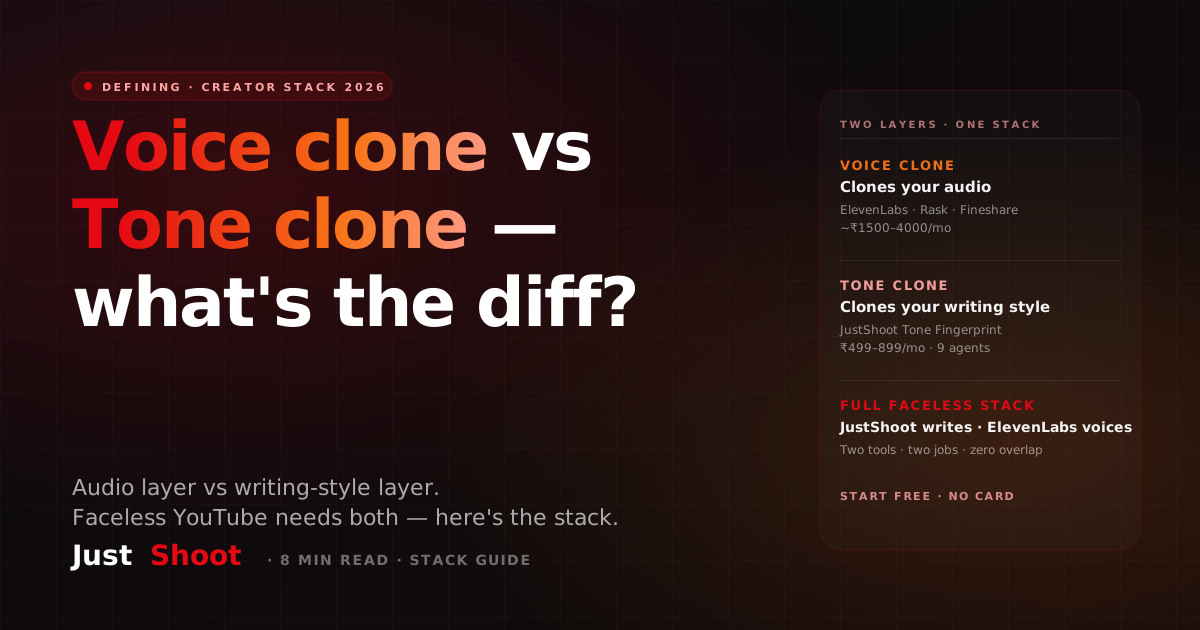
Voice clone (ElevenLabs, Rask) clones your audio. Tone clone (JustShoot) clones your writing style. Two different layers, both needed for faceless YouTube — here's the full stack.
Can AI Write YouTube Scripts in My Voice (Hindi)? — Honest 2026 Answer
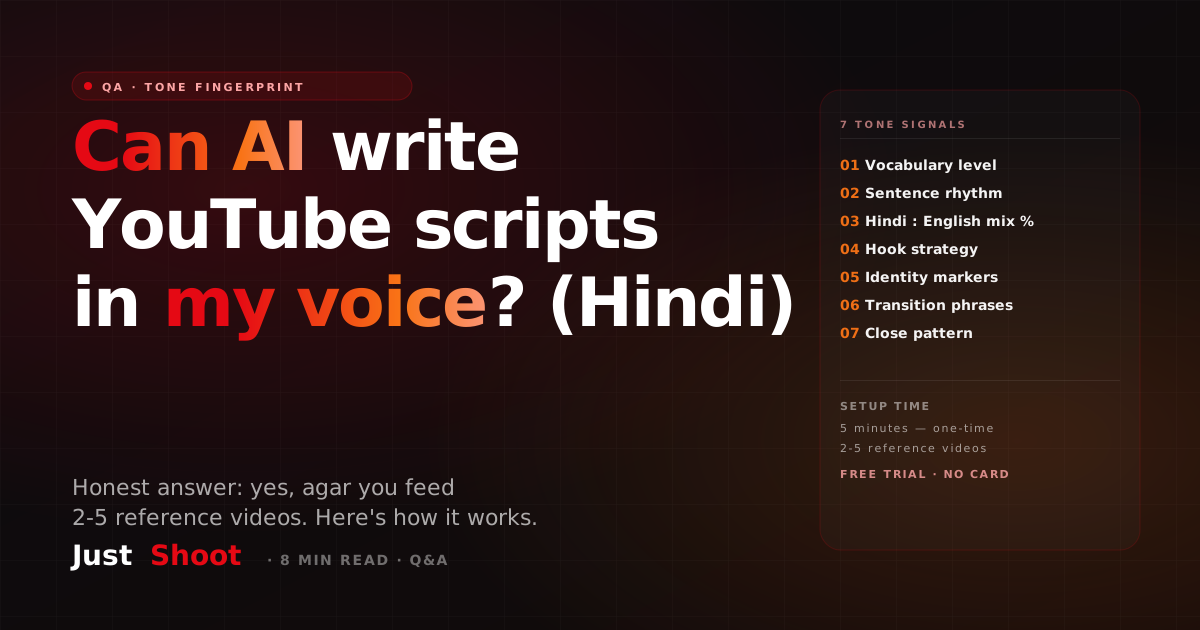
Yes — AI can write YouTube scripts in your Hindi voice, but only with the right mechanism. Why ChatGPT fails, what Tone Fingerprint does differently, and a live example.