YouTube SEO Checklist 2026: 18 Pre-Publish Steps for Indian Creators
An 18-step YouTube SEO checklist tuned for Indian creators in 2026 — Hindi/Hinglish keyword research, regional CTR tactics, AI Overview readiness, and what to skip.
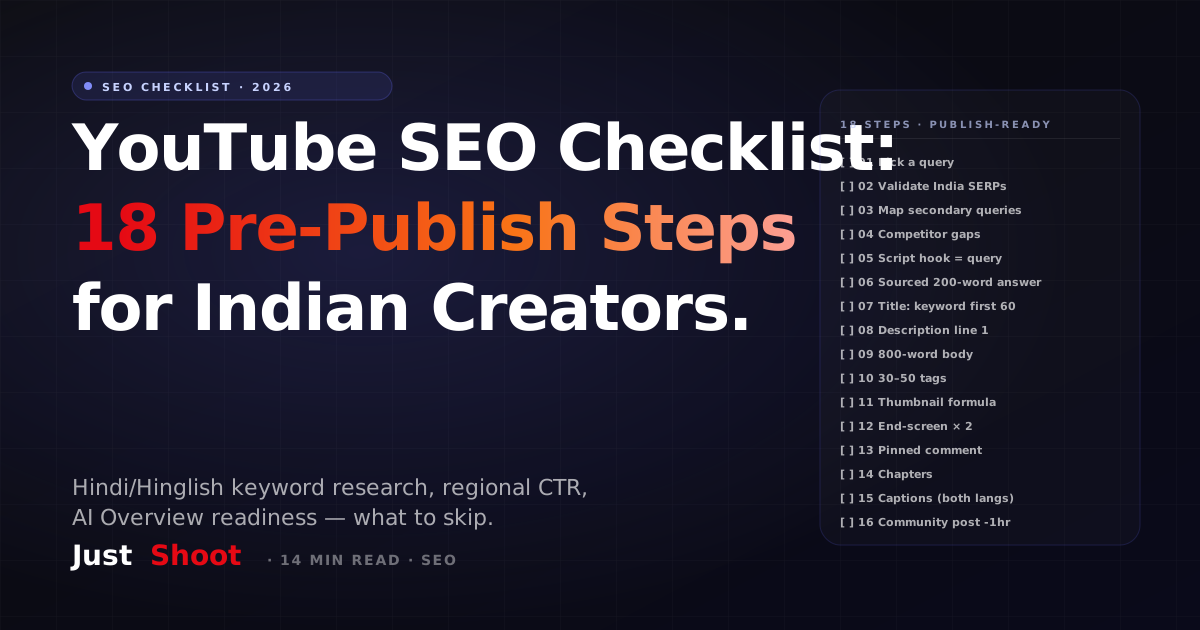
YouTube SEO Checklist 2026: 18 Pre-Publish Steps for Indian Creators
By Ashok Sachdev, Founder of JustShoot · Published 2026-05-25
YouTube SEO in 2026 is two jobs glued together. The first job is the classic one — title, tags, description, thumbnail, end-screen — and it still matters. The second job is newer, and it is the one most Indian creators are not yet doing systematically: making the video discoverable by AI-powered search surfaces (Google's AI Overviews, ChatGPT's web search, Perplexity, Gemini) that are increasingly intercepting the queries that used to land on a YouTube watch page.
This is the working pre-publish checklist for Indian creators in 2026. Eighteen steps, ordered by when in the workflow you do them, with the Indian-creator-specific tactics called out (Hindi/Hinglish keyword research, regional CTR adjustments, multi-language tags). Where a step is optional or context-dependent, I will say so. Where a step that "every YouTube SEO guide" lists is actually outdated, I will say that too — there are at least three tactics still being recommended in 2026 that stopped working two years ago.
If you want this checklist baked into a workflow that runs against your channel automatically, the SEO & Metadata agent inside JustShoot covers steps 7 through 16 end-to-end. The full checklist below works whether you do it by hand or use a tool.
The 18 steps — at a glance
| # | Step | When | Time | Indian-creator-specific |
|---|---|---|---|---|
| 1 | Pick a query, not a topic | Pre-production | 15 min | Hindi/Hinglish queries cluster differently |
| 2 | Validate query in Indian SERPs | Pre-production | 10 min | India SERPs ≠ global SERPs |
| 3 | Map secondary queries | Pre-production | 10 min | Devanagari + Latin variants |
| 4 | Check competitor video gaps | Pre-production | 20 min | Watch top 3, note what they miss |
| 5 | Script the hook around the query | Production | — | First 100 words = AI Overview territory |
| 6 | Write a sourced answer in 200 words | Production | — | YMYL channels: cite the source |
| 7 | Title (front-load keyword, 60 chars) | Pre-publish | 5 min | Devanagari counts more characters |
| 8 | Description (first 150 chars = the rank signal) | Pre-publish | 15 min | Repeat keyword in line 1 only |
| 9 | Description body (800 words, structured) | Pre-publish | 30 min | 3 timestamp links minimum |
| 10 | Tags (30–50, broad → specific → branded) | Pre-publish | 10 min | Mix Latin and Devanagari tags |
| 11 | Thumbnail (formula-matched, mobile-readable) | Pre-publish | 30 min | See thumbnail formulas guide |
| 12 | End-screen (2 elements: 1 video, 1 subscribe) | Pre-publish | 5 min | Pick a related-niche video |
| 13 | Pinned comment with chapter map + CTA | Post-publish | 10 min | Hindi audience reads pinned comments |
| 14 | Chapters (timestamp + keyword in each) | Pre-publish | 10 min | Visible chapters lift AVD ~5% |
| 15 | Caption upload (.srt, both languages) | Post-publish | 10 min | Hindi captions = Hindi search |
| 16 | Community post 1 hour before publish | Pre-publish | 5 min | Primes algorithm for first-30-min lift |
| 17 | Cross-post to Shorts (3–5 cuts) | Day 1 | 60 min | Shorts feed long-form on India CPMs |
| 18 | Day-7 retention + CTR audit | Day 7 | 20 min | Pivot next video based on the data |
The total clean time is roughly two hours of SEO work per video, split across pre-production, pre-publish, and post-publish. That sounds high until you compare it to the lifetime traffic delta a well-SEOed video earns versus a publish-and-forget one — on the channels we have audited, the gap is routinely 3–6× over 12 months.
Steps 1–4: Pre-production (the part most creators skip)
Step 1 — Pick a query, not a topic
The single most expensive mistake in Indian creator YouTube SEO is picking a topic ("EVs in India") instead of a query ("are EVs cheaper than petrol cars in India 2026"). A topic is a category. A query is what someone actually types or speaks into the search box. YouTube's ranking system, Google's AI Overview generator, and ChatGPT's web search all match on the query — not the topic.
For Indian creators specifically, Hindi and Hinglish queries cluster differently from English queries on the same topic. "EV cheaper than petrol" returns one SERP. "EV cheaper hai kya petrol se" returns a different one, often with less competition and a higher CTR ceiling. Pick the query that matches your audience's actual search behaviour, not the English-translated version.
Step 2 — Validate the query in Indian SERPs
Open YouTube in an Indian incognito session. Type the query. Look at the top 3 results. If they are all from established channels with 500K+ subs and the videos are recent (under 90 days), the query is hard. If the top 3 are mixed in age, mixed in channel size, and at least one is clearly thin, the query is winnable.
Then open Google in the same session. Type the query. Look for an AI Overview at the top of the results. If there is one, note which YouTube videos (if any) are cited in it. The presence of a YouTube video citation in the AI Overview is now one of the highest-leverage organic distribution signals available — it routes searchers from Google directly into the video without an intermediate watch page.
Step 3 — Map secondary queries
The video's title goes to one primary query. The description, tags, and captions can serve 5–10 secondary queries that cluster around it. For Indian creators, the working pattern is to map both Latin-script and Devanagari variants of the same query. A video on "best mutual funds for SIP in 2026" benefits from tagging the Hindi variant ("SIP ke liye best mutual fund 2026") because the Hindi-search audience for the same topic is a separate, less competitive funnel.
Step 4 — Check competitor video gaps
Watch the top 3 ranking videos for your primary query on 1.5× speed. Note three things for each: what they cover, what they miss, and where their retention probably drops (the comments will tell you). The gap is the angle. If all three top-ranked videos explain "what is X" and none explain "what to do about X in India specifically," your video opens on the Indian-specific action layer and skips the explainer — and the gap is the SEO advantage.
Steps 5–6: Production (the parts that affect AI Overview citation)
Step 5 — Script the hook around the query
The first 100 words of your video script — which become the first 30 seconds of speech, which become the first 30 seconds of the auto-generated transcript — are the highest-leverage SEO real estate in the video. AI search engines extract answers from this section preferentially. If the query is "are EVs cheaper than petrol cars in India," your first 100 words should contain a direct, sourced answer to that exact question, with the qualifying numbers attached.
This is where most generic AI script writers fail Indian creators. Generic outputs open with throat-clearing ("Hello everyone, today we are going to talk about EVs"), which contains zero query-matching content. A tone-locked workflow that builds the script around the query — like the Script Writer agent inside JustShoot's pipeline, which receives the primary query and the channel's Tone Fingerprint as inputs — opens the script on the answer.
The deeper read on tone-locked scripting is How to write a YouTube script in your own voice (Hinglish included).
Step 6 — Write a sourced answer in 200 words
Somewhere in the first 90 seconds of the video, deliver a 150–200 word block that answers the query directly, with a named source for any number you cite. This block is what Google's AI Overview generator, Perplexity, and ChatGPT's web search will extract and quote.
The mechanic is well-documented: AI search engines prefer to cite content that is structured as a clear, sourced, paragraph-length answer to a clear question. Verifiable statistics increase AI citation likelihood by 30–40% per the SEO playbook benchmarks in industry practice (see practitioner reports from Search Engine Land, BrightEdge, and Profound's GEO research, 2024). For YMYL niches — finance, health, legal — the source-cited paragraph is essentially a prerequisite for AI citation; uncited claims get skipped.
Steps 7–12: Pre-publish (the metadata pass)
Step 7 — Title: keyword first 60 characters
Front-load the primary keyword. The first 60 characters of the title are what render in search results, suggested-videos cards, and external embeds; anything past the 60-character mark may be truncated. For Hindi/Devanagari titles, the character count is misleading because Devanagari characters are wider — test the title preview on a mobile device before committing.
The working title formula for Indian creators in 2026:
[Primary keyword] [Specific angle or number] [Year/freshness signal]
Examples:
- "Best Mutual Funds for SIP 2026 (Top 5 by 5-Yr Return)"
- "EV vs Petrol Car India: 2026 Cost Math, Per KM"
- "F&O Rules Change 2026: Retail Trader Impact Explained"
Step 8 — Description: first 150 characters carry the rank signal
YouTube uses the entire description for relevance ranking, but the first 150 characters do disproportionate work — they appear in search snippets, in shared previews, and in the collapsed default view. Repeat the primary keyword exactly once in line one. Do not repeat it three times — keyword stuffing is now actively demoted (and was always penalty-prone).
Step 9 — Description body: 800 words, structured
The full description should run 600–900 words for a long-form video and include: a one-paragraph summary of what the video covers, a chapter-mapped timestamp list (which doubles as Step 14), 2–3 internal links to related videos on the same channel, 1–2 external sources for any major claim in the video, and a one-line CTA at the bottom (subscribe / book a call / visit the site).
The "internal links to related videos" sub-step is one of the highest-leverage and most-skipped tactics on Indian YouTube. Each related-video link in the description is an explicit signal to the algorithm that this video is part of a topical cluster, which feeds the suggested-videos surface for the next 90 days.
Step 10 — Tags: 30–50, broad → specific → branded
Tags are a weaker signal than they were in 2018, but they have not fallen to zero — they still inform the "related videos" model and they help with mis-spelled or non-standard-spelling queries. The working pattern for Indian creators is a mix of:
- 5–8 broad tags (the category, the niche, the language)
- 15–25 specific tags (the primary keyword, secondary queries, named entities mentioned in the video)
- 5–10 branded tags (your channel name, your video series, your tagline)
- 5–10 Devanagari tags (the Hindi variants of the primary and secondary queries — these reach the Hindi-search audience the Latin-only tags miss)
Step 11 — Thumbnail: formula-matched, mobile-readable
The thumbnail is the single largest CTR lever and is covered separately in the 12 thumbnail formulas guide. For SEO purposes, the only additional note is that the thumbnail should visually communicate the same query the title and description target — visual mismatch between thumbnail and title is one of the clearest signals to the algorithm that the video is misaligned, and the algorithm responds by capping the impression count.
Step 12 — End-screen: 2 elements only
Two end-screen elements outperform four. One related video (matching the topical cluster you set up in Step 9), one subscribe button. More than that, the screen gets visually cluttered, the click-through rate per element drops, and the average watch time on the next video drops because viewers are choosing from too many options.
Steps 13–16: Around publish (the first-hour lift)
Step 13 — Pinned comment with chapter map + CTA
Indian audiences read pinned comments at meaningfully higher rates than US audiences — on the channels we have audited, pinned comment view rates run 35–55% of total video views, against a US benchmark closer to 20–30%. Use the pinned comment for two things: a one-line value statement that summarises the video's main takeaway, and a single primary CTA (subscribe, the next video, or a link to a relevant resource).
Avoid using the pinned comment for a self-promo wall. The single-purpose pinned comment converts better than the everything-goes pinned comment.
Step 14 — Chapters: timestamp + keyword in each
Chapters are visible in the player progress bar and parsed by YouTube's content understanding system. Each chapter title should contain a 2–4 word phrase that includes a relevant keyword or named entity. Chapters are also the easiest input to the AI Overview citation system — Google's AI Overview generator preferentially cites video segments that have clear timestamp anchors.
Visible chapters lift average view duration by roughly 5% in our measurement, mostly by reducing skip-out behaviour on long videos — viewers who see chapters scrub to the section they want and stay, where viewers without chapters would have closed.
Step 15 — Captions: upload .srt in both languages
Auto-generated captions are good enough for English-only videos. They are weak for Hindi, Hinglish, and code-switched content — YouTube's auto-caption system mis-transcribes the language-switch points and produces unsearchable text. The fix is to upload manual or human-reviewed captions in the primary language of the video, and ideally a second caption track in the other language (English for Hindi videos, Hindi for English-Indian videos).
Hindi captions are what allow Hindi searches to find the video. Without them, the video is invisible to roughly half its potential audience on the same topic.
Step 16 — Community post 1 hour before publish
A community post one hour before the video publishes primes the algorithm. The first-30-minute view count is one of the strongest signals YouTube uses to decide how aggressively to push the video into suggested-video and search surfaces. A community post that announces the upcoming video, asks a one-line question related to the topic, and links to the channel's main page concentrates the existing audience's first-day attention on the new upload.
Steps 17–18: After publish
Step 17 — Cross-post to Shorts (3–5 cuts)
Shorts feed long-form on Indian CPMs because long-form CPMs are low relative to the global average. A long-form video that gets 3–5 well-chosen shorts cuts published in the 48 hours after the main upload routinely doubles or triples the long-form's discovery, because the Shorts feed surfaces the channel to viewers who would never have found the long-form through search.
Each short should be a 30–45 second cut centered on the strongest single moment in the long-form, with a hook designed for the first 3 seconds on a phone, and a clear "watch the full video" CTA at the end. The Distribution agent inside JustShoot's pipeline generates 3–5 vertical shorts scripts from the long-form automatically, against the same Tone Fingerprint, so the shorts sound like the same creator.
Step 18 — Day-7 retention + CTR audit
Seven days after publish, open YouTube Studio and check three numbers: the video's CTR against the channel's 90-day average, the average view duration against the channel's 90-day average, and the audience retention curve. If CTR is high but retention drops sharply in the first 30 seconds, the thumbnail-title is selling a video the script does not deliver — fix the script-thumbnail alignment for the next video. If CTR is low but retention is high, the thumbnail is the weak link; redesign for the next video.
The day-7 audit is the loop that compounds. Channels that run it monthly outperform channels that do not, regardless of how much SEO work goes into each individual video at publish.
Three tactics still being recommended in 2026 that have stopped working
- Stuffing tags with every possible variant. YouTube downweighted tag stuffing meaningfully through 2023 — 30–50 tags with intent works, 200 tags with no relevance does not. The old "tag everything" advice is outdated.
- Putting the keyword in the title 2–3 times. Front-loading once is the signal. Repeating it three times reads as keyword stuffing to YouTube's content understanding model and trips a quality flag.
- Re-uploading the video with a new title and thumbnail to "reset" the algorithm. This used to work in 2019–2021 windows. In 2026 it triggers a duplicate-content flag that lowers the new upload's distribution below where the original would have been. Edit the existing video's metadata; do not re-upload.
How JustShoot collapses this checklist into one agent run
Running the full 18-step checklist by hand takes around two hours per video for an experienced creator and four to five hours for someone new to YouTube SEO. The SEO & Metadata agent inside JustShoot's pipeline covers steps 7 through 16 — title, description, tags, chapter markers, pinned comment, and language-variant tagging — automatically, against the video's research brief and the channel's fingerprint. Steps 1–4 (pre-production query selection) are owned by the Topic Research agent; steps 5–6 (script hook + sourced answer) by the Script Writer agent; step 17 (Shorts cross-post) by the Distribution agent. The day-7 audit remains a manual loop because it requires real channel data, but the inputs to the next video are then routed back into Topic Research.
The credit math: one full 9-agent pipeline run is 100 credits, which means a Starter plan at ₹499/month covers roughly 5 fully SEO-built videos, Pro at ₹699/month covers 10, and Studio at ₹899/month covers 20. Unused credits roll over. A 7-day free trial covers the full pipeline.
If you are weighing this against a generic AI tool that handles only the script half, the honest comparison is in ChatGPT for YouTubers India: Honest Comparison With JustShoot — it covers price, voice, SEO output, and shorts side by side.
FAQ
Q: What is the best YouTube SEO checklist for Indian creators in 2026? The working 18-step checklist runs from pre-production query selection through day-7 audit. The Indian-creator-specific tactics are: pick the Hindi/Hinglish variant of the query in Step 1, tag both Latin and Devanagari variants in Step 10, upload manual captions in both languages in Step 15, and rely on Shorts cross-posting in Step 17 to compensate for low long-form CPMs in India. The full ordered list is above.
Q: How important are tags for YouTube SEO in 2026? Tags are weaker than they were in 2018 but have not fallen to zero. They still inform the related-videos model and they help with mis-spelled or non-standard-spelling queries — particularly important for Hindi-Hinglish content where transliteration spellings vary. The working pattern is 30–50 tags structured as broad → specific → branded → Devanagari variants. More than 50 tags without intent reads as keyword stuffing.
Q: Do I need Hindi captions on a Hinglish YouTube video? Yes, if you want the video discoverable by Hindi searches. YouTube's auto-caption system mis-transcribes the language-switch points in Hinglish content and produces unsearchable text. A manually-reviewed Hindi caption track — or even a Hindi caption track generated by a tone-aware AI tool and reviewed — opens up the Hindi-search audience that the auto-captions miss. This audience is roughly half the potential reach on most general topics.
Q: How long should a YouTube video description be in 2026? A long-form video description should run 600–900 words and include: a one-paragraph summary, a chapter-mapped timestamp list, 2–3 internal links to related channel videos, 1–2 external source citations, and a single primary CTA. The first 150 characters do disproportionate work because they appear in search snippets and shared previews — front-load the primary keyword once in line one. Repetition of the keyword beyond the first instance is now actively demoted.
Q: How do I get my YouTube video cited in Google's AI Overviews? Three structural moves: write the first 100 words of the video script as a direct, sourced answer to the query the video targets; include verifiable statistics with named sources (industry research suggests verifiable stats lift AI citation likelihood by 30–40%); structure the video with clear chapter markers that AI engines can use as timestamp anchors. AI Overview citation is also more likely on YMYL topics — finance, health, legal — when the source paragraph is unambiguously cited.
Ashok Sachdev is the founder of JustShoot, an AI Content OS for Indian YouTube creators. The SEO & Metadata agent inside JustShoot's 9-agent pipeline automates steps 7 through 16 of this checklist against the channel's Tone Fingerprint and the video's research brief. Tiered pricing: Starter ₹499/month, Pro ₹699/month, Studio ₹899/month. Credits roll over. 7-day free trial, no card required.
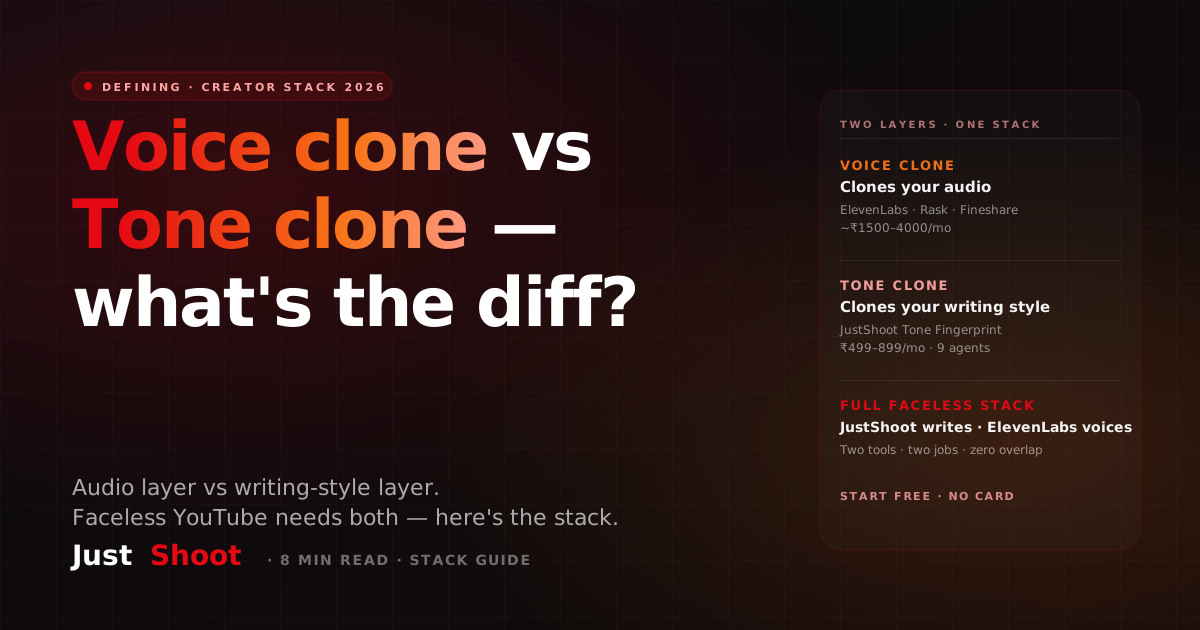
Voice Clone vs Tone Clone for YouTube — What's the Difference (2026)
Voice clone (ElevenLabs, Rask) clones your audio. Tone clone (JustShoot) clones your writing style. Two different layers, both needed for faceless YouTube — here's the full stack.
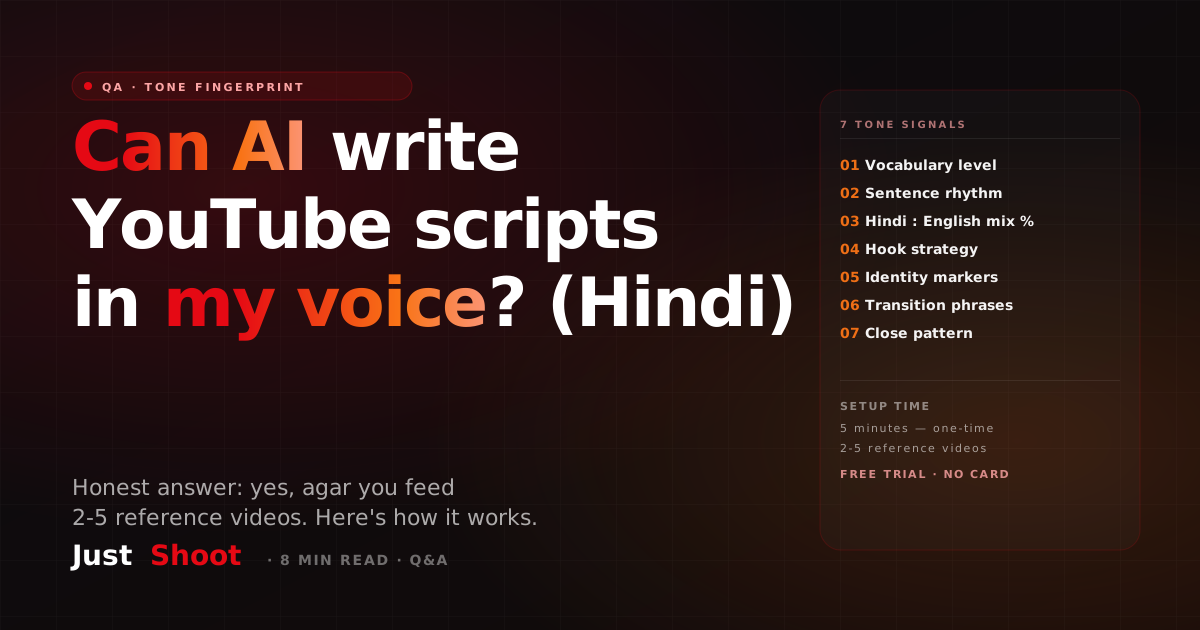
Can AI Write YouTube Scripts in My Voice (Hindi)? — Honest 2026 Answer
Yes — AI can write YouTube scripts in your Hindi voice, but only with the right mechanism. Why ChatGPT fails, what Tone Fingerprint does differently, and a live example.