Hinglish vs Hindi vs English on YouTube: Which One Should an Indian Creator Pick in 2026?
Hinglish vs Hindi vs English on YouTube India in 2026 — audience size, CPM, retention, AI Overview readiness, and a decision framework that picks for you in 2 minutes.
Hinglish vs Hindi vs English on YouTube: Which One Should an Indian Creator Pick in 2026?
By Ashok Sachdev, Founder of JustShoot · Published 2026-05-25
The fastest, most-asked question we hear from new Indian creators is this: "Bhai, Hindi mein banaun, English mein, ya Hinglish mein?" The answer matters more in 2026 than it did even two years ago, because language pick now drives three separate downstream things at once — the size of your addressable audience, the CPM band YouTube will eventually pay you on, and — newer — whether AI search surfaces like Google's AI Overviews and ChatGPT web search will surface your video to the right query at all.
This post is the decision framework we use inside JustShoot's onboarding flow when a creator has to lock the language for their channel. It works whether you are at zero subs or fifty thousand, and it works for both long-form and shorts. The short version: there is a correct answer for almost every niche, but the correct answer is not "always Hinglish" — even though that is what most growth Twitter threads tell you.
TL;DR — the 2-minute answer
If you want to skip the analysis and just want the call:
- Pick Hinglish if your audience is metro/Tier-1, age 18–34, your niche is finance, tech, business, commentary, urban lifestyle, or career advice, and your script uses a lot of English jargon (SIP, EMI, IPO, framework, debug, growth) that has no clean Hindi equivalent.
- Pick pure Hindi (Devanagari, no English code-switch beyond proper nouns) if your audience is Tier-2/Tier-3, age 25+, your niche is news/explainer, mythology, history, geopolitics, agriculture, or government schemes, and your videos run long-form (12+ min).
- Pick pure English if your audience is global Indian diaspora or international, your niche is tech tutorials, software, or developer content where the entire global SERP is already in English, and your subscriber-acquisition strategy depends on Google search ranking rather than YouTube discovery.
- Pick a regional language (Tamil/Telugu/Bengali/Marathi/Gujarati/Punjabi/Kannada/Malayalam) if the niche is regional culture, regional politics, regional cinema, or the audience your sponsors want is a specific state. Regional CPMs are lower, but the audience anchor is unbeatable.
If none of those four fit cleanly, you are probably looking at Hinglish — that is the safe default for Indian creator content in 2026.
Why the language pick matters more in 2026 than in 2022
Three things changed.
First, YouTube's search and recommendation system in India is now language-aware in a way it was not before. The auto-caption transcript, the title, and the description are scored against the queries that match the same language. A Hindi-script title competes in the Hindi-language SERP, a Devanagari-mixed title competes in a hybrid SERP, and a romanized-Hinglish title competes in the Latin-script SERP — and these three SERPs have measurably different competition levels. Picking the language is now also picking the SERP you compete in.
Second, AI search surfaces — Google's AI Overviews, ChatGPT web search, Perplexity, Gemini's answer panel — now intercept a meaningful share of queries that used to land on YouTube directly. The AI engines are language-aware in the same way; an Indian-English query produces an English-citation AI Overview, a Hindi-typed query produces a Hindi-citation AI Overview, and a Hinglish romanized query produces a Latin-script citation. Each surface rewards a different language profile. (For the full breakdown on getting cited by these surfaces, see our YouTube SEO checklist for 2026.)
Third, CPM math in India shifted. Pure English content from Indian creators still earns the highest CPMs (₹150–400 range for finance/tech topics, India-served), Hinglish sits in the middle (₹50–150), and pure Hindi sits lowest (₹20–80) for the same topic. But pure Hindi has the largest organic discovery surface because the Hindi-search audience is undersaturated — and the gap between "what high-quality Hindi creators charge sponsors" and "what mid-quality English creators charge" closed substantially in 2024–25 as brands realised that Tier-2/Tier-3 buying power is the new growth surface. CPM is not the only revenue lever, and for most creators it is not even the primary one — sponsorships are.
The result: the language pick is now a strategic decision with three vectors (audience size, CPM band, AI-search readiness) instead of one, and the correct answer depends on the niche, the format, and the monetisation plan, not on a universal default.
The 5-dimension decision framework
We score each language pick against five dimensions. Each dimension is a number you can estimate in a minute. The total picks the language.
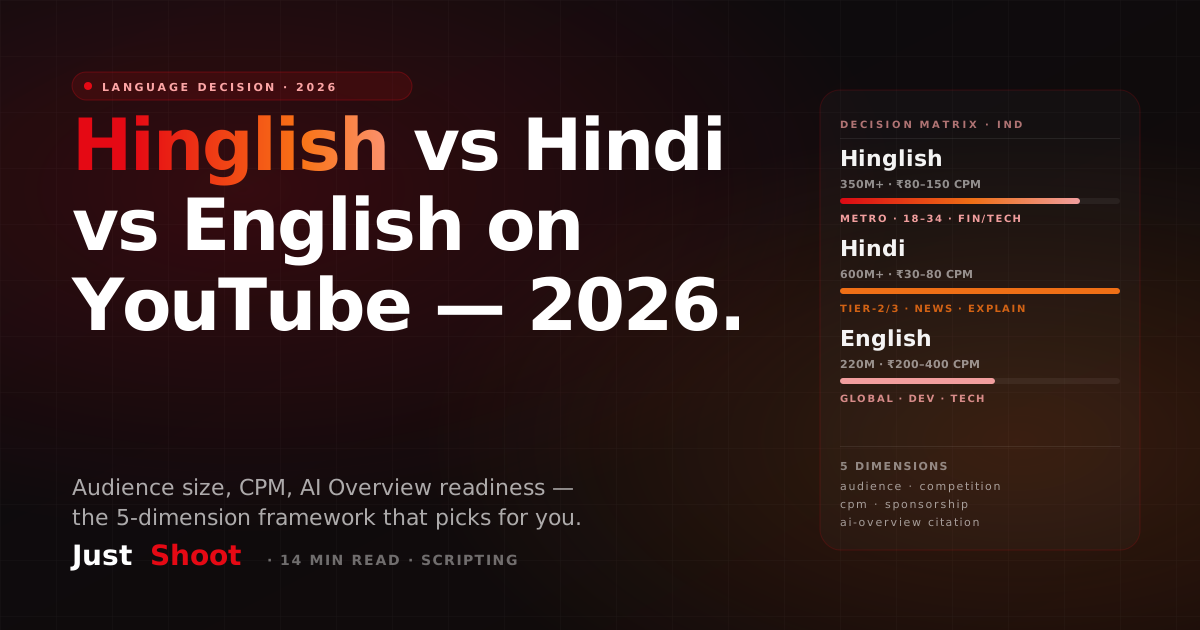
| Dimension | Hinglish | Pure Hindi | Pure English | Regional |
|---|---|---|---|---|
| Addressable audience (India + diaspora) | 350M+ | 600M+ | 220M | 60M–120M each |
| Competition density (top 10 % well-produced) | High | Medium | Very high | Low–Medium |
| Avg CPM for finance/tech (₹) | 80–150 | 30–80 | 200–400 | 25–90 |
| Sponsorship rate for 100K creator | ₹40K–₹120K | ₹25K–₹80K | ₹60K–₹150K | ₹15K–₹50K |
| AI Overview citation likelihood (2026) | Rising | High for Hindi queries | Mature | Low — still emerging |
Read the table by your row, not your column. If your monetisation plan depends on sponsorships in finance and your audience is metro/Tier-1 in the 18–34 age band, Hinglish wins on the sponsorship rate row and the addressable audience row and is competitive enough on CPM. If your monetisation plan depends on YouTube Premium revenue from a large daily watch-time and your niche is news/explainer for a Tier-2/Tier-3 audience, pure Hindi wins on audience size and competition density, and the lower CPM is more than offset by the volume.
The single biggest mistake creators make at the language-pick stage is over-weighting CPM. CPM is a per-thousand-view number; sponsorship rates are a per-video number, and for most channels under 500K subs, sponsorship revenue is 4–10× larger than AdSense. The 6× CPM advantage of English over Hindi disappears in real income terms once a creator hits sponsorship scale, because Indian-language sponsors pay premiums for audience match that English creators cannot deliver.
Niche-by-niche: what works, what does not
The decision framework above is the general case. The niche-specific calls below override it where the niche has a clear winner.
Finance, tax, investing, SIP
Pick Hinglish. The audience is dominated by 22–40-year-old urban Indians who think in English jargon (SIP, mutual fund, IPO, F&O, NPS, EMI, ELSS) but talk to family and friends in Hindi. A pure-English finance channel feels foreign to this audience; a pure-Hindi finance channel feels like it cannot handle the technical depth. Hinglish lets the English jargon stay sharp and the cultural framing stay relatable. The top Indian finance channels — Pranjal Kamra, Akshat Shrivastava, CA Rachana Ranade, Labour Law Advisor — all run Hinglish to varying ratios. The deeper read on this specific niche is in our Hindi finance script template guide.
News, explainer, current affairs
Pick pure Hindi (with Devanagari) for the mass-audience play, or Hinglish for the urban-news play. Dhruv Rathee runs Hindi-dominant with English clipped in for proper nouns and numbers, which is functionally Hinglish but reads as Hindi-first. Sham Sharma runs a sharper Hindi-dominant register for a more political-news audience. The trade-off: pure Hindi explainer content has the largest possible audience in India but slightly lower CPM; Hinglish-leaning explainer has a smaller urban audience with higher sponsorship value.
Tech tutorial, dev tools, software walkthrough
Pick pure English unless your audience is explicitly Tier-2/Tier-3 students learning coding for the first time, in which case Hinglish wins for the comfort factor. Pure-English tech tutorials compete in a global SERP and earn global CPMs; Hinglish tech tutorials own a smaller-but-fast-growing Indian-specific SERP. CodeWithHarry runs Hinglish for the beginner audience; Anjana Vakil runs pure English for a global engineering audience.
Lifestyle, vlogging, daily-life
Pick Hinglish for metro audiences, regional for state-specific audiences. Lifestyle is a relatability play, not an information-density play, so the language has to match exactly how the audience talks to their friends. A Tamil lifestyle vlogger reaches a far more loyal audience in Tamil than in Hinglish; a Mumbai/Delhi/Bangalore lifestyle vlogger does the opposite.
Commentary (Dhruv Rathee-style)
Pick Hindi-dominant Hinglish. The format depends on the host's voice carrying both the analytical authority (English jargon stays sharp) and the cultural framing (Hindi storytelling stays anchored). Mohak Mangal, Akash Banerjee, Dhruv Rathee — all run this register. For the structural breakdown on commentary scripting, see our scriptwriting-in-your-own-voice guide, which covers the hook-and-bridge patterns that work for this niche.
Education (school, JEE, NEET, UPSC, government schemes)
Pick Hindi-dominant Hinglish for K-12 / JEE/NEET, pure Hindi for UPSC and government scheme explainers. The competitive exam audience is split: K-12 and JEE/NEET learners are increasingly Hinglish-comfortable because of the English-medium creep into Indian schooling, while UPSC and government-scheme audiences skew older and Hindi-dominant. Khan Sir runs almost-pure Hindi to enormous reach; Unacademy creators mix Hinglish for K-12 content.
Gaming (BGMI, Free Fire, Minecraft)
Pick Hinglish. Gaming audiences in India are dominated by 15–28-year-olds who speak Hinglish naturally, who use English game terminology (push, snipe, frag, rotate, clutch) for which there are no clean Hindi equivalents, and who switch between Hindi and English mid-call on Discord. CarryMinati, Mortal, Dynamo, Scout — all Hinglish. A pure-Hindi gaming channel reads as unnatural to the audience.
Regional (Tamil, Telugu, Bengali, Marathi, Gujarati, Punjabi, Kannada, Malayalam)
Pick the regional language if the niche is regional cinema, regional politics, regional cuisine, or the audience your sponsors want is location-specific. The CPMs are lower in absolute terms, but the audience anchor and the local-sponsor rate per video are unmatched. The same JustShoot agent pipeline runs in all 11 supported languages with the same Tone Fingerprint logic; the language is a flag, not a different product.
The Hinglish ratio: not 50/50, but a spectrum
If you have decided on Hinglish, the next decision is the ratio. Hinglish is not a single point on the spectrum — it ranges from 90 % English with Hindi connector words sprinkled in (the "Hindi-flavoured English" of Indian-Twitter founder posts), through 60/40 balanced (the urban-creator default), down to 20 % English used only for technical terms (the news-explainer profile).
The working pattern we have measured across hundreds of channels:
- Finance, tech, business: 60–70 % English jargon density. The reason is that the English terms are the technical anchors the audience is searching for, and substituting them with Hindi equivalents reads as either childish or untrustworthy.
- Commentary, current affairs: 30–40 % English jargon density. The Hindi storytelling carries the emotional weight; English is reserved for proper nouns, organisations, and numbers.
- Lifestyle, vlogs, comedy: 25–35 % English density, mostly contemporary slang and brand names. The Hindi is the cultural register.
- Gaming: 50–60 % English game terminology, 40–50 % Hindi reactions and connectors. The mix is dictated by the in-game vocabulary.
- Education: 35–50 % depending on subject. STEM subjects skew higher English; humanities and social sciences skew higher Hindi.
The ratio is part of your channel's Tone Fingerprint, and it should be defined explicitly rather than left to drift. A channel that runs 60/40 in one video and 30/70 in the next is harder for the audience to anchor on; the algorithm picks up the inconsistent retention curve and slows promotion.
Common decision mistakes
There are four mistakes we see repeatedly when a creator picks language at the channel-setup stage. None of them are obvious; all of them cost months.
Mistake 1: "I will start in English to reach the global audience, then switch to Hindi if it doesn't work." Switching the primary language of a channel mid-stream is the closest thing to starting over. The algorithm has already learned which audience to push the channel to; that audience does not understand the new language; the new audience does not yet know the channel. Pick the language at week zero; do not plan to switch.
Mistake 2: "I will run two channels — one in Hindi and one in English." This works if you are a team. It does not work if you are one person, because the time investment per channel is the same, and you end up making half-good content on both. Run one channel, in one language, until it crosses 100K, before considering a second-language spin-off. (When you do spin off, JustShoot's multi-channel Studio plan supports up to 3 channels with separate Tone Fingerprints — but that is a problem to solve after you have one working channel, not before.)
Mistake 3: "My niche is English globally, so I will run in English even though my audience speaks Hindi." This is the classic mistake in Indian developer-content and creator-economy meta channels — creators see that the global SERP is in English, copy the format, and find that their actual viewers are Indians who would have engaged more in Hinglish. The SERP is a competitive analysis input; it is not a directive on language choice. Pick the language your audience speaks, not the language the global SERP rewards.
Mistake 4: "I will let my script writer / AI tool pick the language for me." Generic AI tools (ChatGPT, Gemini, Claude used directly) default to English for technical prompts and to neutral Hindi for Hindi prompts, neither of which matches the natural Hinglish register most Indian creators want. The language has to be a setting on the workflow, not an emergent property of the writing tool. Tools like JustShoot's Script Writer agent take the language as an explicit input (along with the Hinglish ratio, the Tone Fingerprint, and the script structure) so that the language pick is locked once at the channel level and applied automatically to every output.
How the language pick interacts with the Tone Fingerprint
The deeper integration is that language is one of the seven signals in the Tone Fingerprint framework we use to capture a channel's voice. Specifically, language is signal #2 — the exact ratio of English to Hindi to regional language, averaged across the creator's existing videos, with the cluster breakdown of where English shows up (jargon, numbers, brand names) and where Hindi shows up (storytelling, emotion, connector phrases).
That fingerprint, once captured, is the constant input to every script generation. The Script Writer agent inside JustShoot's pipeline reads the fingerprint and produces a draft that holds the language ratio constant — so a creator who is 65/35 Hinglish does not get a 50/50 draft from the AI, and a creator who is 30/70 Hindi-dominant does not get a 50/50 either. The language and the ratio are locked at the channel level and reapplied automatically.
The pricing for the full pipeline is ₹499/month Starter (500 credits, ~5 videos), ₹699/month Pro (1000 credits, ~10 videos), ₹899/month Studio (2000 credits, ~20 videos, with 3-channel separate-Tone-Fingerprint support for creators who want to run a Hinglish flagship and a regional spin-off later). Annual billing is 20 % off. 7-day free trial covers the full pipeline.
FAQ
Q: Should I make YouTube videos in Hindi, English, or Hinglish in 2026? Hinglish is the safe default for Indian creator content in 2026 — metro/Tier-1 audiences, ages 18–34, niches like finance, tech, business, commentary, urban lifestyle, and career advice all anchor on Hinglish. Pick pure Hindi if your audience is Tier-2/Tier-3 and your niche is news/explainer, mythology, geopolitics, or government schemes. Pick pure English only if your audience is global diaspora or your niche is software/dev where the global SERP is English-first. Pick a regional language (Tamil/Telugu/Bengali/Marathi/Gujarati/Punjabi/Kannada/Malayalam) for state-specific niches. The 5-dimension framework above — audience size, competition density, CPM band, sponsorship rate, AI-search citation — picks for you in 2 minutes.
Q: Is Hinglish actually better for YouTube SEO in India? It depends on the SERP you want to win. Hinglish — romanized Latin-script — competes in the same SERP as English content, where competition is high but the audience size is large. Pure Hindi (Devanagari) competes in the Hindi SERP, which has lower competition but a different audience profile. For most metro-targeted niches in 2026, Hinglish wins because the queries the audience actually types are romanized Hinglish ("SIP kya hai", "best phone under 30000", "EMI calculator hindi"), and the Hinglish-script content matches those queries cleanly.
Q: What is the right Hinglish ratio for my channel? The ratio depends on the niche. Finance, tech, and business channels run 60–70 % English jargon density. Commentary and current affairs run 30–40 %. Lifestyle and vlog channels run 25–35 %. Gaming runs 50–60 %. Education runs 35–50 % depending on subject. The ratio should be defined explicitly at the channel-setup stage and held constant across videos — drifting ratios produce inconsistent retention curves and slow algorithmic promotion. JustShoot's Tone Fingerprint captures and locks the ratio automatically from your existing videos.
Q: Do Hindi YouTube videos earn less than English YouTube videos in India? Per-thousand-view CPM is lower in Hindi (₹20–80 for finance/tech) than in English (₹200–400 for the same niche, India-served). But sponsorship revenue — which is 4–10× larger than AdSense for most channels under 500K subs — is competitive or higher in Hindi for India-targeted audiences, because Indian brands pay premiums for audience match that pure-English channels cannot deliver. Total revenue per video for a 100K-subscriber Hindi finance channel can match or beat a similarly-sized English finance channel once sponsorships are included.
Q: Can I switch from English to Hinglish on YouTube without restarting my channel? Technically yes; practically it is close to starting over. The YouTube algorithm has already learned which audience to push the channel to based on the language of existing videos; that audience does not engage with the new language; the new audience does not yet know the channel. A language switch typically resets the channel's discovery momentum for 3–6 months. The better play is to keep the existing channel in its current language and launch a second channel for the new language target, only after the first crosses 100K subs.
Ashok Sachdev is the founder of JustShoot, an AI Content OS for Indian YouTube creators. The Tone Fingerprint module captures your channel's exact language ratio from your existing videos and locks it into every script. Pricing: Starter ₹499/month, Pro ₹699/month, Studio ₹899/month. Annual −20%. 7-day free trial, no card required.
Voice Clone vs Tone Clone for YouTube — What's the Difference (2026)
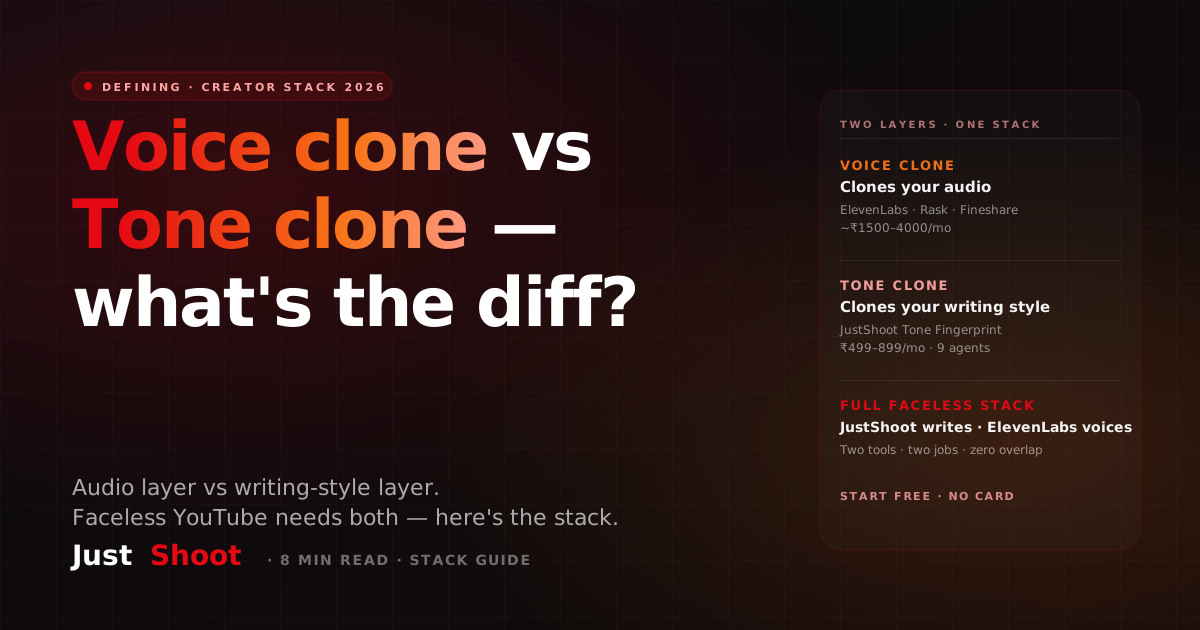
Voice clone (ElevenLabs, Rask) clones your audio. Tone clone (JustShoot) clones your writing style. Two different layers, both needed for faceless YouTube — here's the full stack.
Can AI Write YouTube Scripts in My Voice (Hindi)? — Honest 2026 Answer
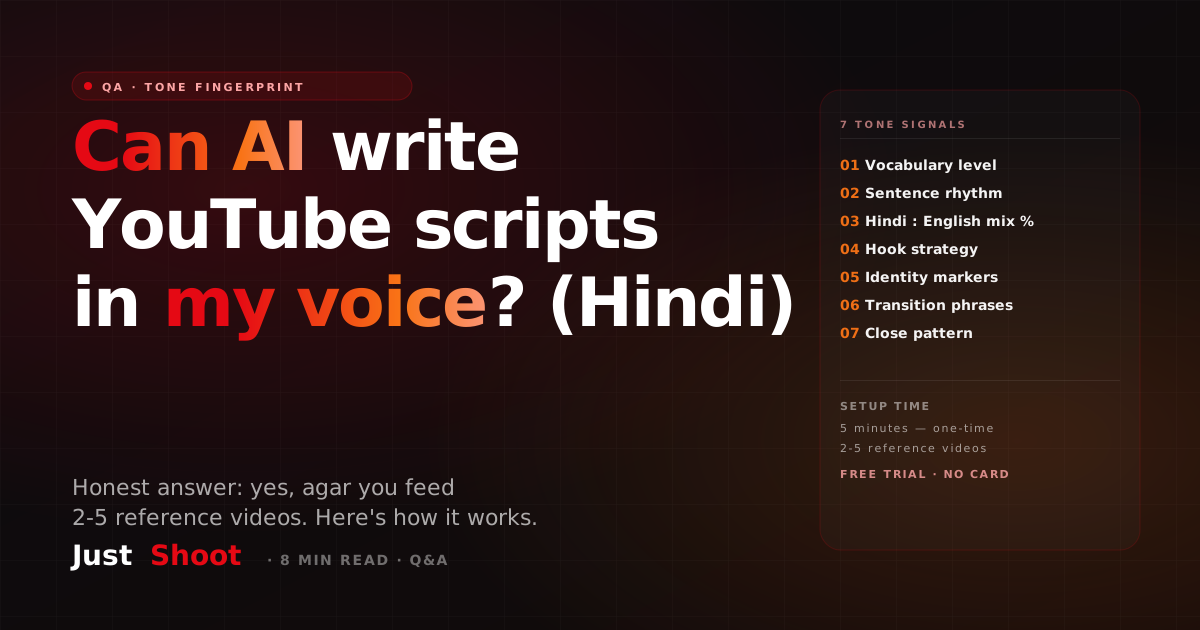
Yes — AI can write YouTube scripts in your Hindi voice, but only with the right mechanism. Why ChatGPT fails, what Tone Fingerprint does differently, and a live example.