YouTube Channel Name Ideas for Hinglish Creators in 2026: A Framework, Not a List
How Indian Hinglish creators should pick a YouTube channel name in 2026 — naming framework, 6 archetypes, the availability checklist, and what to never do.
YouTube Channel Name Ideas for Hinglish Creators in 2026: A Framework, Not a List
By Ashok Sachdev, Founder of JustShoot · Published 2026-05-25
Every "YouTube channel name ideas" blog post is the same — a 200-item bullet list of made-up two-word combos ("WiseTube India," "DesiPulseHQ," "TheBharatBrief"), no framework for picking, no thought given to how the name interacts with the algorithm or the audience. The lists are mostly useless because a channel name is not a creative-writing exercise; it is a strategic decision that ties together search discoverability, brand recall, sponsorship credibility, and — newer in 2026 — AI search citation when ChatGPT/Perplexity/Gemini reference your channel by name.
This post is the framework we walk Indian creators through when they ask us — usually at the channel-setup stage, but sometimes 6–12 months in when they realise the original name was a mistake. Six naming archetypes, the criteria to pick between them, the availability checklist that catches 80 % of preventable conflicts, and the four naming traps that have cost real Indian channels real growth. There is no list of 200 names at the end — by the time you finish the framework, you will have generated your own.
Why the channel name decision matters more in 2026 than in 2018
The channel name was a relatively low-stakes decision in 2018 — it appeared on the channel page, on the watch page byline, and in the YouTube search-suggestion drop-down, and that was the bulk of the surface area. In 2026, the name shows up in at least seven additional places that did not meaningfully exist five years ago.
- AI search engine citations. When ChatGPT, Perplexity, Gemini, or Claude cite a YouTube creator as a source, they cite by channel name. A clean, distinctive name gets quoted; a generic name gets paraphrased away.
- Google's AI Overview citations. Same mechanic — the AI Overview pulls a YouTube video into its answer and credits the channel by name. Names that are easy to read in a small grey font (clean spacing, no all-caps, no leetspeak) get cited more cleanly.
- WhatsApp share previews. When a viewer shares your video in a WhatsApp group, the channel name appears prominently in the preview card. WhatsApp is the dominant share surface for Indian video; channel names that are obviously creator-led ("Akshat Shrivastava") read as more shareable than abstract brand names ("ASN Capital").
- Sponsorship outreach inbox subject lines. Brand managers cold-emailing creators write the channel name in the subject — pronounceable single-word or short-phrase names get higher open rates than 4-word descriptive names.
- Newsletter cross-references. Creator economy newsletters, business publications, and AI-curated round-ups quote channel names verbatim. A name that is one searchable token compounds discoverability across these mentions.
- The "creator name" auto-tag in YouTube Shorts. Shorts now surface the channel name prominently in the bottom-left overlay — short names with high visual contrast read better at 9:16.
- Multi-language search. A romanized Hinglish name competes in the Latin-script SERP, a Devanagari name in the Hindi SERP, and a name with mixed scripts in neither cleanly — the language choice in the name is also a SERP choice. (For the long-form version of this language-pick logic, see Hinglish vs Hindi vs English on YouTube.)
The combined effect: a channel name in 2026 is a brand asset, a discoverability asset, and an AI-citation asset simultaneously. The blog-post-style "200 cute names" lists do not weigh any of these; the framework below does.
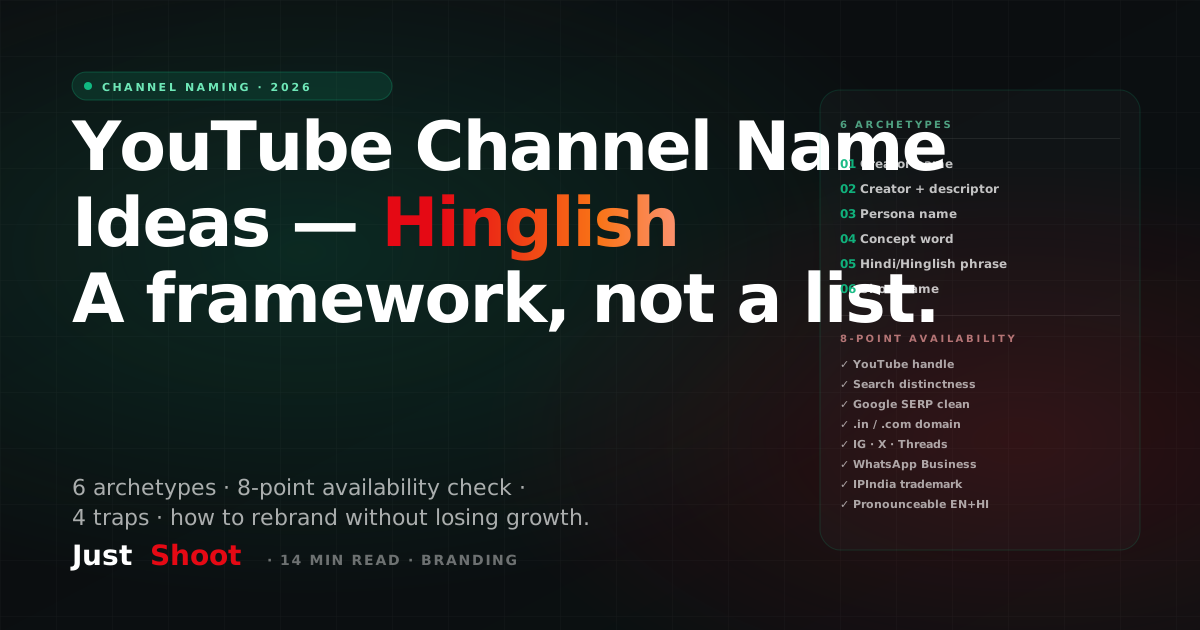
The 6 naming archetypes
Most working Indian creator channel names fall into one of six archetypes. Each archetype has a clear win condition and a clear failure mode; the picking decision is mostly about which one fits your niche and your long-term plan.
| Archetype | Example pattern | Win condition | Failure mode |
|---|---|---|---|
| 1. Creator name (full) | "Pranjal Kamra," "Dhruv Rathee," "CA Rachana Ranade" | You are the brand; long career horizon | Hard to scale beyond one host |
| 2. Creator name + descriptor | "Akshat Shrivastava," "Sandeep Maheshwari" | Personal brand + topical claim | Descriptor locks you to a niche |
| 3. Persona name | "CarryMinati," "Tanmay Bhat," "ThugesH" | Persona-driven content, strong voice | Persona-fatigue risk in long run |
| 4. Concept word | "Beerbiceps," "Labour Law Advisor," "Finance With Sharan" | Concept owns a topical slot | Generic concept words get crowded |
| 5. Hindi/Hinglish phrase | "Bhai Bhabhi," "Indian Hacker," "Pyar Mohabbat" | Hindi-anchored audience, cultural specificity | Devanagari mix can hurt search |
| 6. Show name (brand-style) | "The Deshbhakt," "The Ranveer Show," "Newslaundry" | Show format, multiple hosts possible | Requires marketing investment to build |
There is no universally best archetype. The question is which one fits your situation along three dimensions: your stage (is the channel new or established?), your niche (is it personality-led or topic-led?), and your long-term plan (do you want this to scale beyond you or stay yours?).
Stage matters
A brand-new channel with no audience and no existing recognition should usually pick archetype 1 (creator name) or archetype 3 (persona name). The reason is that the audience has no prior context — they cannot anchor on a concept word like "FinanceLab" because they do not know what the channel is about, and the concept word is competing with hundreds of similarly-generic concept channels in search. Your name gives the audience and the algorithm an unambiguous anchor.
An established channel with an existing audience can sometimes rebrand to archetype 4 (concept word) or 6 (show name) without losing momentum, because the existing audience carries the recognition. The new name then expands the brand surface beyond the creator.
Niche matters
Personality-led niches — commentary, vlog, comedy, finance personality, lifestyle — favour archetypes 1, 2, and 3. The audience is buying the host; the name should make that explicit.
Topic-led niches — explainer, education, news, tutorial, how-to — favour archetypes 4 and 6. The audience is buying the topic; the name should make the topical promise explicit.
Hindi/Hinglish-anchored niches — devotional, regional storytelling, cultural commentary, traditional cooking — favour archetype 5. The audience anchor is cultural; the name should match the language register the content lives in.
Long-term plan matters
If you want the channel to scale beyond you — eventually run with multiple hosts, produce shows you do not personally feature in, sell the channel one day — archetypes 4 and 6 are essential. Archetypes 1 and 2 are personally tied; the channel value is the creator's personal value, and you cannot meaningfully transfer it.
If the channel is intentionally personal and you want it to stay that way, archetypes 1 and 2 are correct. Trying to rebrand a personal channel to a show-name later usually destroys the brand equity the personal name built.
The availability and conflict checklist
Before committing to a name, run it through this 8-point check. Every one of these catches problems that have killed Indian creator names we know of.
- YouTube channel handle is available. Search the proposed handle (e.g., @yourname) on YouTube. If a channel with the handle already exists, even with zero subscribers, you cannot claim it. The handle is the URL-safe identifier that increasingly dominates how creators are linked across platforms.
- YouTube channel name is sufficiently distinct in search. Type the proposed name into YouTube search. If the first 3 results are existing channels with similar names, the search ambiguity will cost you discovery — pick something more distinct.
- Google search is clean for the first 10 results. Type the name into Google. If the first 10 results are about something else (a movie, a song, a defunct startup, a regional brand), the SEO ceiling for your channel is capped because you will never own the first SERP for your own name.
- Domain is available, at least the .in and ideally the .com. If you cannot register
yourname.inoryourname.com, the brand is structurally weakened — sponsors check this, sponsors who manage paid acquisition need a domain to point at, and the absence of a clean domain signals that the name was not strategically chosen. - Instagram, X (Twitter), and ideally Threads handles are available. Cross-platform handle consistency materially helps audience cross-discovery. If
@yournameis taken on Instagram and you need@yourname_official, the friction compounds. - WhatsApp Business name is not blocked. WhatsApp Business profile names go through a (loose) review; certain brand-style words and trademark conflicts get rejected. Test the name in a WhatsApp Business profile setup before locking.
- Trademark conflict check on the IP India website. A 5-minute search on the IPIndia public trademark database catches the obvious conflicts. This matters more than creators realise — a brand can issue a takedown request to YouTube if your channel name infringes their trademark, and YouTube enforces these.
- Pronunciation in English and Hindi. Read the name out loud in English. Then in Hindi. If the pronunciation is awkward in either, the WhatsApp-share friction is real — viewers introducing your channel to a friend orally will mangle the name, and you lose word-of-mouth conversions.
A name that passes all 8 checks is structurally clean. A name that fails 3 or more should usually be reworked rather than launched and rebranded later.
How to generate names — the working procedure
You do not need a 200-item bullet list. You need a procedure that produces 8–15 candidates that fit your archetype. The procedure below takes roughly 45 minutes.
Step 1 — Lock the archetype. Use the three dimensions above (stage, niche, long-term plan) to pick one of the six archetypes. Write the archetype at the top of a Notion page.
Step 2 — Brainstorm 25 raw candidates inside the archetype. Do not filter at this stage. If your archetype is "Creator name + descriptor," generate 25 combinations of your name with a topical descriptor (your name + finance, your name + tax, your name + analyst, etc.). If your archetype is "Concept word," generate 25 single-word and short-phrase concepts that capture the topical promise.
Step 3 — Filter to 8–12 by removing the obvious failures. Cross off candidates that are too generic ("YouTubeCreator," "Pulse"), that contain a competitor's name, that read awkwardly out loud, or that are clearly trademarked by a major brand. You should have 8–12 surviving candidates.
Step 4 — Run each survivor through the 8-point availability checklist. Most candidates fail at step 1 or 5 (handle availability) — this is unavoidable in 2026. Three to five candidates typically survive.
Step 5 — Read the surviving candidates aloud in front of a friend who is in your target audience. Their first reaction — pronunciation, recall after 30 seconds, what they think the channel is about — is the single most useful signal. The one they remember and pronounce correctly without prompting wins.
Step 6 — Sleep on it. The 24-hour decision rule matters here because channel names are functionally permanent. Changing a channel name later is expensive — you lose recognition across all surfaces that reference you by name, and the YouTube algorithm slightly degrades discovery for ~30 days after a rename while it re-learns the new identifier.
Four naming traps to avoid
Trap 1 — The hyper-descriptive 4-word name. "Indian Finance With Ashok Sachdev" reads as a description, not a brand. The 4-word names are also harder to display in YouTube Shorts overlays, in WhatsApp share previews, and in sponsor outreach subject lines. Sub-3-word names structurally outperform.
Trap 2 — The leetspeak/special-character name. "Kr00n4l TV," "FxN | INDIA," "Money$haan" — names with numerals replacing letters or special characters between words read as low-trust in 2026. They were a creative-style flag in 2014–18; in 2026 they correlate with smaller, lower-credibility channels and sponsors filter against them. Use clean alphabetic characters.
Trap 3 — The year in the name. "Tech 2026" — by January 2027 the name reads as stale. Channel names should be temporally neutral. Year-in-the-name is acceptable for one-shot project names or limited-run shows, but never for a long-run channel.
Trap 4 — The non-distinctive Hindi compound. "Bharat Today," "India Pulse," "Hindustan Now" — these names sound brand-substantial but they share roots with thousands of existing media properties (newspapers, news channels, blogs, government entities). Search discovery is awful, trademark conflict is high, and the audience cannot anchor on the channel because the name reads like a category descriptor. If you want a Hindi/Hinglish anchor (archetype 5), use a more specific cultural phrase — something with novelty, not category words that already mean something to everyone.
How the channel name interacts with the Tone Fingerprint
The channel name and the channel's voice should align — and they often do not, in ways the creator does not notice until the channel is 100 videos in. A channel called "The Calm Investor" should sound calm; a channel called "Pulse" should sound urgent; a channel called "Bhai Bhabhi" should sound conversational and culturally anchored. When the voice the audience hears does not match the name they see, the audience confusion shows up as inconsistent retention curves and slower subscriber conversion.
The Tone Fingerprint — the channel's measurable voice profile in vocabulary, rhythm, hooks, signature transitions — should be consistent with the name. If you are using JustShoot's onboarding flow, the Tone Fingerprint is captured from your existing reference videos, and we surface a flag if the captured voice register clashes with the proposed channel name. Channels that align name + voice + niche + audience compound much faster than channels where one of the four is off-axis. The framework for defining and locking the voice independently is in our tone-of-voice channel post.
A note on rebrands — when and how
About one in four creator channels we onboard at JustShoot are at the rebrand stage rather than the launch stage. The rebrand decision is hard because the cost is real (recognition loss, algorithmic discovery dip for ~30 days, sponsor outreach friction during transition) but staying with a wrong name is also costly (search discoverability cap, audience confusion, sponsorship rate compression).
The trigger for a rebrand is usually one of three signals: (a) the channel has out-grown the original niche and the name no longer describes the content, (b) the existing name keeps coming up in search-ambiguity issues that cost discovery, (c) the creator has reached the stage where the personal name needs to expand into a show or brand name to scale beyond solo content.
If you are rebranding, do it once and do it well: pick a clean name that passes all 8 availability checks, announce the rebrand in a dedicated video that explains the strategic reasoning, link the old channel handle as a forwarding alias if YouTube allows it, and budget for 30–45 days of slightly suppressed discovery while the algorithm re-learns the new identifier.
What this looks like inside the JustShoot onboarding
When a creator starts onboarding on JustShoot, the channel name is one of the inputs to the first agent (Topic Research). The agent uses the name to calibrate the niche assumption, the audience inference, and the search-discoverability strategy. A channel named for the creator gets a different topic-recommendation profile than a channel named for a topic — the agents treat the name as a signal of intent.
If you want the full 9-agent pipeline to run on your channel — Topic Research, Script Research, Fact Check, Legal Review, Script Writer, Storyboard, Thumbnail, SEO/Metadata, Distribution — the tiered pricing is Starter ₹499/month (500 credits, ~5 videos), Pro ₹699/month (1000 credits, ~10 videos), Studio ₹899/month (2000 credits, ~20 videos across up to 3 channels with separate Tone Fingerprints). Annual −20 %. 7-day free trial, no card required.
For the broader read on building the channel's strategic stack — language pick, voice definition, script structure, SEO metadata — the tone of voice framework, language decision, script template, and SEO checklist cover the rest of the channel-setup foundation in detail. The Indian Creator Weekly newsletter ships Friday with channel teardowns and trending angles — useful input for the ideation half of the channel-setup decision.
FAQ
Q: What is the best YouTube channel name format for Indian Hinglish creators in 2026? There is no single best format — the right pick depends on your stage (new vs established), your niche (personality-led vs topic-led), and your long-term plan (solo vs scaled). The six working archetypes are: full creator name, creator name + descriptor, persona name, concept word, Hindi/Hinglish phrase, or show name. New personality-led channels usually win with archetype 1 or 3; established topic-led channels with archetype 4 or 6. The framework above walks through the picking decision in 6 steps.
Q: Should my YouTube channel name be in Hindi, Hinglish, or English? The language of the name should match the language of your content and the SERP you want to compete in. Hinglish (romanized Latin script) competes in the same search index as English and is the safe default for most Indian creators. Pure Hindi (Devanagari) names compete in the Hindi search index, which has less competition but a smaller addressable audience. Pure English names work for global-diaspora niches. Mixed-script names (Devanagari + Latin) compete in neither index cleanly and structurally underperform. The same language pick logic as for video content applies — covered in detail in Hinglish vs Hindi vs English on YouTube.
Q: Can I change my YouTube channel name later if I pick wrong? Yes, but it is expensive. A channel rename loses recognition across all surfaces that reference you by name (Google search, AI search citations, WhatsApp share previews, sponsor outreach, newsletter mentions), and the YouTube algorithm slightly suppresses discovery for ~30 days while it re-learns the new identifier. The trigger to rebrand is usually one of: out-grown the niche, search ambiguity costing discovery, or needing to scale beyond a personal name into a show/brand. If you rebrand, do it once, announce it explicitly, and budget for 30–45 days of suppressed growth in transition.
Q: How do I check if a YouTube channel name is available in 2026? Run the 8-point availability checklist: YouTube handle, YouTube channel-name search distinctness, first 10 Google results clean, .in and .com domain availability, Instagram + X + Threads handles, WhatsApp Business name accepted, IPIndia trademark check, pronunciation in English and Hindi. Most candidate names fail at the handle-availability step (1 or 5) in 2026 because the easy names are taken. A name that passes all 8 is structurally clean.
Q: Should I include the word "India" in my YouTube channel name? Usually no, unless the channel is explicitly geo-positioned for the Indian audience inside a broader category that needs the distinction (e.g., a global comparison channel where the India focus is the differentiator). "X India" names read as overly descriptive and add to the 4-word name trap covered above. The distinction is to use "India" when the geo-positioning is the actual brand promise, and to avoid it when the geo-positioning is implicit from the language and the creator identity.
Ashok Sachdev is the founder of JustShoot, an AI Content OS for Indian YouTube creators. The 9-agent pipeline starts with Topic Research and ends with publish-ready Shorts and SEO metadata, all in the channel's Tone Fingerprint. Pricing: Starter ₹499/month, Pro ₹699/month, Studio ₹899/month. Annual −20%. 7-day free trial, no card required.
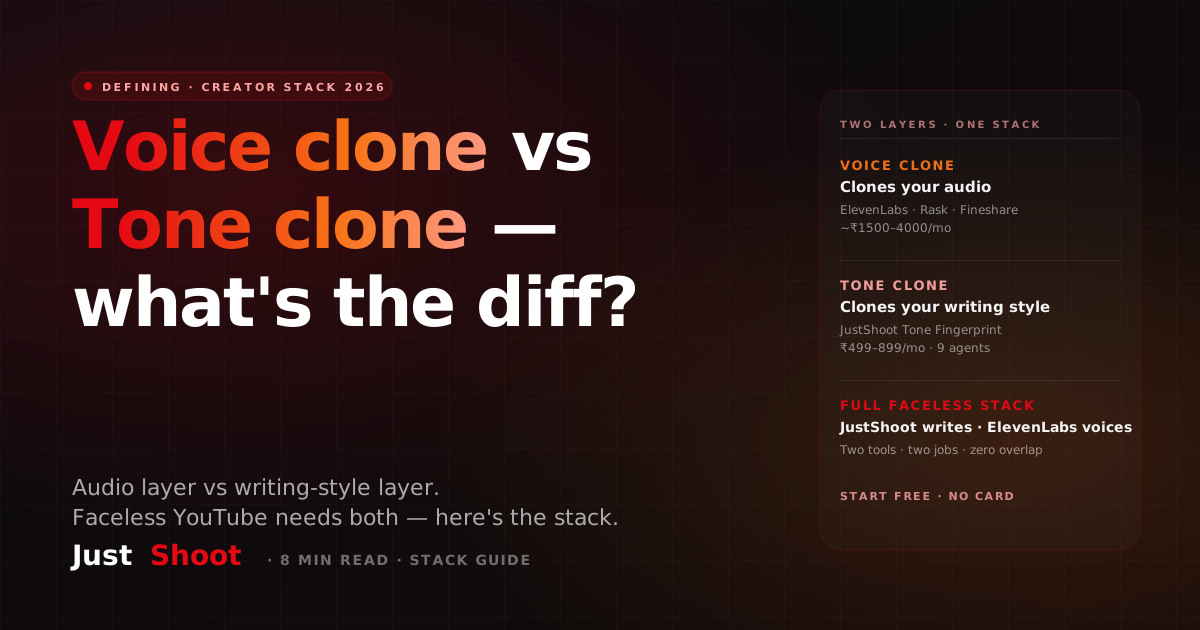
Voice Clone vs Tone Clone for YouTube — What's the Difference (2026)
Voice clone (ElevenLabs, Rask) clones your audio. Tone clone (JustShoot) clones your writing style. Two different layers, both needed for faceless YouTube — here's the full stack.
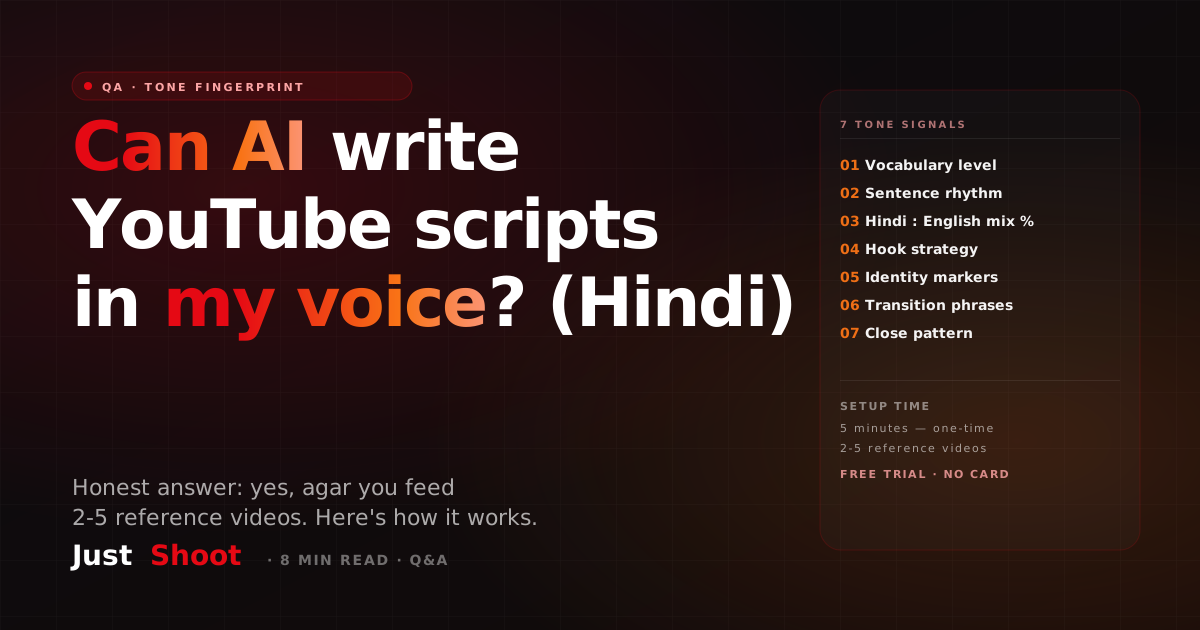
Can AI Write YouTube Scripts in My Voice (Hindi)? — Honest 2026 Answer
Yes — AI can write YouTube scripts in your Hindi voice, but only with the right mechanism. Why ChatGPT fails, what Tone Fingerprint does differently, and a live example.