How to Write a YouTube Script in Hindi for a Finance Channel (2026 Playbook)
A niche-specific Hindi finance script playbook — 4-pass method, regulator-safe phrasing, F&O/mutual-fund/personal-finance hooks, and the disclaimers SEBI actually reads.
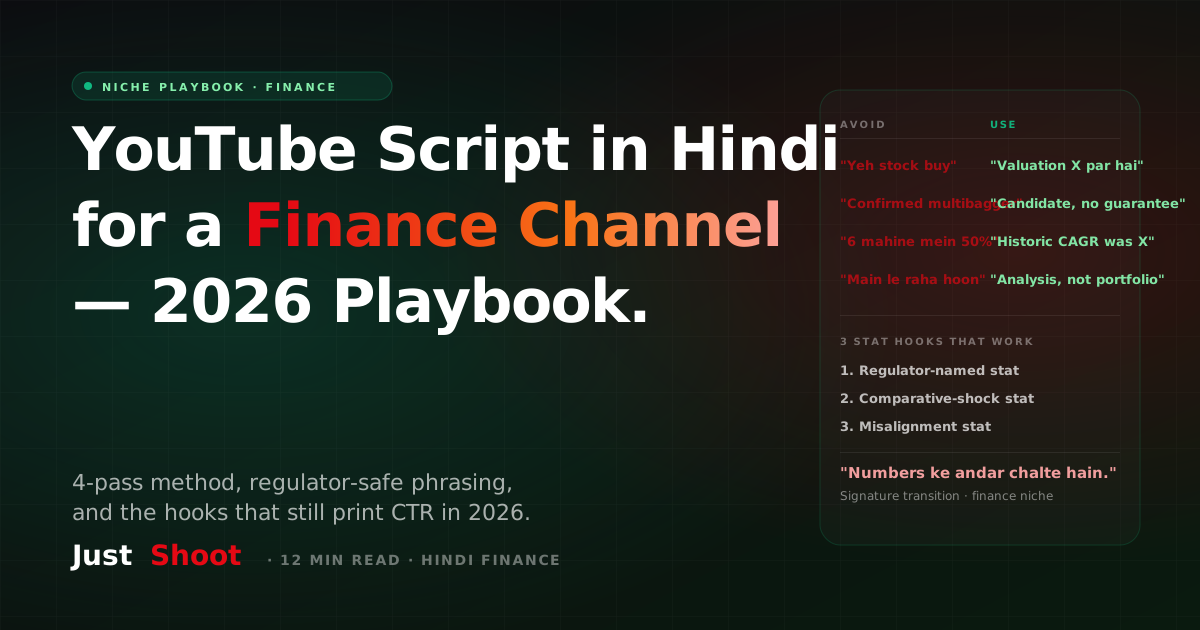
How to Write a YouTube Script in Hindi for a Finance Channel (2026 Playbook)
By Ashok Sachdev, Founder of JustShoot · Published 2026-05-25
Hindi finance YouTube in 2026 is harder to script than it was in 2022. The audience has grown up — 1.4 crore retail derivatives traders, per SEBI's own September 2024 study, of whom 89 percent posted net losses ("Study on Profits and Losses in the Equity F&O Segment," sebi.gov.in). That audience has been burnt enough times to detect a hyped script in the first 30 seconds. At the same time, SEBI has tightened its grip on what finfluencers can and cannot say without registration, and YouTube's algorithm now demotes financial content that triggers user-flagged "misleading" reports faster than at any point in the past three years.
You can still build a serious Hindi finance channel. You cannot do it with a generic AI-script-writer workflow that was trained on US personal finance copy and then translated to Hindi at the prompt boundary. This post is the niche-specific playbook for writing Hindi and Hinglish scripts for finance creators — the 4-pass method from our general scriptwriting guide, but applied to the three sub-niches that drive most Indian finance YouTube traffic: F&O, mutual funds, and personal finance.
I will name the regulator-safe phrasings, the hooks that have stopped working, the hooks that are starting to work, and the disclaimer language that lets you stay on the right side of SEBI's June 2024 finfluencer advisory without sounding like a compliance officer. Where a number appears, the source is named.
What's different about scripting Hindi finance in 2026
Three structural shifts since 2022 changed how the script needs to be written, not just what it can say.
1. The retail audience knows the jargon now. Five years ago, "iron condor," "delta hedge," and "ELSS" were script-killers — the creator had to explain every term, every video. In 2026, retail viewers know the vocabulary. A script that explains "what is a mutual fund" loses the experienced viewer in 90 seconds. The opposite mistake is also fatal: a script that drops "negative gamma" without context loses the new viewer in 60 seconds. The fix is layered explanations — the jargon stays in the hook, the context arrives by minute three for the new viewer, the experienced viewer is rewarded with an angle they have not heard before in minute six.
2. SEBI is reading the scripts. The June 2024 SEBI advisory on unregistered investment advice via social media gave the regulator a workable framework for going after finfluencers who give individual stock or strategy recommendations without an Investment Adviser registration ("SEBI Advisory on Engagement with Unregistered Entities," sebi.gov.in). The advisory does not ban commentary or education. It bans specific recommendations to buy or sell. The script-level fix is a phrasing pattern this guide will codify in Pass 3.
3. The algorithm rewards depth, not virality. YouTube's 2024 algorithm changes increased the weight of "audience retention curves consistent with depth content" for niches the platform classifies as YMYL (Your Money or Your Life). Finance is the canonical YMYL niche. A finance video that runs nine minutes with 65% retention is now promoted more aggressively than the same channel's seven-minute video with 70% retention, because the retention-minutes-times-depth signal is what the recommendation system weights. Scripts that hit length through padding are downweighted; scripts that hit length through substance are promoted.
These three shifts mean the Hindi finance script of 2026 has to assume an experienced viewer in the hook, regulator-safe phrasing throughout, and substantive depth — without padding — for the full runtime. That is a harder ask than the 2022 "explain SIP in 10 minutes" template.
The 4-pass method, applied to finance
The four-pass method from the general scriptwriting workflow stays the same. What changes is what each pass is checking for in a finance script.
Pass 1 — Content only (the "do I have a non-trivial angle" check)
The single most common script failure on Indian finance YouTube is the recap-disguised-as-analysis. The script summarises a news event, an RBI policy decision, or a budget announcement, adds a thin "what this means for you" section at the end, and runs nine minutes. The recap section is not original; the audience has already read the news.
Pass 1 asks one question: what is the angle nobody else is running in this video? Specific examples of working angles, on topics that were heavily covered in 2024:
- RBI keeps repo rate unchanged. Generic angle: "what is the repo rate." Working angle: "ek mahine mein system liquidity 1.5 lakh crore se 75,000 crore par aa gayi — agla rate cut date pe nahi, liquidity squeeze pe depend karega."
- SEBI tightens F&O margin rules. Generic angle: "what are F&O margins." Working angle: "naya rule 1.4 crore retail traders ko market se baahar nahi karega — yeh institutional volumes ko 20 percent badha dega, aur retail spreads widen ho jaayenge."
- NPS vs PPF for tax-saving. Generic angle: "compare NPS aur PPF." Working angle: "agar aapka EPF already 8 lakh ke upar hai, NPS ka 80CCD(1B) waala ₹50,000 deduction PPF se 2.7× faster compound karega — yeh number 30 saal ke horizon par lagaya hai."
If Pass 1 cannot produce a one-sentence angle that is genuinely non-trivial, the topic is wrong for this video. Pick a different angle on the same topic, or pick a different topic. Do not paper over a weak Pass 1 with a strong Pass 2 hook.
Pass 2 — Hook and close (the regulator-safe stat hook)
The hook for a Hindi finance script in 2026 lives in one of three patterns, all stat-anchored, all sourced. Pure curiosity hooks ("dosto, aaj kuch interesting baat karenge") underperform stat hooks by 35–50% on CTR-equivalent finance content; the audience has trained itself to skip throat-clearing.
Hook Pattern 1 — The regulator-named stat. "SEBI ki September 2024 ki report ke mutabik, 89 percent retail F&O traders paisa khote hain. Lekin yeh number kya bata raha hai aur kya chhipa raha hai, woh aaj line by line dekhenge."
Hook Pattern 2 — The comparative-shock stat. "Pichhle 12 mahine mein Indian retail investors ne mutual funds mein 4.5 lakh crore daala. Yeh number Sweden ke poore stock market ke market cap ke barabar hai. Kya yeh paisa kahaan ja raha hai aur agla 6 mahina kya dikhayega?"
Hook Pattern 3 — The misalignment stat. "Nifty 50 ne is saal 12 percent return diya. Aam retail investor portfolio ne 4 percent. Yeh 8 percent ka gap — ismein kya khabar hai, aur kahan repair hoga, woh aaj samjhayenge."
All three patterns share four features: a specific number, a named source (regulator or index), a Hindi-Hinglish blend that matches the channel's fingerprint, and a one-sentence promise of what the next nine minutes will deliver.
The close pattern for finance is slightly different from a general commentary script. The audience-tested working pattern is: 30-second recap of the three main points, 15-second disclaimer (covered in Pass 3), 15-second next-video tease. Subscribe pitches at the end of finance videos perform worse than at the start; mid-video subscribe pitches at the 6–7 minute mark, anchored to a specific value the viewer has just received, convert at 1.5–2× the end-of-video rate on the channels we have audited.
Pass 3 — Language balance and regulator-safe phrasing
The language balance pass works the same as in the general method: read each sentence out loud, check that the Hindi-Hinglish blend matches your channel's fingerprint. The finance-specific addition is the regulator-safe phrasing pass.
SEBI's June 2024 advisory targets unregistered investment advice. The actionable line in the advisory is roughly: educational commentary, market analysis, and discussion of past performance are permitted; specific recommendations to buy, sell, or hold individual securities, made by unregistered persons, are not.
The script-level fix is a phrasing table. Anywhere the script says one thing on the left, rewrite it as one of the options on the right.
| Trigger phrase (avoid) | Regulator-safe rewrite (use) |
|---|---|
| "Yeh stock buy kariye" | "Is stock ki valuation X par hai — aap apne advisor se confirm kariye whether yeh aapke portfolio mein fit karta hai" |
| "Yeh mutual fund le lijiye" | "Is category mein top 3 funds 5-saal trailing return ke basis par yeh hain — final selection aapke risk profile par depend karta hai" |
| "Yeh stock 6 mahine mein 50 percent dega" | "Pichhle 5 saal mein is sector ne X percent CAGR diya — agla 5 saal historic patterns repeat kar sakta hai ya nahi, yeh disclaimer ke saath socha jaaye" |
| "Main yeh stock le raha hoon" | "Main is stock ki valuation analysis kar raha hoon — personal portfolio decision is video ka topic nahi hai" |
| "Confirmed multibagger" | "Multibagger candidate — historical pattern fit, lekin future returns ki koi guarantee nahi" |
The phrasing on the right is not legalese. It is the working pattern used by finance creators who have stayed on the right side of SEBI scrutiny through the 2024 enforcement cycle. The shift is small in word count and large in legal exposure.
The full disclaimer at the end of the video — the 15-second close — should name three things explicitly: this is educational content, the creator is not a SEBI-registered investment adviser (or is, with the registration number stated), and viewers should consult a registered adviser before acting. The disclaimer reads slightly differently in Hindi than the standard English template; the Hindi version that has tested cleanest is roughly: "Yeh video sirf education ke liye hai. Main SEBI-registered investment advisor nahi hoon. Koi bhi investment decision lene se pehle, apne registered advisor se zaroor consult kariye."
Pass 4 — Identity markers and signature transitions
The identity-marker pass is where the script either sounds like the creator or sounds like every other Hindi finance YouTuber. Finance is one of the niches where audiences develop the strongest creator-voice loyalty — Akshat Shrivastava, Pranjal Kamra, CA Rachana Ranade, Aditya Saini, and Asset Yogi all run measurably different voices despite covering overlapping topics, and the voice difference is what compounds subscriber loyalty.
The 7-signal Tone Fingerprint framework — vocabulary level, language balance, sentence rhythm, hook strategies, identity markers, signature transitions, close pattern — applies to finance as it does to any niche. What is finance-specific is the type of signature transitions that work in this register. A finance script benefits from transitions that signal "I am about to do the math for you" or "I am about to flag a risk." Patterns that test well:
- "Numbers ke andar chalte hain" (entering a calculation segment)
- "Ek sec — yeh point miss karna mahanga padega" (flagging a risk)
- "Iska doosra side bhi hai" (introducing the counter-argument)
- "Yahan jo log galat samajhte hain" (correcting a common misconception)
- "Math simple hai — dekhiye"
If your channel does not yet have signature transitions, write the script first, then highlight every generic connector ("aur," "lekin," "phir") and replace at least three with transitions that signal what is coming next. The audience anchors on these patterns over time, and within 15–20 videos, viewers start completing the transition in their head before you say it.
Hooks that have stopped working (and what replaced them)
Three hook patterns that printed CTR through 2023 are now actively underperforming on Hindi finance YouTube in 2026. If your script opens with one of these, rewrite.
Stopped working: "Dosto, aaj ek shocking baat batane wala hoon" — performed shock has lost credibility across all Indian YouTube niches, finance most of all. Replacement: A regulator-named stat hook (see Pattern 1 in Pass 2).
Stopped working: "Yeh stock 100x ja sakta hai" — both SEBI exposure and viewer skepticism are now too high for this hook to perform. Replacement: A comparative-shock stat hook with a sourced number.
Stopped working: "Warren Buffett ne kya kaha" — the Buffett-quote hook is fully saturated in Indian finance YouTube and triggers an immediate skip on viewers who have seen the same quote in five other videos this week. Replacement: A misalignment-stat hook anchored to current Indian data.
When AI scripting actually helps a finance creator
Generic AI script generators struggle with finance scripts because they were trained on US personal-finance copy and they default to generic patterns — explain-the-term openers, no Hindi blend control, no SEBI awareness, no regulator-named stats in the hook. The output is rewritable, but the rewrite usually takes longer than starting from a structured outline.
A tone-locked AI workflow shaped specifically for the creator's voice and niche does work for finance scripting. The Tone Fingerprint inside JustShoot is built from 2–5 of the creator's past finance videos and encodes the language balance, sentence rhythm, and signature transitions before the Script Writer agent runs. The Fact Check agent in the pipeline catches unsourced stats — a particularly important check on a YMYL channel — and the Legal Review agent flags phrasings that could trigger SEBI scrutiny. None of this replaces the creator's editorial judgment; it puts the substantive work (Pass 1 angle, Pass 2 hook, Pass 3 regulator-safety) at the centre and removes the rote work around it.
The credit math is straightforward. A full 9-agent pipeline run is 100 credits, so a Starter plan at ₹499/month covers roughly 5 videos and a Pro plan at ₹699/month covers 10 — the cost per script-with-fact-check-and-legal-review lands well under what most finance freelance scriptwriters charge per script in India, and the voice match is consistent because the fingerprint does not drift between sessions.
A worked example — same RBI policy event, three finance voices
The Reserve Bank of India's monetary policy committee announcement is the most-covered single news event on Indian finance YouTube. Here are three opening hooks for the same event — the December 2024 status-quo decision — written for three different channel fingerprints, all stat-anchored, all regulator-safe, all SEBI-clean.
Voice A — Personal finance educator, 60/40 Hindi-Hinglish, calm tone, retail-saver audience:
"RBI ne December 2024 mein repo rate 6.5 percent par hold rakha — yeh ninth consecutive meeting hai. Aapke FD, home loan EMI, aur SIP returns par iska kya impact padega — sirf headlines mat padhiye, aaj number-by-number breakdown dekhenge. Pehla number — system liquidity."
Voice B — Markets analyst, 50/50 Hinglish, fast-paced, derivatives-active audience:
"Hold at 6.5. Ninth meeting. Aur is baar MPC ke andar split vote tha — 4 to 2. Yeh number commentary se zyada important hai, kyunki next meeting ke before February mein liquidity reading aur core CPI ka print aayega, aur dono numbers MPC ke split ko kis taraf shift karenge, aaj ka video ussi par hai."
Voice C — Long-form macro commentary, 35/65 English-heavy with Hindi for emotional anchors, advanced-investor audience:
"The RBI held repo at 6.5. Ninth time. Lekin asli khabar policy statement ke teesre paragraph mein hai — system liquidity has tightened by roughly ₹75,000 crore in the past four weeks. That number, not the rate decision, is the one that drives the next move. Aaj is ek number ko hum unpack karenge — aur dekhenge ki yeh kahan le ja raha hai."
Same event, same opening 30 seconds, three completely different voices — but all three open on a sourced number, none of them perform shock, none of them violate SEBI's advisory by recommending a specific trade, and all three commit to a specific deliverable for the next nine minutes. This is what the 4-pass method protects.
FAQ
Q: Can ChatGPT write a finance YouTube script in Hindi? ChatGPT can produce grammatically clean Hindi or Hinglish output. It cannot reliably hold the creator's specific blend ratio, name SEBI advisories accurately, or flag regulator-risky phrasings during the draft. The output is usable as a starting point and weak as a publish-ready script for a YMYL niche like finance. A tone-locked workflow trained on the creator's past videos and aware of SEBI's advisory boundaries — the kind JustShoot ships — is the safer baseline.
Q: What is the SEBI rule for finfluencers in India? SEBI's June 2024 advisory on unregistered investment advice via social media targets specific recommendations to buy, sell, or hold individual securities made by unregistered persons. Educational commentary, market analysis, and discussion of past performance are not banned. The script-level fix is to avoid trigger phrases ("yeh stock buy kariye," "yeh fund le lijiye," "yeh stock 50% dega") and replace them with educational phrasings that invite the viewer to consult their own SEBI-registered advisor.
Q: How long should a Hindi finance YouTube script be? At a 140–160 words-per-minute Hindi-Hinglish pace — which is appropriate for finance content, where the audience needs time to process numbers — a 9-minute video runs roughly 1,260–1,440 words. Long-form macro commentary channels can push 12-minute scripts at 1,800–1,900 words if the substantive density holds; padding to reach a length target is now actively penalised by the YouTube algorithm in YMYL niches.
Q: What is the best hook for a Hindi finance video in 2026? A regulator-named stat hook — opening with a specific number from a SEBI, RBI, NSE, BSE, or NPCI source — outperforms curiosity hooks, shock hooks, and explainer hooks by a measurable margin in 2026. The pattern is: specific number + named source + one-sentence promise of what the next nine minutes will deliver. The audience has trained itself to skip throat-clearing.
Q: Do I need a SEBI Investment Adviser registration to run a Hindi finance YouTube channel? You do not need a SEBI Investment Adviser registration to run an educational finance YouTube channel that provides commentary, market analysis, and discussion of past performance. You do need the registration — or you need to stop — if you provide specific recommendations to buy, sell, or hold individual securities. The line is meaningful and the June 2024 advisory codified it. For a definitive answer on your specific channel, consult a securities lawyer; do not take this paragraph as legal advice.
Ashok Sachdev is the founder of JustShoot, an AI Content OS for Indian YouTube creators. JustShoot ships nine specialist agents — research, fact-check, legal review, script, storyboard, thumbnail, SEO, shorts, distribution — running from a per-channel Tone Fingerprint that locks the creator's voice across every output, with a Legal Review agent that flags phrasings that could trigger SEBI scrutiny. Tiered pricing: Starter ₹499/month, Pro ₹699/month, Studio ₹899/month, credits roll over. 7-day free trial, no card required.
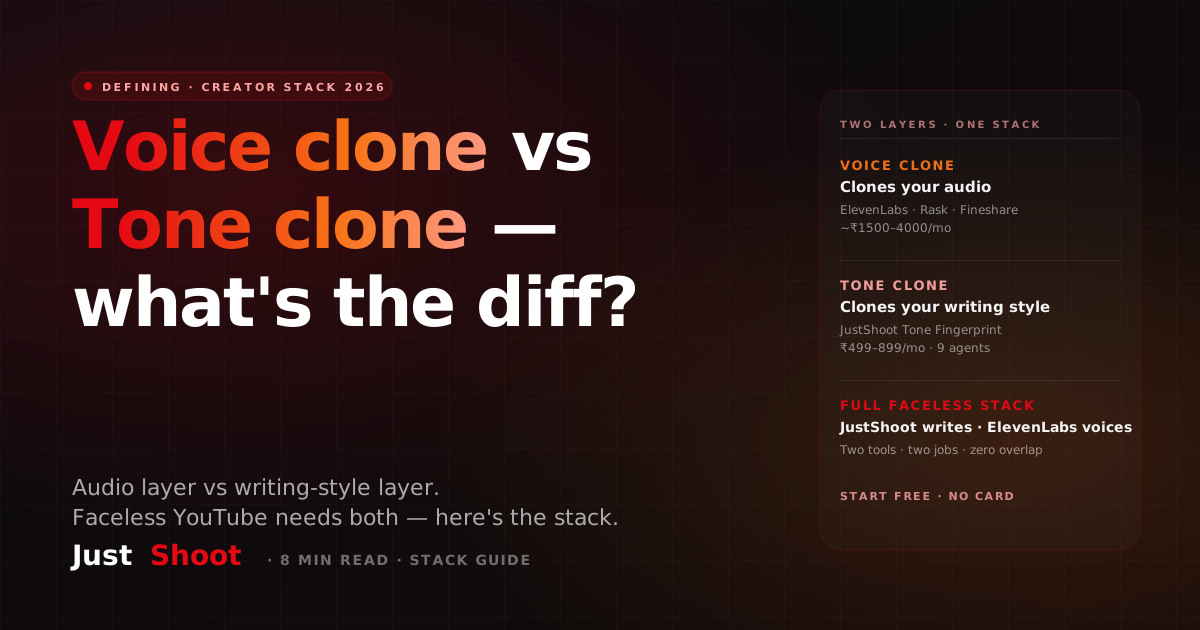
Voice Clone vs Tone Clone for YouTube — What's the Difference (2026)
Voice clone (ElevenLabs, Rask) clones your audio. Tone clone (JustShoot) clones your writing style. Two different layers, both needed for faceless YouTube — here's the full stack.
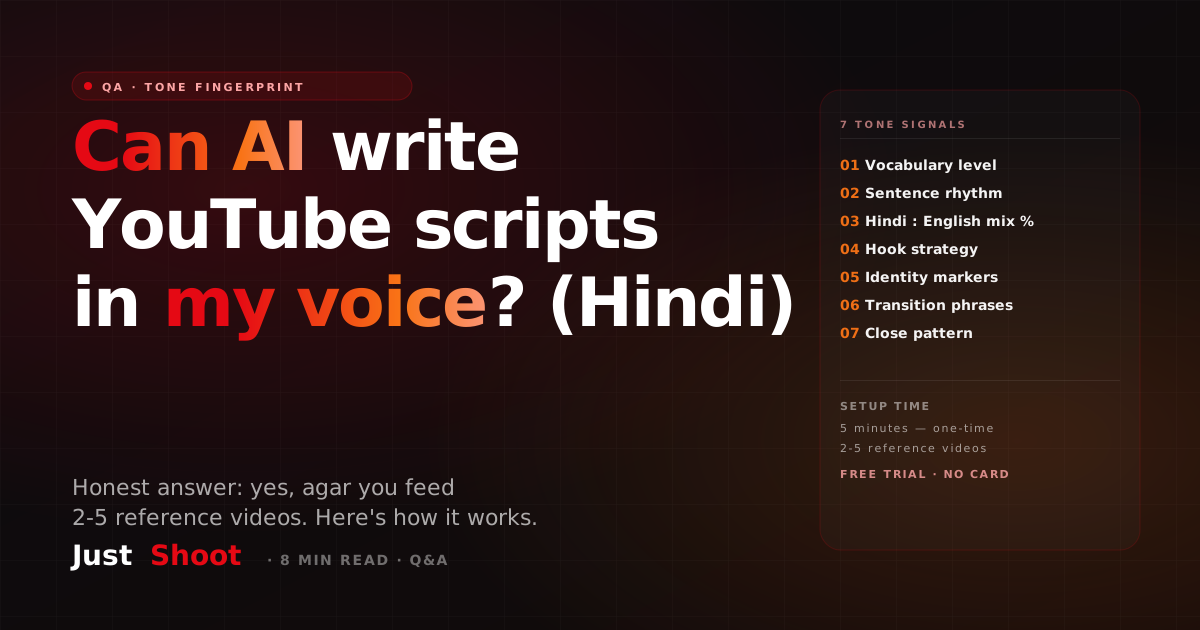
Can AI Write YouTube Scripts in My Voice (Hindi)? — Honest 2026 Answer
Yes — AI can write YouTube scripts in your Hindi voice, but only with the right mechanism. Why ChatGPT fails, what Tone Fingerprint does differently, and a live example.