YouTube Script Writer Hindi: How to Write in Your Own Voice (Hinglish Guide)
A working method for writing YouTube scripts in your own voice in Hindi and Hinglish — no press-release AI copy, no awkward translations, no flat hooks.
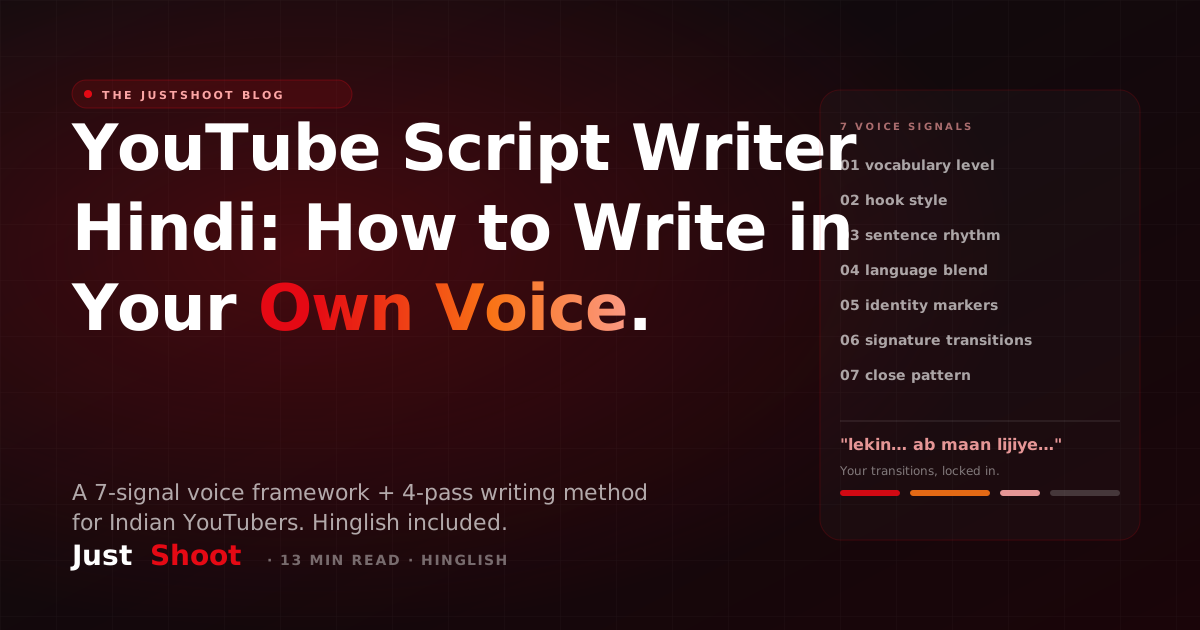
YouTube Script Writer Hindi: How to Write a Script in Your Own Voice (Hinglish Edition)
By Ashok Sachdev, Founder of JustShoot · Published 2026-05-23
If you have ever asked ChatGPT to write a YouTube script in Hindi or Hinglish, you already know the problem. The script comes back grammatically clean and emotionally flat. The hook reads like a Republic Day speech. Your Hindi half sounds like it was translated from English by a worried bureaucrat. You spend 40 minutes rewriting, you record it, and the comments still say "AI-generated lag raha hai."
This guide is the script-writing workflow I have shipped to Indian YouTubers in finance, commentary, education, and lifestyle niches over the past year. The output is a script that opens on your hook, sounds like your channel on frame one, switches between English and Hindi in your exact blend ratio, and tells a clean enough story that the average viewer does not need to be a literature student to follow it.
You can run the workflow by hand, or you can use JustShoot to automate it. The method matters more than the tool. Here it is.
What "your voice" actually means (and what AI keeps missing)
When a creator says "this doesn't sound like me," they mean one of seven specific things — most of them measurable, none of them subjective once you write them down.
| Voice signal | What to measure | Typical creator example |
|---|---|---|
| Vocabulary level | Average word complexity. Are you "ek extremely interesting development" or "ek dilchasp baat"? | News-explainer creators sit at moderate; finance creators drift advanced. |
| Language balance | The exact English-to-Hindi ratio per sentence. | Dhruv Rathee runs roughly 70 percent Hindi / 30 percent English code-switched. Akshat Shrivastava sits closer to 50/50. |
| Sentence rhythm | Short-punchy or long-flowing. Average sentence length in words. | Tanmay Bhat: short bursts. Mohak Mangal: long, recursive sentences. |
| Hook strategy | The opening pattern you use most. "Question hook," "stat hook," "frame-the-stakes hook," "story hook." | Beerbiceps opens on a personal frame. Soch by Mohak opens on a stat. |
| Identity markers | Phrases that only this creator uses. | "Bhai, ek second"; "yaar dekho"; "asal mein"; "ab maan lijiye." |
| Signature transitions | How you move between ideas. | "Lekin", "iska jawab hai", "ab dekho", "khaas karke". |
| Close pattern | How you wrap and CTA. | Some channels end with a question, some with a call-back to the opening, some with a hard subscribe pitch. |
When ChatGPT writes a YouTube script in Hindi, it nails maybe two of these — usually vocabulary level and a generic hook — and gets the other five wrong. The viewer cannot articulate that the rhythm is wrong, but they feel it inside 30 seconds and they swipe.
The fix is to write your seven signals down once, then make every script obey them.
The 4-step method (the part you came for)
Step 1: Build your Tone Fingerprint from your last 5 videos
Pick five recent uploads — the ones that performed well and felt like you. Pull the transcripts. You can use yt-to-text.com for free, or YouTube's auto-captions exported as .srt, or, if you are using JustShoot, the Tone Fingerprint module does this for you and runs the analysis automatically.
For each transcript, write down:
- The opening 30 seconds verbatim. This is your hook library. Look at the five hooks side by side — one pattern dominates.
- Every sentence-starting transition word for the first three minutes. Count them. "Lekin" 6 times, "matlab" 4 times, "ab" 3 times — that's a signature, not a coincidence.
- The first 200 words of each, marked for language. Highlight English words in one colour and Hindi in another. Count. If three of five videos run 65 percent Hindi, that is your channel's ratio. Lock it.
- The last 30 seconds. Your close pattern. Subscribe pitch first? Cliffhanger first? Recap first? Pick the one that shows up most.
- Five phrases that appear in at least three of the five videos and that you would not expect a random Hindi YouTuber to use. Those are your identity markers.
You now have a one-page fingerprint. Tape it to your monitor.
Step 2: Outline before you write — and outline in the same language ratio as the script
This is where most AI tools fail and most creators rush past. If you outline in English and then translate to Hinglish, you will write English-shaped sentences with Hindi words pasted on top. Outline in the exact blend you want to ship.
A working outline for a 10-minute Hinglish video looks like this:
[Hook — 0:00–0:30]  English-heavy stat or frame
[Setup — 0:30–1:30] Switch to Hindi-heavy storytelling
[Problem — 1:30–4:00] 60/40 Hindi/English, 3 specific examples
[Turn — 4:00–5:30]   "Lekin" pivot — what most people miss
[Mechanism — 5:30–8:00] Most technical section, English terms allowed
[Implication — 8:00–9:00] Back to Hindi-heavy, emotional
[Close — 9:00–10:00] Recap + cliffhanger + subscribe
The structure is borrowed from how the best commentary channels actually move. The point is that your blend ratio is not constant across the video — it shifts with emotional register. English clusters around stats and jargon. Hindi clusters around story and emotion. The Tone Fingerprint captures both the average ratio and where the shifts happen.
Step 3: Draft with one constraint per pass — never all at once
Treat the script as four passes, not one.
Pass 1 — Content only. Get the substance down. Write in whichever language flows. Do not worry about hooks, transitions, or rhythm. This is the "do I actually have something to say" pass. If you have nothing to say, stop here and pick a different topic.
Pass 2 — Hook and close. Rewrite the opening 30 seconds against your hook library from Step 1. Rewrite the closing 30 seconds against your close pattern. Everything in the middle stays untouched.
Pass 3 — Language balance. Go sentence by sentence and adjust the English-Hindi blend to match your ratio. This is where most "AI script" giveaways live — a translated script has English-shaped Hindi sentences. Read each sentence out loud. If you would not say it that way on camera, rewrite it.
Pass 4 — Identity markers and transitions. Inject your signature transitions ("lekin," "ab maan lijiye," "iska jawab hai") at the points where you wrote vague connectors ("and then," "so," "but"). Add at least two identity markers in the first three minutes — viewers anchor on them.
Four passes sound slow. With your fingerprint on the monitor, each pass takes 10–15 minutes. The total is shorter than one chaotic draft that you rewrite five times.
Step 4: Read it out loud, with a timer
This is the step nobody can replace and nobody on YouTube does. Read the script out loud at your natural pace. Time it. If you write 1,800 words and read 9 minutes, your pace is around 200 wpm — that is fast even for commentary. If your channel is education or finance, target 140–160 wpm. If you read for 12 minutes and the video is meant to be 10, cut 20 percent — the cut is almost always in the middle of paragraphs, never at the ends.
Mark anywhere your tongue stumbles. That is a sentence that does not fit your rhythm, no matter how clever it reads. Rewrite or drop.
A working example — same topic, three voices
Topic: "Why India's UPI volume just crossed 18 billion transactions in a month." The underlying claim is sourced from NPCI's monthly product statistics, which reported 18.31 billion UPI transactions in October 2024 (NPCI, "UPI Product Statistics," npci.org.in). Here are three opening hooks for three different creator voices, same fact:
Voice A — News-explainer, Hindi-heavy (think Soch by Mohak Mangal):
"Ek mahine mein attharah arab transactions. Ye number kya hai? Ye number hai UPI ka — October 2024 mein. Aur isse zyada interesting fact ye hai ki ye sirf India mein hua hai. Lekin sawaal ye nahi hai ki kitne ho rahe hain. Sawaal ye hai ki ek country jiska per capita income $2,500 hai, woh duniya ka sabse bada real-time payments system kaise chala rahi hai."
Voice B — Finance creator, 50/50 Hinglish (think Akshat Shrivastava):
"18 billion transactions in October. Ek mahine mein. Ye Visa aur Mastercard combined ke do-thirds hai. Aur agar aap finance background se hain, toh aap jaante hain that this number doesn't just measure payments. It measures something else — savings behaviour, credit appetite, even tax compliance. Ab maan lijiye aap ek policymaker hain. Aapke paas ye data hai. Aap kya karenge?"
Voice C — Commentary, English-heavy with sharp Hindi inflections (think Dhruv Rathee in his finance episodes):
"Look at this number. 18.31 billion. That is the number of UPI transactions in October 2024 alone, according to NPCI. Aur agar aap soch rahe hain, 'okay, big number, so what' — ek second rukiye. Compare this to the United States, where the equivalent real-time payments system, FedNow, processed under one percent of this in the same month. Lekin yahaan asli baat shuru hoti hai."
Same fact, same opening 30 seconds, three completely different voices. AI tools that write "in Hindi" produce something closer to Voice A every time, regardless of which channel you actually run. The Tone Fingerprint is what makes the choice automatic instead of manual.
Three statistics worth quoting (and where they come from)
- UPI processed 18.31 billion transactions in October 2024. Source: NPCI Product Statistics, "UPI" page on npci.org.in — published monthly.
- India has 467 million YouTube users — the largest YouTube audience in any country. Source: Statista, "Countries with the largest YouTube audiences as of February 2024," statista.com. This is a rolling estimate; check the current figure before quoting.
- YouTube long-form retention drops fastest in the first 30 seconds — the window that decides whether a video earns its full ad payout. Source: YouTube Creator Insider, "Audience retention basics" (support.google.com/youtube). Specific percentages vary by niche, so quote the principle, not a single number.
If a stat does not survive Step 2 of fact-checking, drop it. A blog or a script that cites a number you cannot back is worse than one that does not cite numbers at all.
How JustShoot automates this method
Running the 4-step method by hand for one video takes around two hours after you have built your fingerprint, and around five hours the first time you build the fingerprint from scratch. Most weekend creators do it once, ship one video, and never do it again — the next video drifts back to ChatGPT-flavoured copy.
JustShoot bakes the method into a pipeline. The Tone Fingerprint is built once from 2 to 5 reference videos and versioned as your style evolves. The Script Writer agent reads the fingerprint as system context, so every script generation starts from your hook patterns, language ratio, and signature transitions instead of a default neutral voice. Eight other agents — topic research, fact-check, legal review, storyboard, thumbnail, SEO, shorts, distribution — run from the same fingerprint, so the entire package sounds like one creator, not nine.
Pricing is tiered — Starter at ₹499/month for 5 videos, Pro at ₹699/month for 10, Studio at ₹899/month for 20 — credit-based, with unused credits rolling over. There is a 7-day free trial with no card. Compared to the ₹15,000+ per video a serious YouTuber pays for a researcher, scriptwriter, thumbnail designer, and SEO freelancer separately, the math is straightforward.
Whether you use the tool or run the method by hand, the order matters: fingerprint first, outline in the blend, draft in passes, read out loud. Skip a step and the script reverts to AI-flat.
The honest part — when this method does not help
Three situations where the workflow above will not save you:
- You do not have a strong voice yet. If your first ten videos all sound different from each other, you do not have a fingerprint to capture. Ship 15 more videos, then build the fingerprint. The method amplifies what is already there; it does not invent a voice.
- You are pivoting niches. A finance creator moving to lifestyle needs a new fingerprint, not the old one. Old transcripts will pull the new content back toward the old register.
- The topic is wrong for your voice. If a topic genuinely does not fit your channel — say, a serious geopolitical brief for a roast channel — no amount of voice-matching will save it. The hook will be wrong because the frame is wrong.
Voice is a multiplier. It only works when there is something underneath to multiply.
FAQ
Q: What is the best YouTube script writer for Hindi creators? The best script writer is the one trained on your own voice. Generic AI tools like ChatGPT produce neutral Hindi that does not match any specific creator. Tools like JustShoot build a Tone Fingerprint from your past videos and write every script in that fingerprint, which is closer to "your script writer" than "a script writer for Hindi."
Q: Can ChatGPT write a YouTube script in Hindi? Yes, ChatGPT can produce grammatically correct Hindi or Hinglish output. It cannot match a specific creator's hook style, language blend ratio, or signature transitions, because it has no memory of the creator's past videos. The output reads neutral — useful as a research draft, weak as a publish-ready script.
Q: How long should a Hindi YouTube script be for a 10-minute video? At a 140–160 words-per-minute Hindi-Hinglish pace, a 10-minute video runs 1,400 to 1,600 words. Faster commentary creators can push 1,800 words; education channels often land closer to 1,300. Time the script by reading out loud — word count is a proxy, not the metric.
Q: How do I make AI scripts not sound like AI? Three concrete moves: (1) inject your own signature transitions ("lekin," "ab maan lijiye," "iska jawab hai") in place of the AI's generic connectors; (2) rewrite the first 30 seconds entirely by hand against your hook library; (3) adjust the language blend sentence by sentence to match your channel's natural ratio. After those three passes, the AI provenance is invisible to viewers.
Q: Is there a free tool to write YouTube scripts in Hinglish? ChatGPT's free tier can produce a Hinglish draft. For a tone-locked workflow, JustShoot offers a 7-day free trial with the full 9-agent pipeline and Tone Fingerprint included — no card required. After the trial, plans start at ₹499/month for 5 videos. If you're weighing the two head-to-head, read our honest ChatGPT vs JustShoot for Indian creators breakdown — it covers price, voice, SEO output, and shorts side-by-side.
Ashok Sachdev is the founder of JustShoot, an AI Content OS for YouTube creators built around the Tone Fingerprint — a per-channel voice lock that turns your last 5 videos into a system prompt every downstream agent obeys. JustShoot ships in 11 languages including Hindi, Hinglish, Gujarati, Marathi, Tamil, Telugu, Bengali, Punjabi, Kannada, and Malayalam.
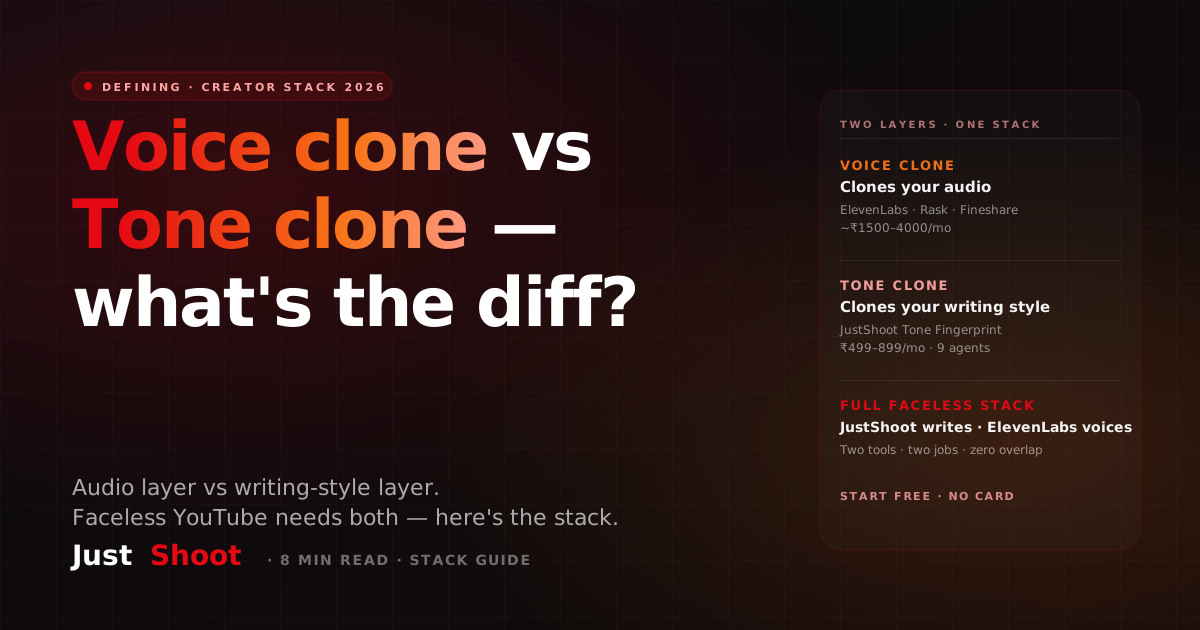
Voice Clone vs Tone Clone for YouTube — What's the Difference (2026)
Voice clone (ElevenLabs, Rask) clones your audio. Tone clone (JustShoot) clones your writing style. Two different layers, both needed for faceless YouTube — here's the full stack.
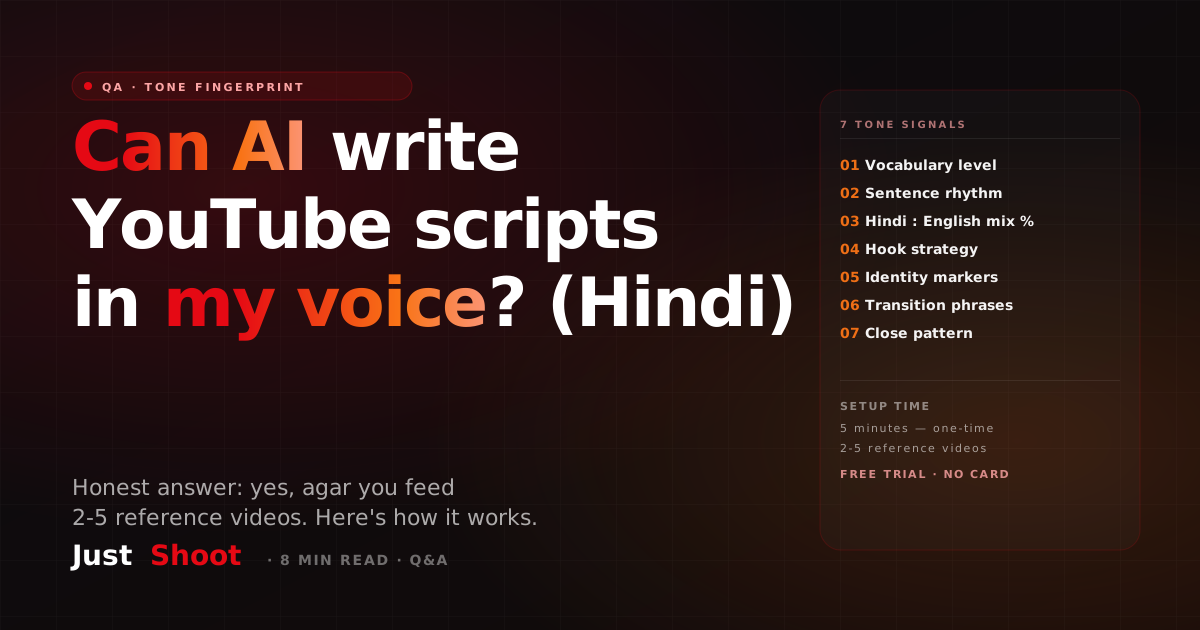
Can AI Write YouTube Scripts in My Voice (Hindi)? — Honest 2026 Answer
Yes — AI can write YouTube scripts in your Hindi voice, but only with the right mechanism. Why ChatGPT fails, what Tone Fingerprint does differently, and a live example.