How to Make Viral YouTube Shorts in India in 2026: The 3-Second Hook Framework
How to make viral YouTube Shorts for Indian creators in 2026 — the 3-second hook, the 3-block script, retention curves, repurposing from long-form, and what to skip.
How to Make Viral YouTube Shorts in India in 2026: The 3-Second Hook Framework
By Ashok Sachdev, Founder of JustShoot · Published 2026-05-25
Most Indian creator advice on Shorts has not caught up to how the format actually behaves in 2026. The standard guidance — "post 3 a day, use trending audio, hook fast" — is technically not wrong but it papers over the structural change in how Shorts surface on Indian YouTube specifically: the algorithm in 2026 is far more retention-sensitive than it was in 2022–23, the watch-time threshold for a Short to enter the "viral push" tier is higher than most creators realise, and the audio-pick decision now matters less than the first-second visual decision.
This post is the working framework we use inside JustShoot's Distribution agent — the agent that generates 3–5 vertical shorts from every long-form video in the pipeline — and that we recommend Indian creators run when they want to scale a long-form channel through shorts, or when they are building a shorts-first channel and need a repeatable production method. It is calibrated to India specifically because the shorts engagement patterns here differ from the US/global benchmarks in three measurable ways, covered below.
If you only want the script template, scroll to "The 3-block shorts script." Everything above is the reasoning behind why the structure works.
What the YouTube Shorts algorithm actually rewards in 2026
Three things changed in the last 18 months that older shorts advice does not account for.
First, the watch-time threshold for entering the algorithmic push tier moved up. In 2022, a 30-second Short with 60 % completion rate would consistently push into the wider feed. In 2026, the same Short with the same completion rate plateaus — the threshold for the push tier on Indian Shorts is closer to 75 % completion at 30 seconds, or 85 % completion at 15 seconds. The implication: shorter Shorts have a structural advantage because completion is easier, and the 60-90-second long Shorts are the riskiest format unless the retention curve is exceptional.
Second, the first-second visual decides watch-time more than the first-second audio. Indian Shorts viewers scroll with audio off roughly 40-60 % of the time depending on the time of day and the platform context (in-app, locked screen, public commute). A Short that depends on the audio hook in second 1 loses these viewers. A Short that depends on a visual hook in second 1 — a specific face expression, a bold text overlay, a recognisable cultural visual — holds them.
Third, the "viral push" surface in India is now heavily language-segmented. A Hinglish Short and a pure-Hindi Short get pushed into different feeds with different competition densities. The Hinglish feed is more crowded but has higher monetisation potential; the pure-Hindi feed has lower competition but smaller per-view rates. (For the long-form version of this language-pick analysis, see Hinglish vs Hindi vs English on YouTube — the same logic applies to Shorts with slightly different ratios.)
These three structural shifts mean the working playbook for Indian Shorts in 2026 is different from what worked even 18 months ago.
The 3-second hook framework
The first 3 seconds of a Short decide whether it gets watched, skipped, or partially watched. The hook framework that consistently performs across Indian channels we have audited fits this 3-second window with four distinct hook archetypes — each one targeting a different audience emotional state at the moment of scroll.
| Hook archetype | First-frame element | First-line audio | Best for |
|---|---|---|---|
| Pattern interrupt | Visual that does not match the feed (close-up face, unexpected object, bold text) | "Ek second ruko" / "Yaar dekh" | All niches, especially crowded ones |
| Stakes promise | Numeric overlay or before/after frame | Direct claim with a number ("89% retail traders…") | Finance, education, tech-review |
| Question | Face speaking directly to camera | "Kya aapko pata hai…" / "Aapne kabhi socha hai…" | Commentary, lifestyle, vlog |
| Story-cold-open | A scene mid-action, no setup | "Pichhle hafte…" / "Kal raat…" | Vlog, storytelling, gaming |
The working pattern: for each Short, pick one archetype and execute it cleanly. Mixing two ("pattern interrupt + stakes" in 3 seconds) typically dilutes both. Channels that pick one primary archetype and reuse it across most Shorts build audience recognition; channels that switch every Short look inconsistent to the recommendation system.
The Hinglish-specific note: the hook line should land in 5–7 words, not 10–12. English audiences tolerate slightly longer hook lines because English is faster per syllable; Hindi/Hinglish syllables are heavier and the same word count takes longer. A 7-word Hinglish hook is roughly equivalent to a 10-word English hook in spoken duration.
The 3-block shorts script
The 7-block long-form script template — covered in detail in the YouTube script template for Hindi and Hinglish — does not compress to Shorts. Shorts need their own structure. The version that consistently works is 3 blocks.
[BLOCK 1 — HOOK | 3–5 sec | one of: pattern-interrupt / stakes / question / story]
[Visual hook must work with audio off]
[Audio line: 5–7 words for Hinglish, 7–9 for English]
[The promise of the Short must be implicit in the hook — not delayed to block 2]

[BLOCK 2 — INSIGHT | 15–25 sec | single beat]
[The actual content of the Short — ONE point, not two]
[Build with: claim → proof (stat / example) → re-emphasis]
[Pacing: 1.2x faster than long-form — talk at the upper end of your natural rhythm]
[Visual cuts every 2–3 seconds — static talking-head Shorts underperform]

[BLOCK 3 — PAYOFF + CTA | 3–7 sec]
[ONE close: "watch full video" / "comment your view" / "save this for later"]
[Avoid: subscribe pitch in Shorts CTA — converts ~3x worse than the "watch full video" CTA]
[Visual: text overlay of the CTA — many Indian Shorts viewers tap CTA from the overlay, not the audio]
Total runtime: 21–37 seconds. The single most common length that performs across Indian Shorts in 2026 is the 25–30 second band; shorter than 18 seconds rarely has time to deliver the insight, and longer than 40 seconds requires a retention curve that most channels cannot consistently hit.
A worked example — Hinglish finance Short, 27 seconds
The example below is a Short repurposed from a hypothetical 8-minute long-form video on SIP returns (the same long-form we worked through in the script template post). The mechanic of cutting a Short from a long-form is covered in the next section; the script here is the finished output.
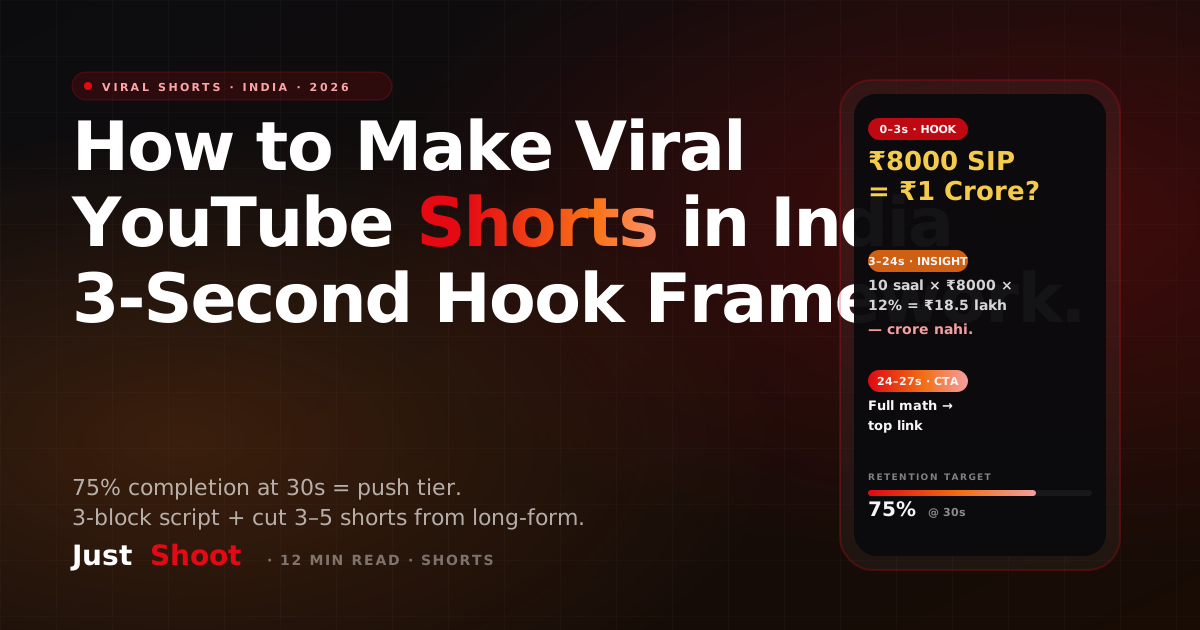
HOOK (3 sec) — [face close-up, bold yellow text overlay: "8000/month SIP = ₹1 Crore?"] "Ek second. Kya 8000 ki SIP se 10 saal mein crore banta hai?"
INSIGHT (21 sec) — [cut to whiteboard graphic with the math] "Sach yeh hai. 8000 monthly × 10 saal × 12 percent average return — total ₹18.5 lakh. Crore nahi. Crorepati banne ke liye chahiye 15000 monthly × 20 saal. [cut to face] Instagram pe jo 1 crore wala number dikhaya jaata hai, woh 20+ saal ka horizon assume karta hai — 10 saal ka nahi."
PAYOFF + CTA (3 sec) — [face, text overlay: "Full math → top link"] "Pura calculation full video mein. Link uppar."
The Short delivers one insight (the realistic 10-year SIP outcome), opens with a pattern-interrupt + question hook, and closes with a watch-full-video CTA. Total ~150 words at the upper end of Hinglish pace (~155 wpm vs the long-form 140 wpm). The visual cuts (face → whiteboard → face) every 3–5 seconds prevent the static-talking-head retention drop.
How to cut 3–5 Shorts from a single long-form
The highest-yield Shorts strategy for an Indian channel that already publishes long-form is repurposing — not creating Shorts from scratch. Three rules govern which long-form moments make good Shorts.
Rule 1 — Pick the climax moments. Re-watch your long-form on 1.5× speed and mark every moment where you said something memorable, surprising, or framed as a contrarian take. These are your Shorts candidates. The 8-minute SIP video above has at least 3 climax moments — the realistic 10-year number, the "crorepati requires 15+ years" recalibration, and the "SIP failure is 99 % expectations" climax line. Each one is a separate Short.
Rule 2 — Add a hook the long-form did not have. The original long-form's hook works for someone who searched for the topic. A Short feeds to people scrolling — different intent, different hook. Re-shoot the first 3 seconds with a hook calibrated to the scroll-feed audience, even if you reuse the long-form's body audio for the middle.
Rule 3 — Re-pace the audio. Long-form pace (140 wpm Hinglish) is slow for Shorts. Either speed-ramp the audio to 1.15-1.2× (without pitch-correcting too aggressively — it sounds robotic) or re-record the body block faster. Shorts viewers expect a quicker delivery; the long-form pace reads as plodding on the feed.
The mechanic of generating 3–5 Shorts scripts from a single long-form is what JustShoot's Distribution agent automates inside the 9-agent pipeline. The agent reads the long-form script, identifies the climax moments, generates a Shorts script for each one with a calibrated first-3-second hook, and outputs the cut-list so the editor knows which timestamps of the original to use. The Shorts inherit the channel's Tone Fingerprint — same vocabulary level, same signature transitions, same close pattern.
Retention curve targets — what to optimise toward
Open YouTube Studio for your channel. For each Short, look at the retention curve. The shape you want is a long flat top with a small drop at the end — completion rate 75 %+ at 30 seconds, or 85 %+ at 15 seconds. The shape you do not want is a steep first-3-second drop (the hook failed) or a steep middle drop (the insight took too long to land).
If the first-3-second drop is above 25 %, the hook is the problem — re-shoot the hook, keep the body. If the middle drop is the problem, the insight is too slow — cut the setup, get to the claim faster. If the end drop is the problem (viewers leaving in the last 5 seconds), the payoff is weak — re-cut the CTA or shorten the Short.
A Short that consistently holds 75 % completion at 30 seconds across the first 1,000 views enters the algorithmic push tier and routinely earns 50,000–500,000+ views over the next 4–14 days. A Short at 55 % completion plateaus around 5,000–15,000 views and does not push further. The difference between 55 % and 75 % completion is almost entirely structural — better hook, tighter insight, shorter runtime — not topical.
What to skip — three Indian Shorts tactics that no longer work
Skip the "follow my main channel" CTA in the Short itself. This was effective in 2021–22 when the Shorts feed was novel; in 2026 it converts at roughly a third the rate of the "watch full video" CTA, because the audience is now used to the format and treats the subscribe pitch as friction. Use the "watch full video" CTA instead, and let the subscription conversion happen on the long-form watch page.
Skip the over-trending audio. Trending audio in India has a half-life of roughly 3–7 days now, and the Shorts that go viral on a specific audio in the first 24 hours saturate the audio in 48 hours. By the time most creators ship a Short on the trending audio, the audience has already heard 30+ similar ones and the saturation is killing per-Short retention. The newer pattern: use original audio (your own voice-over from the long-form) for 70 % of Shorts, and use trending audio only for the specific Shorts where the visual is also calibrated to the audio (dance, lip-sync, reaction, transition cuts).
Skip the cluttered text-overlay design. Heavy bottom-screen text with 3 lines, multiple colours, and a logo overlay was the standard 2022 design. The 2026 working design is one bold text element near the top of the screen (where the auto-generated subtitles are not), in a single contrasting colour, with one or two-word phrases that change every 2–3 seconds. The cleaner overlay reads better on small screens and does not compete with the face for visual attention.
For the deeper read on how Shorts integrate into a broader SEO and discovery strategy on Indian YouTube, see the 18-step YouTube SEO checklist for 2026 — step 17 covers the Shorts cross-post mechanic and why it disproportionately benefits Indian channels (long-form CPMs are lower in India relative to global averages, so Shorts feed long-form discovery more aggressively than they do in other markets).
How JustShoot's Distribution agent handles this end-to-end
The Distribution agent inside JustShoot's pipeline produces 3–5 Shorts scripts from every long-form, automatically. The inputs are the long-form script, the timestamps of the climax moments (which the agent identifies), and the channel's Tone Fingerprint. The outputs are the Shorts scripts in the 3-block structure above, the cut-list with timestamps from the original video, the first-3-second hook calibrated to the scroll-feed audience, and the CTA matched to the channel's primary funnel (long-form vs newsletter vs comment-prompt).
The full 9-agent pipeline (research → fact-check → legal → script → storyboard → thumbnail → SEO → shorts → distribution) runs at 100 credits per video. Pricing: Starter ₹499/month (500 credits, ~5 videos), Pro ₹699/month (1000 credits, ~10 videos), Studio ₹899/month (2000 credits, ~20 videos). Annual −20 %. 7-day free trial, no card required.
If you want to compare a Shorts-first AI tool to a pre-production OS that includes Shorts, the side-by-side is in the Submagic alternative comparison — Submagic generates captions and clips after you record, JustShoot writes the Shorts script before you record and matches it to your long-form.
FAQ
Q: How long should YouTube Shorts be in 2026 for Indian creators? The 25–30 second band is the most consistent performer. Shorter than 18 seconds does not have time to deliver an insight; longer than 40 seconds requires a retention curve most channels cannot reliably hit. The watch-time threshold for entering the algorithmic push tier in 2026 is roughly 75 % completion at 30 seconds, or 85 % at 15 seconds — shorter Shorts have a structural advantage because completion is easier.
Q: Do trending audio tracks actually help Shorts go viral in India? Less than they used to. Trending audio in India has a 3–7 day half-life and saturates within 48 hours of breaking. By the time most creators ship a Short on the trending audio, the audience has heard 30+ similar ones, and per-Short retention drops because of the saturation. The 2026 pattern is to use original audio (your own voice-over) for ~70 % of Shorts, and reserve trending audio for the specific Shorts where the visual is calibrated to the audio (dance, lip-sync, reaction).
Q: How many Shorts should I post per day on an Indian YouTube channel? 3 per day is the often-quoted number; the actual answer depends on whether the Shorts are quality-controlled. 3 high-retention Shorts per day on a long-form-feeder channel work; 5–8 low-retention Shorts per day spam the algorithm and tank the channel-wide average completion rate, which suppresses the long-form. The rule of thumb: only post a Short if you would defend the first-3-second hook to your audience. Quality beats quantity at any cadence above 1/day.
Q: Should I post the same Short on Instagram Reels too? Yes, with two changes: re-export at 9:16 with no YouTube watermark (Instagram suppresses watermarked content), and tweak the CTA from "watch full video on YouTube" to a softer "save this" or "follow for more" on Instagram (cross-platform CTAs convert badly because the audience doesn't want to leave the platform). The same vertical asset works on both platforms; the platform-specific tweaks lift cross-posted performance significantly.
Q: Do YouTube Shorts help long-form channel growth in India? Disproportionately yes, because long-form CPMs in India are lower than the global average — Shorts feed long-form discovery more aggressively here than in most markets. A long-form channel that ships 3–5 Shorts per long-form upload routinely doubles or triples the long-form's discovery, because the Shorts feed surfaces the channel to viewers who would never have found the long-form through search. The mechanic is covered in step 17 of the YouTube SEO checklist.
Ashok Sachdev is the founder of JustShoot, an AI Content OS for Indian YouTube creators. The Distribution agent generates 3–5 Shorts scripts from every long-form video, calibrated to the channel's Tone Fingerprint. Pricing: Starter ₹499/month, Pro ₹699/month, Studio ₹899/month. Annual −20%. 7-day free trial, no card required.
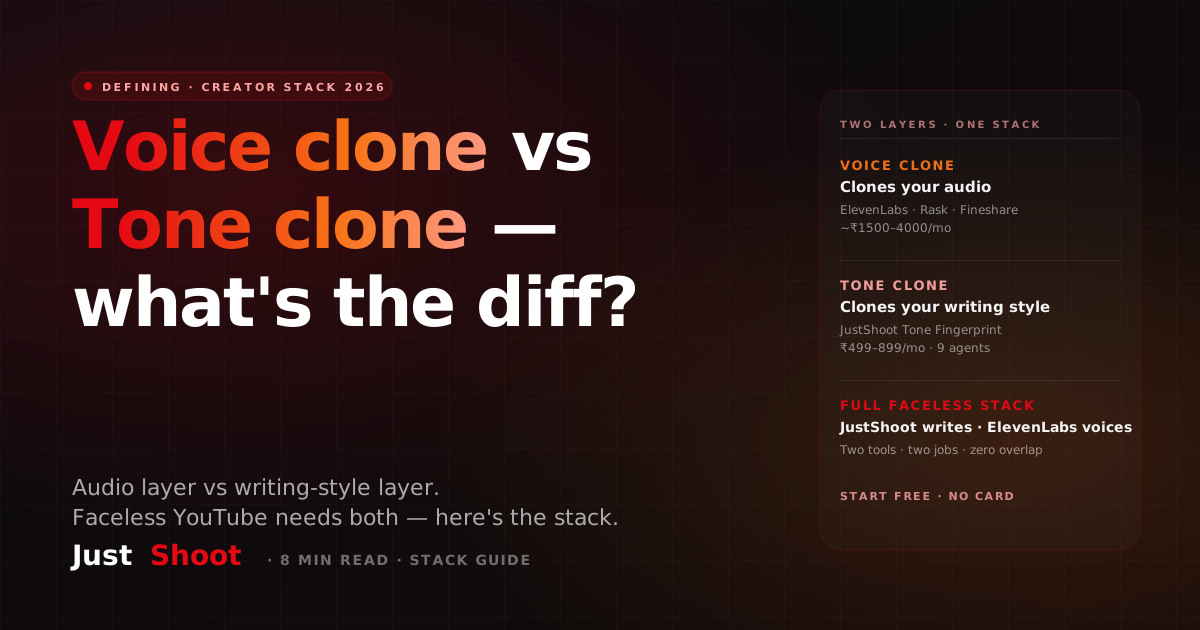
Voice Clone vs Tone Clone for YouTube — What's the Difference (2026)
Voice clone (ElevenLabs, Rask) clones your audio. Tone clone (JustShoot) clones your writing style. Two different layers, both needed for faceless YouTube — here's the full stack.
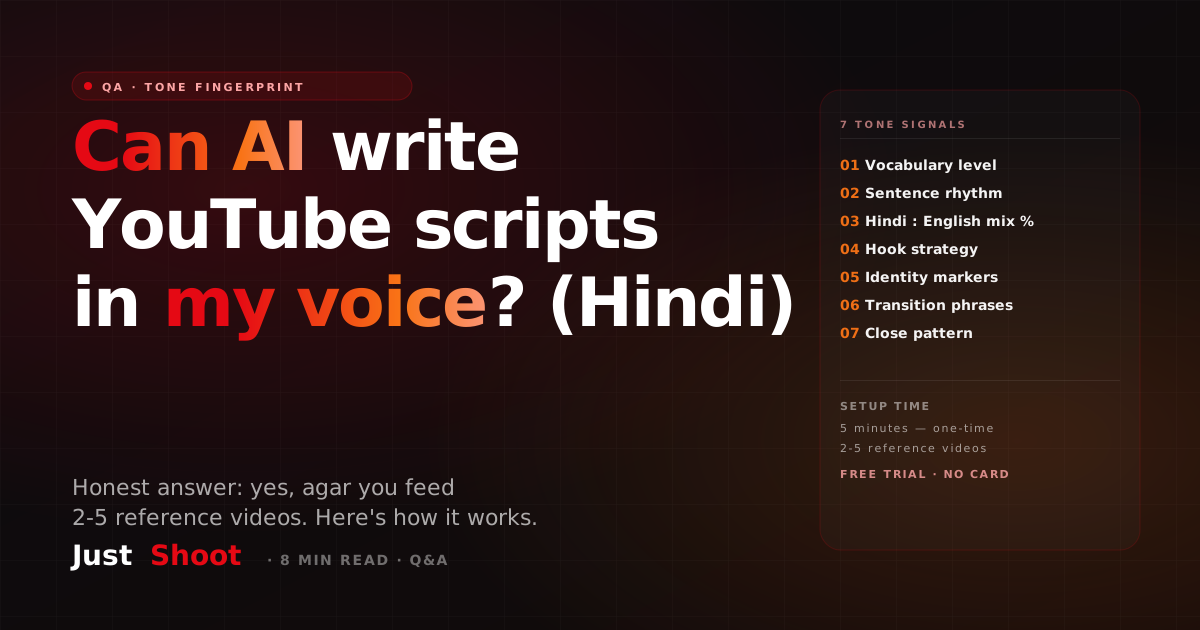
Can AI Write YouTube Scripts in My Voice (Hindi)? — Honest 2026 Answer
Yes — AI can write YouTube scripts in your Hindi voice, but only with the right mechanism. Why ChatGPT fails, what Tone Fingerprint does differently, and a live example.