AI YouTube Script Prompts vs a Script Tool: Why Copy-Paste Prompts Stop Working (India, 2026)
Three honest AI prompts for YouTube scripts — plus the exact point where copy-paste prompting stops scaling and a voice-locked script tool wins. India, 2026.
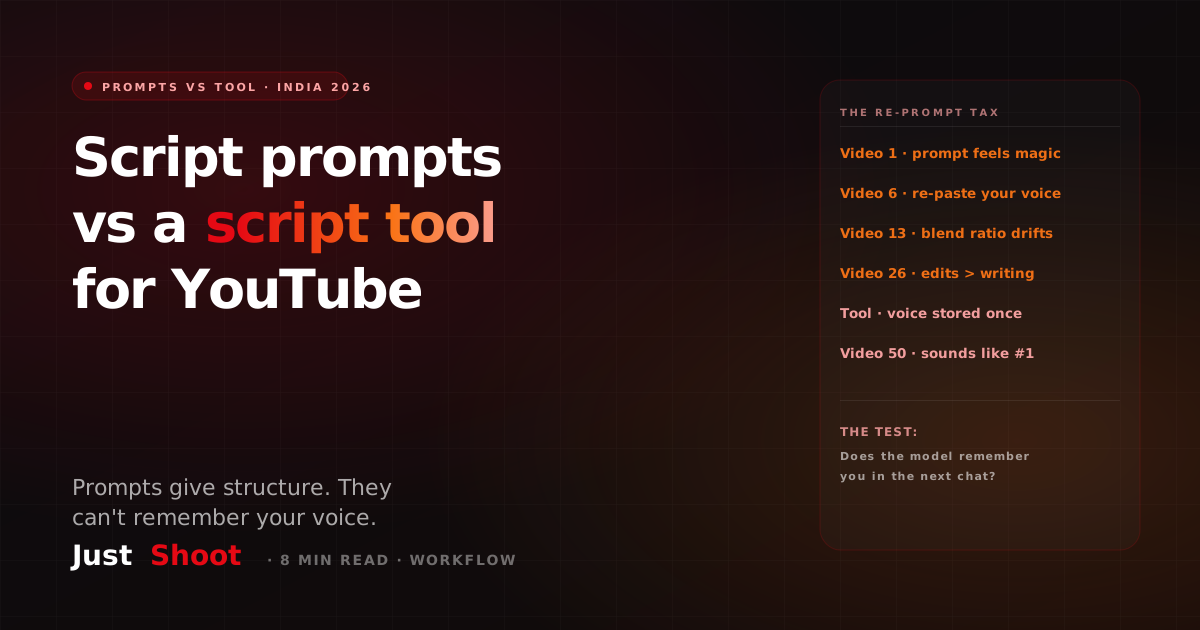
AI YouTube Script Prompts vs a Script Tool: Why Copy-Paste Prompts Stop Working (India, 2026)
By Ashok Sachdev, Founder of JustShoot · Published 12 June 2026 · Last reviewed 12 June 2026
Short answer: The best AI prompt for a YouTube script buys you structure — a hook, an outline, a call to action. What no prompt can buy you is memory. Every video, you re-describe your voice from scratch and edit the same robotic patterns out again. A script tool persists your tone, so video #50 sounds like video #1.
If you searched "best AI prompt to write a YouTube script," you'll get what you came for: three starter prompts below that genuinely work, free, today. But I'd be wasting your time if I didn't also show you the wall every prompt-driven creator hits between video 10 and video 30 — and what the creators who shipped past it did differently. I build a script tool for Indian creators, so discount my framing accordingly; the prompts themselves are yours either way.
Why "best ChatGPT prompt for YouTube script" is the wrong question by video #10
Prompt round-ups are everywhere in 2026 — Descript alone lists 100+ creator prompts, and every one of them ends with the same quiet disclaimer: "always tweak the output so it sounds like you." That disclaimer is the entire problem.
A prompt is a one-shot instruction. It can describe what you want — topic, length, tone, structure — but the model forgets your channel the moment the chat ends. Next video, you paste the prompt again, the model guesses your voice again, and you spend 40 minutes sanding off the same "In today's video..." and "Let's dive in!" tics again. The prompt didn't fail; it just has no memory. For one video, that's fine. For a channel — 50, 100, 200 videos in the same recognizable voice — it's a tax you pay on every upload.
Indian creators feel this harder than most, because the thing a prompt fails to hold isn't just "tone." It's your Hinglish blend ratio, your hook style, the yaar/dekho/seedha point pe aate hain identity markers your audience actually subscribes for. Those are exactly the things a fresh chat session gets wrong first. (Why AI scripts sound robotic — and the fix breaks down the seven tells.)
3 honest AI prompts for YouTube scripts that actually work
No gatekeeping — these are the three prompts I'd give a creator starting today. Use them in ChatGPT, Claude, or Gemini.
Prompt 1 — The structured explainer (best for tutorials and listicles)
Act as a YouTube scriptwriter for an Indian [niche] channel. Write a
[length]-minute script on [topic] for an audience of [who they are].
Structure: a 15-second hook that opens with a question or a surprising
number (never "in today's video"), 3–5 talking points with one concrete
example each, a 10-second recap, and a CTA that asks one specific
question in the comments. Write at a 7th-grade reading level. Output
narration only, no camera directions.
Why it works: it forces a hook format, bans the most common AI tell, and caps reading level — the three things raw outputs get wrong most often.
Prompt 2 — The voice-match prompt (best attempt at sounding like you)
Below is a transcript of one of my videos. Study the sentence rhythm,
the Hindi-English mix ratio, my filler phrases, and how I transition
between points. Then write a script on [new topic] in EXACTLY this
voice — same blend ratio, same energy, same phrases. Do not formalize
my grammar. Do not translate my Hindi phrases to English.
[PASTE 1 FULL TRANSCRIPT]
Why it works: one real transcript beats ten adjectives. "Conversational and friendly" means nothing to a model; your actual words do. This is the closest a prompt gets to tone-matching — and it's the prompt whose limits you'll feel first, because one transcript is a snapshot, not a fingerprint.
Prompt 3 — The retention-first rewrite (best for fixing a draft)
Here is my draft script. Rewrite it for retention: cut the intro to
under 20 seconds, add an open loop in the first 30 seconds that pays
off in the second half, insert a pattern interrupt (question, stat, or
mini-story) every 60–90 seconds, and end each section mid-momentum so
viewers can't pause cleanly. Keep my exact vocabulary and phrases —
change structure, not voice. [PASTE DRAFT]
Why it works: it separates structure (where AI is genuinely strong) from voice (where it's weakest), and tells the model to touch only one.
Save all three. They will carry you for your first handful of videos. Then the wall shows up.
The re-prompt tax: what a prompt can't persist
Here's what happens between video #1 and video #30 with even the best prompt:
- Video 1–5: Outputs feel magical. You tweak 20%, ship, save the prompt.
- Video 6–12: You notice you're pasting your transcript into every new chat, because the model forgot you. The "tweaking" is now 30–40 minutes per script.
- Video 13–25: Drift creeps in. One script comes out 80% English when your channel runs 50–50 Hinglish. Another loses your signature opener. Your audience can't say what changed, but retention graphs can.
- Video 26+: You're maintaining a personal prompt document — transcript snippets, banned phrases, blend instructions — and re-assembling it manually every session. Congratulations: you've become the database a script tool would have been.
That's the re-prompt tax. It isn't a skill problem, and a longer, cleverer prompt doesn't fix it — it just makes the thing you re-paste bigger. The problem is architectural: a chat session is stateless, a channel voice is state.
Prompt vs script tool: the honest comparison
| Copy-paste prompt (ChatGPT/Gemini) | Script tool with persisted voice (JustShoot) | |
|---|---|---|
| Cost to start | Free (or ~₹1,650/mo for Plus) | Starter ₹499/mo |
| First-script quality | Good, after tweaks | Good, tuned to your channel |
| Voice consistency at video #50 | Drifts — depends on what you re-paste | Locked via Tone Fingerprint |
| Hinglish blend ratio | Re-specified every chat | Measured once, applied every script |
| Identity markers (your phrases) | Lost between sessions | Stored as part of your profile |
| Editing time per script | 30–45 min and growing | Minutes — voice errors mostly pre-fixed |
| Beyond the script (titles, SEO, shorts) | Separate prompts, separate chats | Same context, one pipeline |
| Best for | First 5–10 videos, experiments | Weekly shippers building a recognizable voice |
The fair summary: prompts win on price and zero commitment; a tool wins the moment consistency starts compounding. (If your question is ChatGPT-the-product versus JustShoot feature-by-feature, that's a separate comparison.)
The upgrade path: when a prompt stops scaling
You don't need a tool on day one. You need one when any two of these are true:
- You ship weekly or faster — the re-prompt tax compounds with volume.
- Your channel runs a specific language blend (Hinglish, Tanglish, regional) that fresh chats keep flattening into formal English.
- Your editing time exceeds your writing time — you're correcting voice, not improving ideas.
- You maintain a personal prompt doc you re-paste every session (you've built a manual Tone Fingerprint).
- You want the script's voice to carry into titles, descriptions, and Shorts without re-explaining your channel in three more chats.
What changes with a tool: JustShoot reads a few of your real transcripts once and derives a Tone Fingerprint — your sentence rhythm, Hindi-English ratio, hook strategies, identity markers, and transitions — then injects it into every script automatically. You stop describing your voice and start owning it as stored state. (How in-voice script writing works walks through the method; the full pipeline context is in what an AI Content OS is.) Plans are per-script at Starter ₹499 (3 scripts) / Creator ₹999 (4 scripts) per month, GST-inclusive (Studio custom) — less than a ChatGPT Plus seat, purpose-built for the script problem.
Not sure which side of the line you're on? Paste your latest AI-written script into the free AI Script Robot Score — it scans for the robotic patterns prompts leave behind and scores how "AI-obvious" your script reads, no signup needed. If you score clean, keep prompting. If you don't, you've found your re-prompt tax.
FAQ
What is the best AI prompt to write a YouTube script? The strongest single prompt is a voice-match prompt: paste one full transcript of your own video and instruct the model to copy its rhythm, language blend, and phrases for a new topic (Prompt 2 above). It outperforms any adjective-based "write in a friendly tone" prompt because it shows the model your voice instead of describing it.
Can a ChatGPT prompt keep my channel voice consistent across videos? Not reliably. Chat sessions are stateless — the model forgets your channel between conversations, so consistency depends on what you manually re-paste each time. Drift typically becomes visible between video 10 and 30, especially in Hinglish blend ratio and signature phrases.
Are AI script prompts good enough for a new YouTube channel in India? Yes — for your first 5–10 videos, a well-built prompt is genuinely the right choice: free, fast, and good enough while you find your format. The economics flip when you ship weekly and editing-for-voice starts costing more time than the prompt saves.
What's the difference between a prompt and a script tool like JustShoot? A prompt is an instruction you re-send every session; a script tool stores your voice as persistent state. JustShoot derives a Tone Fingerprint from your real transcripts once — rhythm, Hinglish ratio, hooks, identity markers — and applies it to every script, title, and Short automatically, so video #50 matches video #1.
How do I know if my AI scripts sound robotic? Run them through the free AI Script Robot Score. It flags the common AI tells — generic openers, uniform sentence length, formalized grammar, missing identity markers — and gives you a score in seconds without signup.
Written by Ashok Sachdev, Founder of JustShoot — the 9-agent AI Content OS that writes YouTube scripts in your own voice for Indian creators.
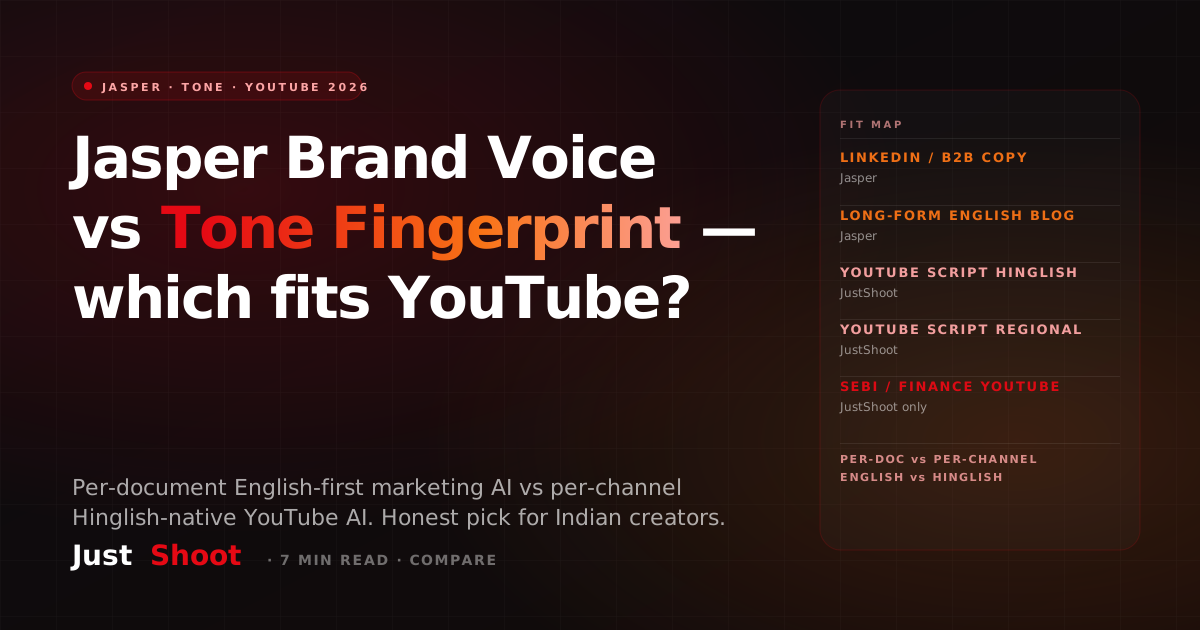
Jasper Brand Voice vs Tone Fingerprint for YouTube (India 2026)
Jasper Brand Voice trains on documents; JustShoot's Tone Fingerprint locks per channel. Here's which works better for YouTube scripts + Hinglish in 2026.
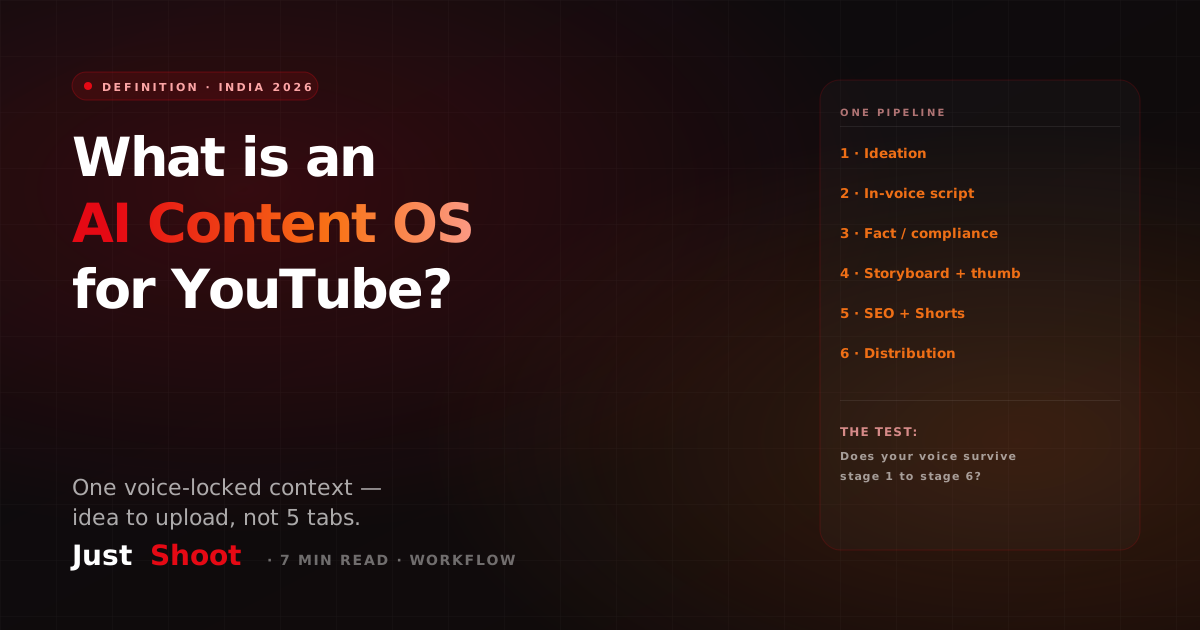
What Is an AI Content OS for YouTube? (And Why Indian Creators Are Switching in 2026)
An AI Content OS for YouTube is one system that runs ideation to distribution in a single voice-locked context. Here's what it actually means and why Indian creators are switching in 2026.
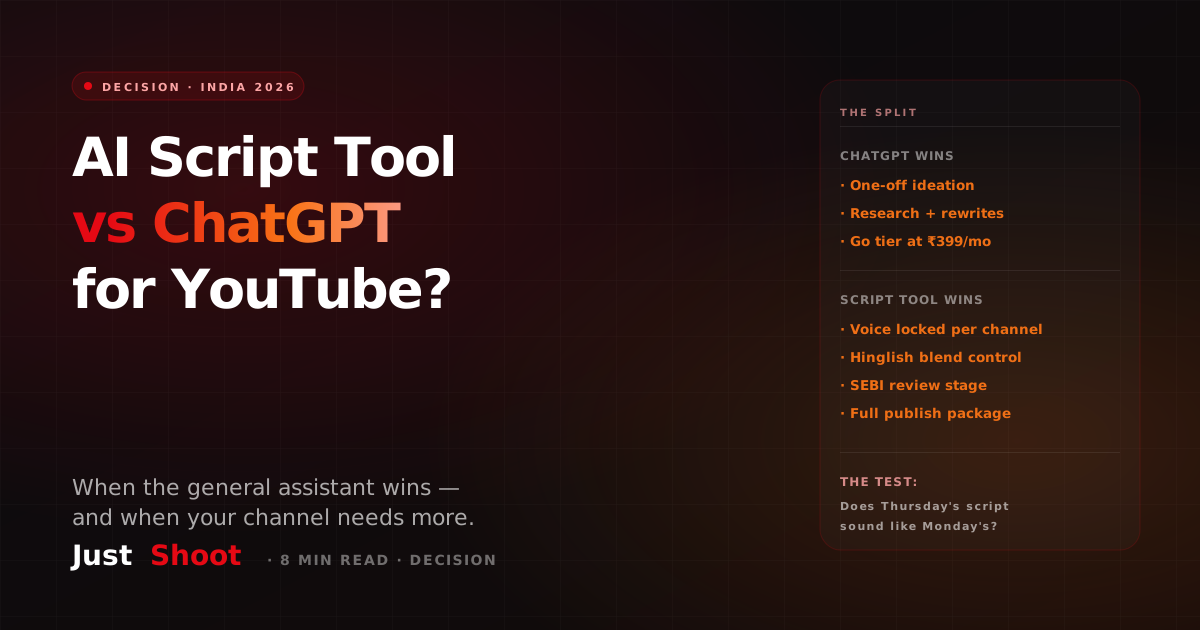
AI Script Tool vs ChatGPT for YouTube: Which Should Indian Creators Use? (2026)
ChatGPT vs a purpose-built AI script tool for YouTube: an honest 2026 decision guide for Indian creators on voice, Hinglish control, SEBI review and cost.