Why Your AI YouTube Scripts Sound Robotic (And How to Fix It)
AI YouTube scripts sound robotic for 3 reasons: uniform sentences, hollow authority, and one rigid template. Here's why — and the real fix for natural, human scripts in 2026.
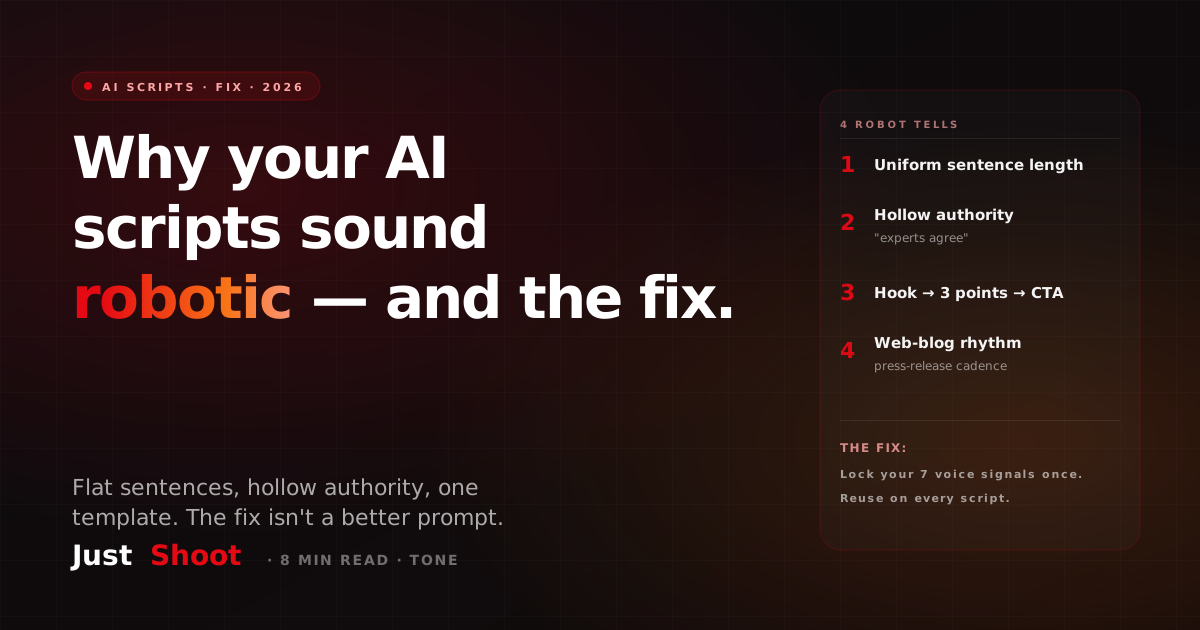
Why Your AI YouTube Scripts Sound Robotic (And How to Fix It)
By Ashok Sachdev, Founder of JustShoot · Published 1 June 2026 · Last reviewed 1 June 2026
Short answer: Your AI YouTube scripts sound robotic for three reasons — every sentence is the same length and shape, they lean on hollow authority ("experts agree"), and they follow one rigid template: hook, three points, conclusion, CTA. AI is trained on corporate blogs and press releases, so it writes like one. The fix isn't a better prompt — it's locking your sentence rhythm, language mix, and signature hooks so every script sounds like you, not a template.
I build an AI scripting tool for Indian creators, so I've read a lot of robotic drafts. The good news: "robotic" is a fixable, mechanical problem — once you can name the four tells, you can kill them. Here's exactly why it happens and how to fix it today.
The 4 tells of a robotic AI script
Read any raw AI script out loud and you'll hear these four signals. They're what makes viewers tune out and what AI detectors flag.
- Uniform sentence length. Every line lands at roughly the same medium length. Real speech is bursty — a three-word punch, then a long flowing thought, then another short jab. Flat, even sentences read as machine output.
- Hollow authority. "In today's digital landscape," "experts agree," "leverage cutting-edge solutions." AI reaches for these because it's trained on marketing copy and press releases — text that asserts credibility instead of earning it (source: fyreinteractive, scriptzen, 2026).
- The Hook → 3 points → CTA template. The same skeleton on every video: open with a question, list three points, wrap, ask for the subscribe. It's safe, it's structured, and it's instantly recognizable as formula.
- Web-blog / press-release rhythm. The script reads like an article, not like a person talking. Written-for-the-eye cadence, not spoken-for-the-ear.
Notice what isn't on this list: "you used AI." None of these tells are caused by the tool. They're caused by shipping the model's default output. That's a crucial distinction, because it means the fix is about the output, not about abandoning AI.
Why this hits Indian creators harder
If you create in Hindi, Hinglish, or a regional language, the robotic problem is worse — and most articles never mention it.
Large language models are trained overwhelmingly on English corporate web text. So when you ask for a Hinglish script, the model tends to flatten natural code-switching into "neutral," over-formal English with a few Hindi words bolted on. The lived rhythm of how an Indian creator actually talks — the mid-sentence switch, the colloquial connectors, the specific Hindi phrase that lands the joke — gets sanded down into something that sounds like a translated brochure.
That's why a generic LLM can technically "write in Hinglish" and still sound nothing like you. It has the vocabulary but not your rhythm. The flattening is most severe exactly where your authenticity lives — your natural language mix.
Why "write more naturally" prompts don't fix it
The instinct is to keep prompting: "make it more casual," "sound more human," "write like I talk." This helps a little, then plateaus. Here's the mechanical reason.
The model has no memory of your voice between sessions. Each time you open a fresh chat, it starts from its statistical default and forgets everything about how your last script sounded. You can describe your voice in a prompt, but description isn't the same as a persisted profile — and you'd have to re-describe it, perfectly, every single time. Miss a detail and the robot tells creep back in.
There's also a detection angle worth knowing. AI detectors don't look for "AI words" — they score text on perplexity (how predictable each word is), burstiness (variation in sentence length), and stylometry (style patterns). ChatGPT's neat, uniform, bullet-friendly formatting is precisely the predictable, low-burstiness pattern that reads as machine-written (source: netus.ai, 2026). A better prompt nudges this; it doesn't solve it, because the model keeps reverting to its trained default.
So the durable fix can't be "prompt harder." It has to be something that persists your voice.
The real fix — capture your tone once, reuse it every script
The fix is to stop re-describing your voice and instead capture it once as a reusable profile, then apply that profile to every script automatically. We call this a Tone Fingerprint.
The 7 signals of a creator's voice
A Tone Fingerprint isn't a vibe — it's seven measurable signals extracted from your existing videos:
- Sentence rhythm — your real mix of short punches and long runs (kills tell #1).
- Language balance — your exact Hindi/English/regional blend ratio (kills the Hinglish flattening).
- Hook strategies — the specific ways you open a video.
- Identity markers — your recurring phrases, catchwords, and tics.
- Transitions — how you move between points without the robotic "moving on to point two."
- Vocabulary level — your actual register, not corporate-default.
- Close pattern — how you wrap and ask, in your own way.
Lock those seven and the four robot tells have nowhere to hide. This is the mechanism behind every JustShoot script — the tone is captured once from your videos and reused, so the output sounds like your channel instead of like a press release. For the deeper distinction between this and synthetic-voice cloning, see voice clone vs tone clone for YouTube.
Curious how robotic your current scripts read? Paste one into the free AI Script Robot-Score — it scores all four tells, flags the exact filler and template phrases, and shows which ones you're shipping.
A 3-step de-robot checklist you can apply today
You don't need a tool to start. Apply these three fixes to your next AI draft right now:
- Vary your sentence length on purpose. After every long sentence, write a short one. Read it aloud — if it sounds even and flat, break it up. This single change moves the burstiness score the most.
- Cut every hollow-authority phrase. Delete "experts agree," "in today's digital landscape," "it's no secret that." Replace with a concrete fact, a specific number, or your own opinion. If you can't back it, cut it.
- Break the template and plant an open loop. Don't open with "in this video I'll show you three things." Open mid-action, tease a payoff you only resolve later, and let the structure follow the story — not the formula.
Do these three and you've removed most of the robot — for free. The catch is you'll do it again on every script, by hand. That manual "verbal run" (a read-aloud rewrite to make it sound human) is exactly what creators report still costs 20–30 minutes per script even after AI drafts it fast (source: Medium/TubeAI creator reports, 2026). A persisted Tone Fingerprint is what lets you skip that rewrite, because the voice is baked in from the first draft.
FAQ
Why does ChatGPT make my scripts sound generic? Because it's trained mostly on corporate blogs and press releases, so it defaults to that rhythm — uniform sentence length, hollow authority phrases, and a rigid hook-points-CTA template. It writes like the average of its training data, which is exactly "generic."
How do I make an AI script sound like me? Vary your sentence length, cut hollow-authority filler, and break the standard template — or, more durably, lock a Tone Fingerprint that captures your rhythm, language mix, and hooks and applies them to every script automatically. See the tone-clone explainer.
Can a better prompt fix a robotic script? Partially. A good prompt nudges the output, but the model forgets your voice between sessions, so it keeps reverting to its default. A persisted tone profile fixes it permanently because your voice isn't re-described each time — it's reused.
Does a robotic script affect YouTube monetization? Indirectly. Robotic, templated scripts read as low-effort and repetitive, which is what YouTube's 2026 "inauthentic content" policy targets. Original, in-your-voice content is what stays safe — see does using AI to write YouTube scripts hurt your channel.
Does this work for Hinglish and regional scripts? Yes — and it matters most there. English-trained models flatten natural code-switching into neutral English, so Hinglish and regional scripts are exactly where a tone profile that captures your real language balance makes the biggest difference. See the best AI for Hinglish script writing.
"Robotic" isn't a verdict — it's a checklist of four fixable tells. Vary your rhythm, cut the filler, break the template, and lock your voice once so you stop redoing it.
See how your scripts read today: score a script free with the AI Script Robot-Score →, or try JustShoot → and generate a script against your real videos to hear your own tone carried through.
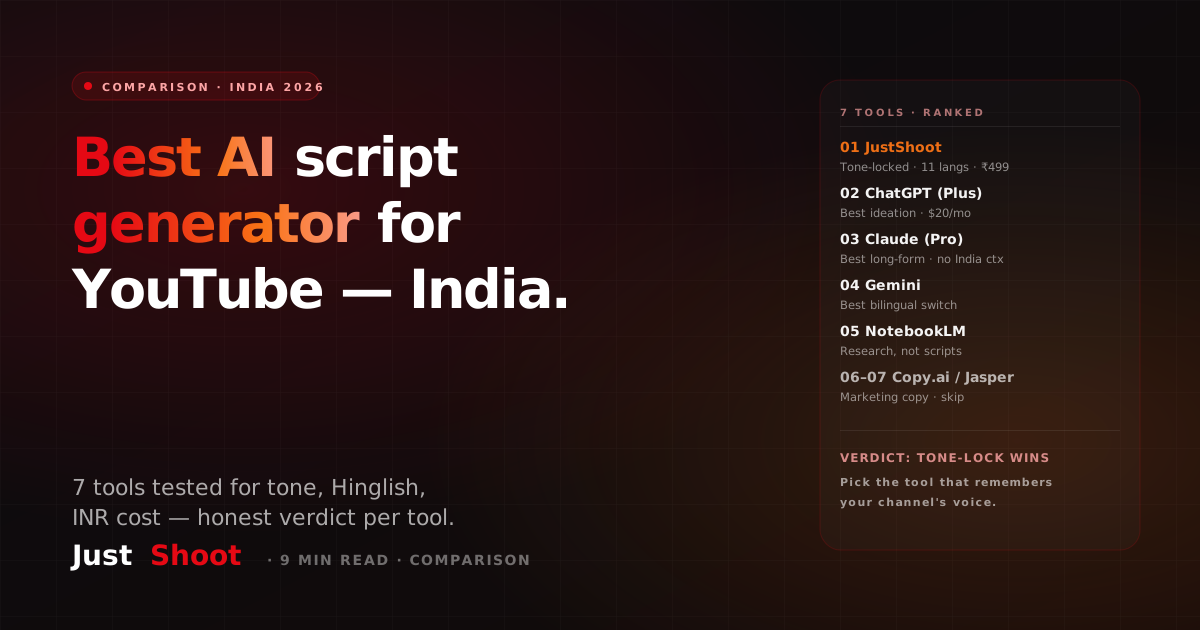
Best AI Script Generator for YouTube in India 2026 — Honest Rundown of 7 Tools
Which AI script generator actually works for Indian YouTubers in 2026 — tone match, Hinglish, INR pricing, and the one layer every tool below misses. Ranked honestly.
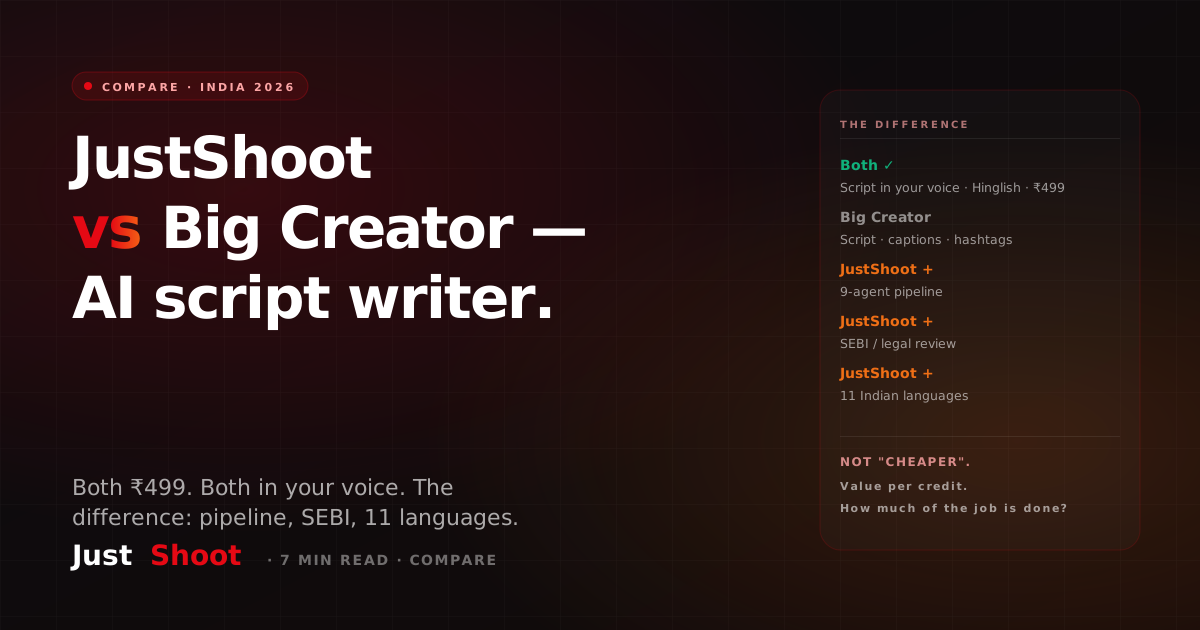
JustShoot vs Big Creator: AI Script Writer for Indian Creators (2026)
JustShoot vs Big Creator compared for Indian YouTubers in 2026 — both write scripts in your voice from ₹499. The real difference: pipeline breadth, SEBI review, and 11 languages.